

| AMRAP stands for | As Many Reps (or Rounds) As Possible |
| EMOM stands for | Every Minute On the Minute |
| RPE scale range | 1 (rest) to 10 (maximal effort) (Borg RPE scale, widely used in exercise science) |
| Tabata protocol duration | 4 minutes (8 rounds of 20 sec on / 10 sec off) (Based on Tabata et al., 1996 research protocol) |
| Compound vs. isolation | Compound = multi-joint; isolation = single-joint |
Why Fitness Has Its Own Language
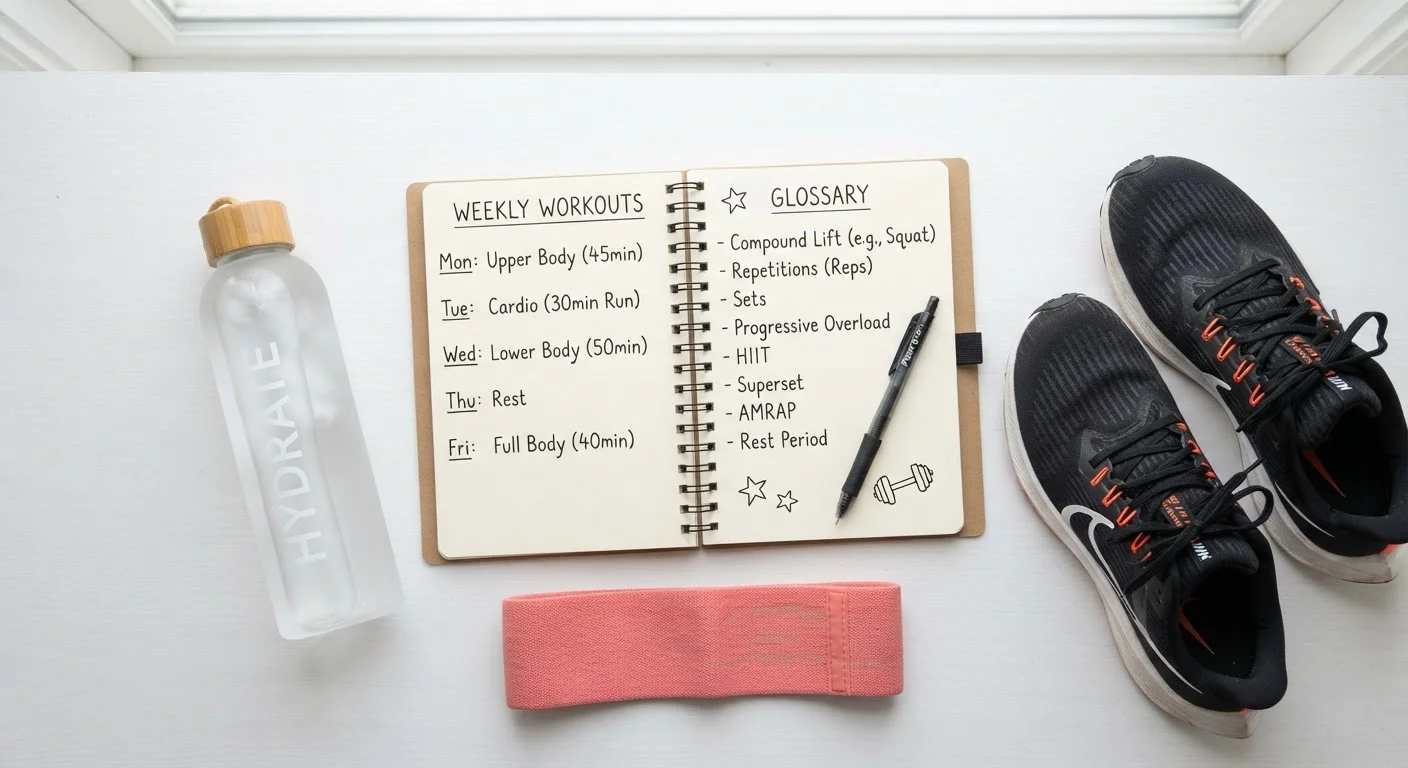
Walk into any gym, open a fitness app, or join a group class, and you'll encounter a wall of abbreviations and jargon that can feel more like a barrier than a welcome sign. Terms like AMRAP, RPE, and superset are second nature to experienced exercisers - but for everyone else, they create unnecessary confusion.
The good news: these terms follow logical patterns, and once you understand the core vocabulary, nearly any workout instruction becomes readable. This reference explains the most commonly used fitness terms in plain English, organized so you can look up exactly what you need.
If you're just beginning a resistance training program, our introduction to strength training is a useful companion to this glossary.
Rep (Repetition)
One complete execution of an exercise movement - for example, one squat from standing to full depth and back up. Reps are the basic unit of workout volume.
Set
A group of consecutive reps performed without stopping. A workout might call for "3 sets of 10 reps," meaning you perform 10 reps, rest, then repeat twice more.
AMRAP
"As Many Reps (or Rounds) As Possible" - a timed workout format where you complete as much work as you can before time runs out.
RPE
Rate of Perceived Exertion - a subjective 1-10 scale used to self-report exercise intensity. Higher numbers indicate greater effort relative to your maximum.
Compound Movement
An exercise that engages multiple muscle groups and joints simultaneously, such as a squat, deadlift, or pull-up. Generally contrasted with isolation exercises.
Isolation Exercise
An exercise targeting a single muscle group using primarily one joint, such as a bicep curl or leg extension.
Progressive Overload
The principle of gradually increasing training demands over time so the body continues to adapt and improve. Without it, progress typically plateaus.
1RM
One-Rep Max - the maximum load you can lift for a single complete repetition. Used as a benchmark to set training percentages in structured programs.
Superset
Performing two exercises back-to-back with little to no rest between them before taking a recovery break. Can target opposing or similar muscle groups.
Active Recovery
Low-intensity movement (such as walking or gentle stretching) performed on rest days or between hard sessions to support circulation and reduce soreness without adding significant training stress.
HIIT
High-Intensity Interval Training - alternating short bursts of near-maximal effort with recovery periods. The specific work-to-rest ratios vary by protocol.
RIR
Reps in Reserve - the number of additional reps you estimate you could have completed before muscular failure. Used to manage training intensity more precisely than going to failure every set.
Training Structure Terms
These terms describe how a workout is organized - the format you'll see in written programs and class instructions.
| AMRAP stands for | As Many Reps (or Rounds) As Possible |
| EMOM stands for | Every Minute On the Minute |
| RPE scale range | 1 (rest) to 10 (maximal effort) (Borg RPE scale, widely used in exercise science) |
| Tabata protocol duration | 4 minutes (8 rounds of 20 sec on / 10 sec off) (Based on Tabata et al., 1996 research protocol) |
| Compound vs. isolation | Compound = multi-joint; isolation = single-joint |
- AMRAP - "As Many Reps (or Rounds) As Possible" within a set time window. You work continuously until the clock stops.
- EMOM - "Every Minute On the Minute." You perform a set number of reps at the start of each minute; remaining time in that minute is rest.
- Superset - Two exercises performed back-to-back with minimal rest between them, then a rest period before repeating.
- Circuit - A sequence of multiple exercises performed one after another, usually with little rest, before cycling through again.
- Tabata - A specific interval protocol: 20 seconds of work followed by 10 seconds of rest, repeated eight times (four minutes total). It originates from sports science research and is a form of high-intensity interval training.
Many popular fitness beliefs about training structure don't hold up under scrutiny. See our article on common exercise myths for a research-grounded look at what actually works.
Effort and Load Terms
These terms help you gauge how hard to push - and they're more useful than vague cues like "go hard" or "take it easy."
~60-70%
Typical 1RM percentage for hypertrophy training
Exercise science guidelines commonly place muscle-building work in the 60-70% of one-rep max range, though individual programs vary.
2 RIR
Common stopping point to balance effort and recovery
Stopping two reps short of failure is frequently recommended in evidence-informed programs to accumulate volume while managing fatigue.
- RPE (Rate of Perceived Exertion) - A self-reported scale, typically 1-10, indicating how hard an effort feels. An RPE of 6 might feel moderately challenging; a 9 is near-maximal. It accounts for daily variation in energy and recovery.
- 1RM (One-Rep Max) - The maximum weight you can lift for exactly one repetition with good form. Programs often prescribe loads as a percentage of your 1RM (e.g., "work at 70% 1RM").
- RIR (Reps in Reserve) - How many more reps you could have done before true failure. "2 RIR" means stopping two reps short of your limit - a useful way to manage intensity without going to failure every set.
- Progressive Overload - Gradually increasing the demand placed on the body over time (more weight, reps, sets, or reduced rest) so that the body continues to adapt.
This article is for informational purposes only and does not constitute medical or professional fitness advice. Consult a qualified healthcare provider or certified fitness professional before starting or significantly changing an exercise program, especially if you have existing health conditions.