

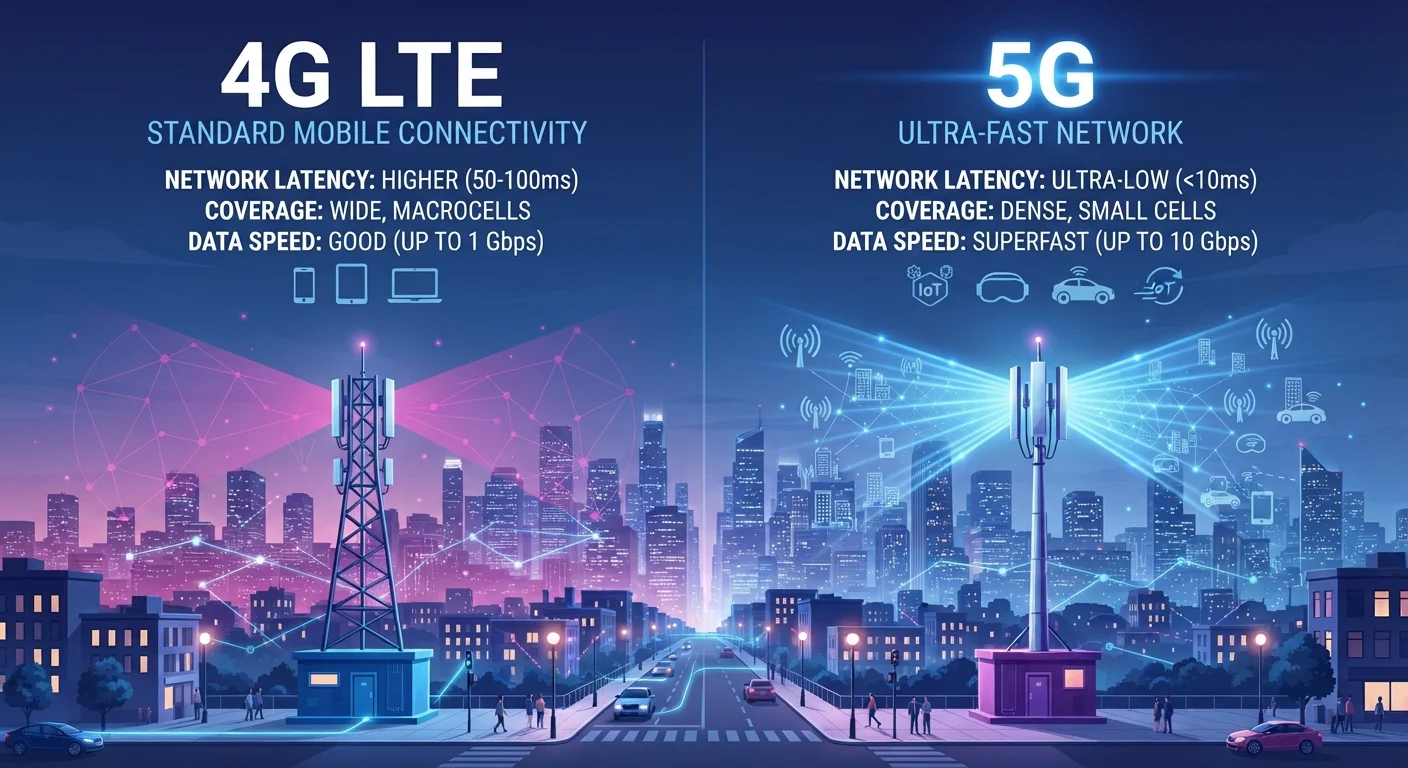
Key Takeaways
- 5G is significantly faster than 4G LTE in ideal conditions, but real-world gains depend heavily on your location and carrier.
- 4G LTE still covers far more of the US than 5G, making it the more reliable fallback network for most users.
- 5G can use more battery than 4G LTE, particularly on older 5G devices and in areas with weak 5G signal.
- Not all 5G is equal - low-band 5G offers wider coverage but speeds similar to 4G LTE; mmWave 5G is blazing-fast but extremely limited in range.
- For most everyday tasks like streaming, browsing, and messaging, many users notice little practical difference between the two.
Option A
5G
The newer, faster network built for tomorrow's demands.
Best for: Users in dense urban areas who stream high-quality video, use cloud apps heavily, or want future-proof connectivity.
Option B
4G LTE
The reliable, proven network covering most of America today.
Best for: Users in suburban or rural areas who want consistent, broad coverage for everyday calls, texts, and browsing.
If you live or work in a major city center
5G
Dense urban areas have the strongest 5G infrastructure, where you're most likely to experience genuinely faster speeds and lower latency.
If you're in a suburban or rural area
4G LTE
4G LTE coverage is far more consistent outside cities, making it the more dependable option for everyday connectivity where 5G signals are sparse.
If battery life is a top priority
4G LTE
4G LTE is generally more power-efficient, especially when 5G coverage is patchy and your phone constantly searches for a stronger signal.
If you're buying a new phone and plan to keep it for several years
5G
5G capability future-proofs your device as networks continue to expand and more services are optimized for higher speeds.
What Each Generation Actually Is
"G" stands for generation - each step forward represents a new set of technical standards that govern how mobile networks transmit data. 4G LTE (Long-Term Evolution) rolled out widely in the US around 2010 and became the backbone of mobile internet as we know it. 5G started deploying domestically around 2019 and is still expanding.
The jump from 4G to 5G isn't just a speed upgrade. It involves new radio frequencies, different antenna technology, and a redesigned network architecture. For most users, the practical question isn't how 5G works under the hood - it's what it actually changes about using your phone day to day. See our complete overview of internet and mobile connectivity for broader context on how these networks fit into the bigger picture.
Speed and Latency: The Numbers vs. Reality
On paper, 5G's theoretical peak speeds can reach 10 Gbps - many times faster than 4G LTE's theoretical ceiling of around 1 Gbps. In everyday use, those peaks are rarely achieved. Real-world 4G LTE speeds typically land between 10 and 50 Mbps. Mid-band 5G - the most common type deployed in US cities - often delivers 100 to 300 Mbps in practice.
~200 Mbps
Median 5G download speed in the US
Industry testing data from network analytics firms consistently shows median 5G speeds in the US hovering around this range, though results vary widely by carrier and location.
~30 Mbps
Median 4G LTE download speed in the US
Network measurement organizations tracking US mobile performance report typical 4G LTE median download speeds in the 25-40 Mbps range across carriers.
~90%
US population with 4G LTE access
Major US carriers report combined 4G LTE networks reaching roughly 90% or more of the US population, reflecting over a decade of infrastructure investment.
Latency (the delay before data starts moving) also improves with 5G. 4G LTE averages around 30-50 milliseconds of latency; 5G targets under 10 milliseconds. This matters most for real-time applications like video calls, mobile gaming, or connected devices - less so for routine browsing or streaming.
One important caveat: not all 5G is created equal. Low-band 5G reaches far but delivers speeds only modestly better than 4G LTE. High-band (mmWave) 5G is extraordinarily fast but covers only small outdoor hotspots, typically in dense downtowns. Most users encounter mid-band 5G, which offers a meaningful but not transformative improvement.
| Criterion | 5G | 4G LTE |
|---|---|---|
| Typical real-world speed | 100-300 Mbps (mid-band) | 10-50 Mbps |
| Latency | Under 10 ms (target) | 30-50 ms average |
| US coverage breadth | Growing; strongest in cities | Extensive; nationwide including rural |
| Battery impact | Higher, varies by device | Lower, well-optimised |
| Device requirement | 5G-capable phone needed | Works on most phones since ~2012 |
| Best use case | Dense urban, data-heavy tasks | Broad travel, rural use |
Coverage: Where Each Network Actually Reaches
4G LTE has had well over a decade to mature. Major US carriers have built extensive 4G LTE infrastructure covering the vast majority of the populated country, including most suburban and many rural areas. When you drive through small towns or open highways, 4G LTE is almost always what's keeping you connected.
5G coverage maps have grown quickly, but they tell an incomplete story. A carrier's 5G map may count low-band 5G coverage - which, while technically 5G, performs comparably to strong 4G LTE. Dense, fast mid-band 5G is concentrated in larger cities and some suburbs. mmWave 5G is even more geographically limited.
How to Check What Network You're Actually On
On most smartphones, the status bar shows a small indicator - "5G," "LTE," or "4G" - next to the signal bars. On iPhones, this appears in the top-right corner; on Android devices, it's typically in the top-left or notification bar. Keep in mind that seeing "5G" doesn't guarantee fast 5G speeds, as low-band 5G uses the same icon as faster mid-band 5G on most devices.
Your phone also doesn't sit on one network permanently. When 5G isn't available, your device automatically falls back to 4G LTE - often without you noticing. Understanding how your phone switches between mobile data and Wi-Fi helps clarify when the network your phone is using actually matters.
Battery, Device Compatibility, and Everyday Impact
5G radios can draw more power than 4G LTE, particularly when your phone is in an area with weak 5G signal and is constantly searching for a connection. Early 5G phones were noticeably harder on batteries; newer devices handle it more efficiently. If battery longevity is a concern and you're rarely in strong 5G coverage, manually switching your phone to 4G-only mode (available in most Android and iOS settings) can meaningfully extend your charge.
Device compatibility is straightforward: you need a 5G-capable phone and a 5G-enabled plan to access 5G at all. If your phone was made before roughly 2020, it's almost certainly 4G LTE only. Many 4G LTE phones remain fully functional for everyday use - streaming, messaging, navigation, and social apps all run comfortably on 4G LTE speeds. For tips on how data-intensive habits affect your plan regardless of network generation, see what quietly drains your monthly mobile data.
When evaluating a new plan, the network generation is just one factor. What to evaluate before signing up for an internet plan applies similar logic to mobile: look at coverage in your specific area, not just national averages.