
Physical Activity Across Every Decade: How Exercise Needs Shift Over a Lifetime

Key Takeaways
- Exercise needs shift across decades due to changes in muscle mass, hormones, recovery capacity, and injury risk.
- Strength training becomes increasingly important starting in your 30s to offset natural muscle loss.
- Mobility and balance work should be woven in earlier than most people think - not saved for later decades.
- Consistency across a lifetime matters more than intensity at any single stage.
- Older adults benefit significantly from movement, and it is rarely too late to start or resume activity.
Why Exercise Needs Change With Age
The human body is not static. From your early 20s onward, biological changes quietly alter how your muscles respond to training, how quickly you recover, and what types of movement carry the most benefit. Understanding these shifts is the first step to building a fitness approach that serves you for life - rather than one that works briefly and then burns out or breaks down.
Muscle mass, bone density, cardiovascular efficiency, and hormonal levels all follow age-related trajectories. For most people, peak muscle strength occurs in the late 20s to early 30s, after which a gradual decline begins. Bone density typically peaks around age 30 before slowly decreasing, particularly in women after menopause. Recovery time after intense effort also lengthens with age.
None of this means exercise becomes less valuable as you get older - quite the opposite. Research consistently shows that regular physical activity at every life stage reduces risk for chronic disease, supports mental well-being, and contributes to healthy aging. The key is matching the type, intensity, and structure of movement to where your body actually is. See also how routines need to evolve across the decades for a broader lifestyle perspective.
3-8%
Muscle mass lost per decade without strength training
According to research published in the Journal of Gerontology and cited by the American College of Sports Medicine.
150 min
Recommended weekly moderate aerobic activity for adults
Per U.S. Department of Health and Human Services Physical Activity Guidelines for Americans.
30%
Reduction in all-cause mortality risk linked to regular activity
Consistent finding across multiple large cohort studies in journals including The Lancet and BMJ.
Your 20s: Building the Foundation
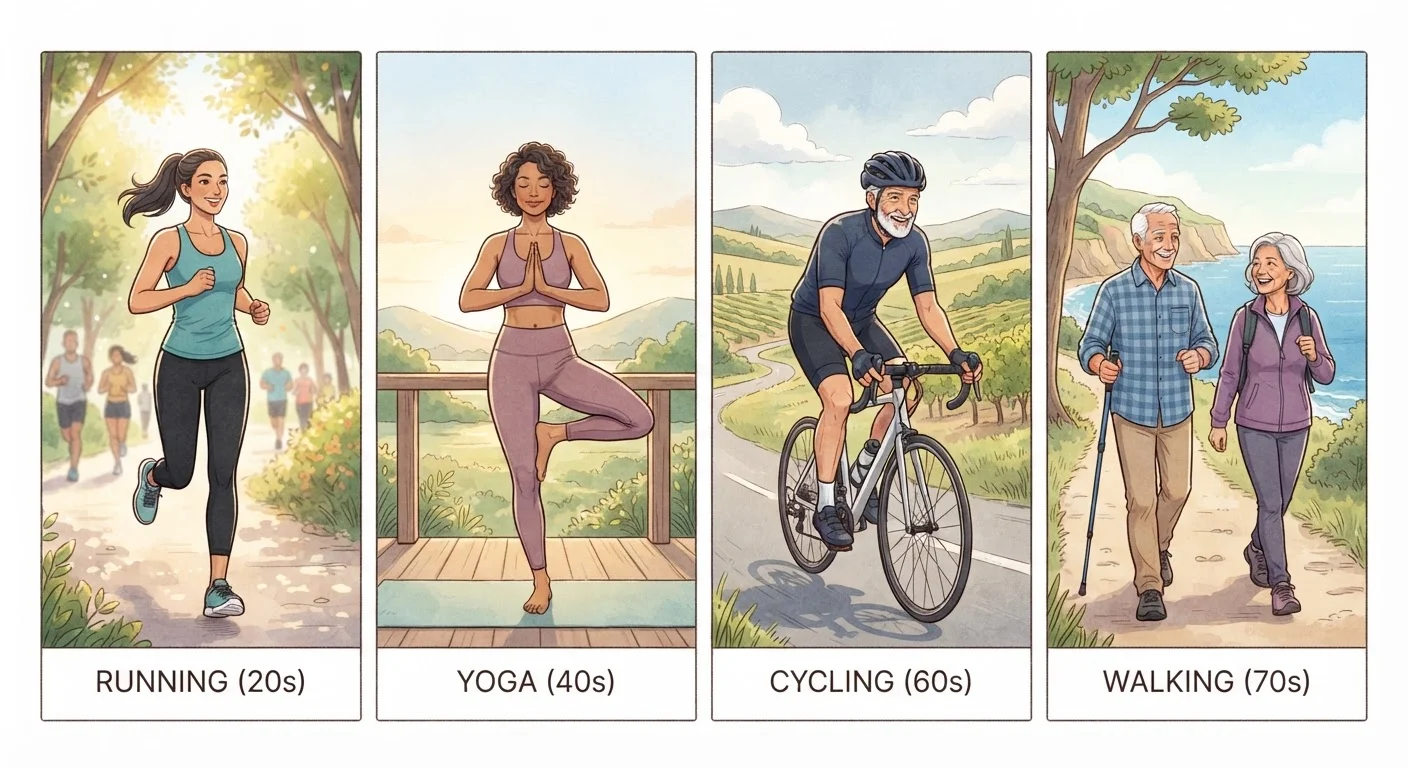
Your 20s represent a biological window of relative resilience. Recovery is faster, connective tissue is more forgiving, and adaptation to new training loads tends to happen quickly. This is an ideal time to develop foundational fitness habits - not to chase peak performance, but to establish movement patterns and preferences that can carry forward.
The most valuable investments in your 20s include developing cardiovascular endurance, experimenting with different movement styles to find what you genuinely enjoy, and beginning to build strength. Many people in this decade focus exclusively on cardio or aesthetics; adding resistance training early pays compounding dividends in muscle mass and bone density over time.
Equally important: learning to recover. Sleep, adequate nutrition, and rest days are not optional extras - they are part of training. Developing this mindset early prevents the overtraining and injury patterns that derail many younger exercisers. Building a workout habit that actually sticks starts here, with consistency valued over intensity.
In your 20s, use variety strategically: try different movement modalities - cycling, resistance training, swimming, yoga - before settling into a routine. The goal is discovering what you'll actually sustain.
Intrinsic motivation and enjoyment are among the strongest predictors of long-term exercise adherence, according to behavioral research on physical activity.
From your 30s onward, treat strength training as non-negotiable rather than optional. Even two sessions per week of full-body resistance work can meaningfully offset age-related muscle and bone loss.
The progressive decline in muscle mass (sarcopenia) accelerates without stimulus; resistance exercise is the most evidence-supported intervention to slow it.
Your 30s and 40s: Adapting to Shifting Demands
Life in your 30s and 40s often brings competing demands - career pressures, caregiving, less discretionary time - while the body begins to require more intentional maintenance. Starting around age 30, muscle mass naturally declines at roughly 3-8% per decade without intervention. Strength training is no longer optional at this stage; it becomes a primary tool for preserving functional capacity.
Hormonal changes also begin to play a role. Testosterone levels in men tend to decline gradually from the early 30s. For women approaching perimenopause (often beginning in the mid-40s), fluctuating estrogen affects bone density, body composition, and exercise recovery. These changes are normal, and understanding them allows for smarter training rather than frustration.
Recovery takes longer in this decade than in your 20s. Programming two or three strength sessions per week, alongside moderate cardiovascular activity, tends to be more sustainable than daily high-intensity effort. Mobility work - often neglected in youth - starts paying meaningful returns here. See the difference between mobility, flexibility, and stretching to understand what each contributes.
Schedule Recovery Like You Schedule Workouts
In your 30s and 40s, recovery is a training variable, not a luxury. Muscles adapt and strengthen during rest, not during the workout itself. Building deliberate rest days and prioritizing sleep quality will help you train more consistently without accumulating overuse injuries that sideline progress.
Your 50s and 60s: Prioritizing Longevity
By your 50s and 60s, the conversation around exercise shifts decisively toward long-term health outcomes: maintaining independence, supporting cardiovascular health, managing chronic conditions, and preserving bone strength. The guidelines from major health organizations - including the U.S. Department of Health and Human Services - recommend that adults aim for at least 150 minutes of moderate-intensity aerobic activity per week, plus muscle-strengthening activities on two or more days. These recommendations apply across adulthood, including this decade.
For women, the years around menopause bring increased attention to bone health. Weight-bearing activities - walking, resistance training, low-impact aerobics - help maintain bone density and reduce fracture risk. For both men and women in this decade, balance training becomes increasingly relevant as a fall-prevention strategy.
Exercise also interacts meaningfully with mood and cognitive health in midlife. How physical activity affects mood is worth understanding here, as research links regular movement with reduced risk of depression and cognitive decline - though it is not a substitute for professional mental health support.
New or Changing Symptoms Warrant Medical Attention
If you experience chest discomfort, unusual shortness of breath, dizziness, or joint pain when exercising - especially in your 50s and 60s - stop and consult a healthcare provider before continuing. These can be signs of underlying conditions that require evaluation. Exercise is broadly beneficial, but starting or intensifying a program with unaddressed symptoms carries real risk.
Your 70s and Beyond: Movement as Medicine
Physical activity in older adulthood is among the most evidence-supported interventions for healthy aging. Research published in journals including The Lancet and JAMA consistently demonstrates that regular movement in later life is associated with lower all-cause mortality, improved cognitive function, and better quality of life - independent of when someone began exercising.
For adults in their 70s and beyond, the emphasis shifts toward four domains: aerobic capacity, muscular strength, balance, and flexibility. Walking remains one of the most accessible and effective forms of cardiovascular exercise at this stage. Walking vs. running explores the tradeoffs, but for most older adults, brisk walking done consistently is highly beneficial and lower in injury risk.
If you are returning to exercise after a long gap, a gradual approach is especially important in this decade. Starting a fitness routine after a long break offers a practical framework for easing back in safely. Anyone with existing health conditions should consult a qualified healthcare professional before significantly changing their activity level.
“It is never too late to become more physically active. Even small increases in activity among the least active individuals produce significant health benefits.”
— World Health Organization, Global health guidance body, WHO Global Action Plan on Physical Activity
Principles That Apply at Every Age
Despite the decade-by-decade shifts, several principles hold across the entire lifespan. Consistency is the most powerful variable - moderate exercise done reliably outperforms intense exercise done sporadically. Movement also does not need to be structured or gym-based to count; daily activity like walking, gardening, cycling, or active commuting contributes meaningfully to health outcomes.
For those in desk-heavy jobs, intentional movement breaks matter at every age. Movement strategies for desk workers can help offset the real costs of prolonged sitting, regardless of your decade.
Finally, exercise is most effective when it sits within a broader foundation of sleep, nutrition, and stress management. Sleep, food, and movement as daily lifestyle pillars is a useful starting point for understanding how these elements reinforce each other. Before significantly changing your routine, a personal readiness checklist can help you assess your starting point with confidence.
This article is intended for general informational and educational purposes only. It is not a substitute for personalized advice from a qualified healthcare or fitness professional. If you have existing health conditions, injuries, or concerns about starting or changing an exercise program, please consult a licensed professional before doing so.