

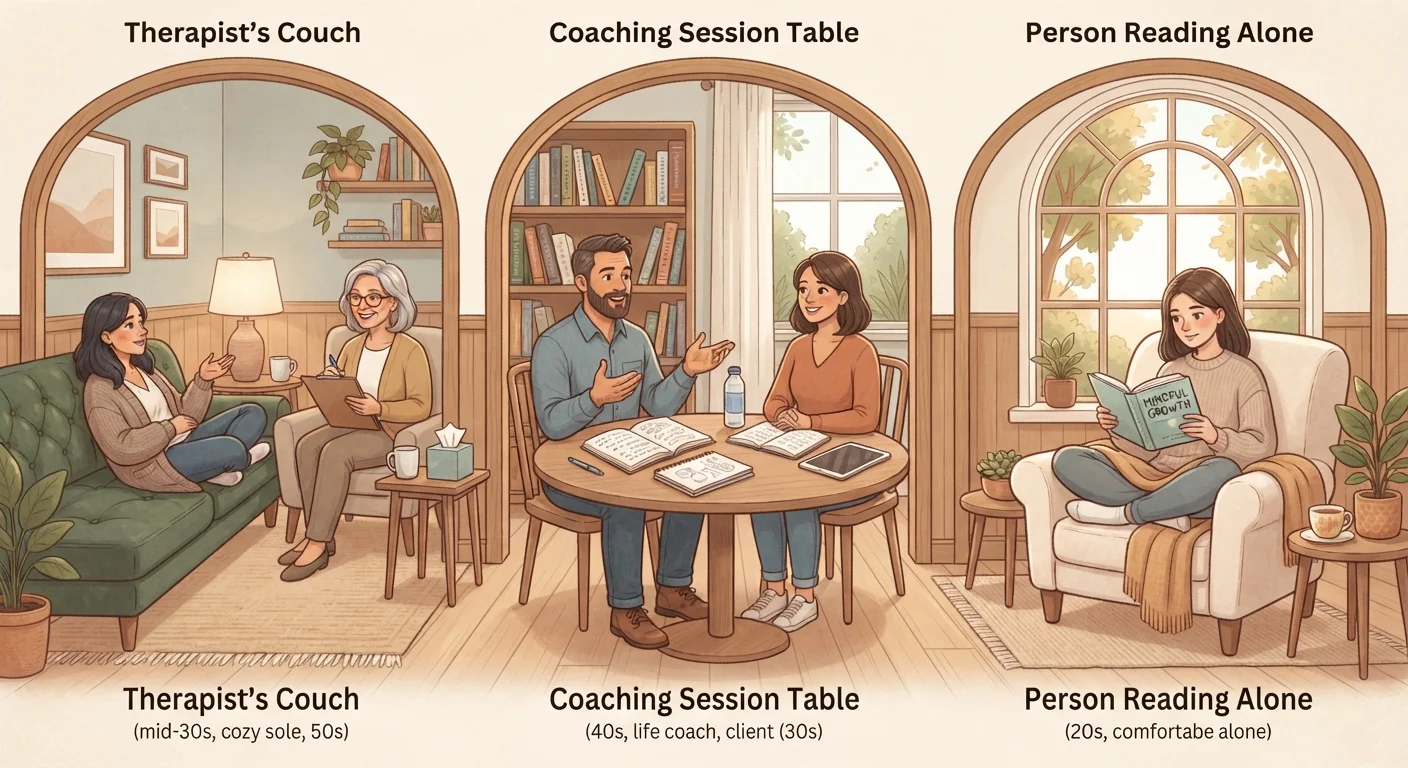
Key Takeaways
- Therapy is a licensed clinical service focused on diagnosing and treating mental health conditions.
- Life coaching is goal-oriented and forward-focused, but is not regulated or a substitute for clinical care.
- Self-help resources can complement professional support but work best when paired with sound guidance.
- The right approach depends on your specific needs, severity of concerns, and personal goals.
- When in doubt about mental health symptoms, consulting a licensed professional is always the right first step.
Our Verdict
Therapy, coaching, and self-help occupy distinct roles in personal well-being. Therapy addresses clinical mental health needs with licensed oversight; coaching supports goal-setting and personal development; and self-help provides accessible tools for everyday growth. None of these is universally superior - the most appropriate path depends on the nature and intensity of what you're navigating.
| Best for | Recommended |
|---|---|
| Those managing mental health conditions, trauma, or persistent emotional distress | Licensed therapy |
| People seeking structured accountability for personal or professional goals | Life coaching |
| Individuals building everyday habits and general knowledge | Self-help resources |
| Those wanting layered support across multiple dimensions of growth | A combination approach |
Why the Distinctions Matter
When you're feeling overwhelmed, stuck, or simply ready for change, the variety of support options can itself feel confusing. Therapy, life coaching, and self-help are often discussed as if interchangeable - but they differ meaningfully in scope, regulation, and purpose. Understanding those differences helps you choose what actually fits your situation, rather than defaulting to whatever is most visible or most affordable.
This isn't about ranking one approach above the others. Each serves a genuine function. The question is which function matches what you need right now. Just as mobility, flexibility, and stretching each serve distinct roles in physical health, these three mental wellness pathways are complementary rather than competitive.
| Therapy | Life Coaching | Self-Help | |
|---|---|---|---|
| Provider licensing | State-licensed required | No legal requirement | No provider involved |
| Primary focus | Mental health treatment | Goals and performance | General growth and learning |
| Can diagnose conditions | Yes (where scope permits) | No | No |
| Evidence base | Established clinical research | Variable by practitioner | Varies widely by resource |
| Best suited for | Clinical or persistent distress | Goal clarity and accountability | Everyday habits and awareness |
| Typical format | Regular 1:1 sessions | 1:1 or group sessions | Books, apps, courses, journaling |
| Insurance coverage (US) | Often covered | Generally not covered | Self-funded or free |
Therapy: Clinical Care for Mental Health
Therapy - also called psychotherapy or counseling - is provided by licensed mental health professionals such as psychologists, licensed clinical social workers (LCSWs), or licensed professional counselors (LPCs). These practitioners complete graduate-level training, supervised clinical hours, and must meet state licensing requirements.
The core purpose of therapy is to assess, diagnose where appropriate, and treat mental health conditions and emotional difficulties. This can include anxiety disorders, depression, trauma, grief, relationship challenges, and more. Therapists use evidence-based frameworks - such as cognitive behavioral therapy (CBT) or dialectical behavior therapy (DBT) - tailored to the individual.
Crucially, therapy is not only for crisis situations. Many people benefit from ongoing therapy as a form of consistent mental health maintenance, even when no diagnosable condition is present.
How to Find a Licensed Therapist
In the US, you can verify a therapist's licensure through your state's professional licensing board. Psychology Today's therapist directory and the SAMHSA National Helpline (1-800-662-4357) are commonly used starting points. Your primary care provider can also offer referrals to mental health professionals.
This article is for general informational purposes only and is not a substitute for professional mental health advice, diagnosis, or treatment. Always consult a qualified mental health professional regarding personal concerns.
Life Coaching: Goal-Oriented and Forward-Focused
Life coaching is a structured, goal-setting relationship between a coach and a client. Unlike therapy, coaching is not regulated by state licensing boards in the United States, and coaches are not authorized to diagnose or treat mental health conditions. Some coaching certifications exist through organizations like the International Coaching Federation (ICF), but these are voluntary credentials, not legal requirements to practice.
Coaching tends to focus on the future: career transitions, building confidence, improving productivity, clarifying values, or developing specific skills. A coach typically acts as an accountability partner and thinking partner rather than a clinician. Sessions often feel more action-oriented and structured around concrete milestones.
Coaching Is Not a Substitute for Therapy
Some coaches market services using therapeutic language - terms like 'healing,' 'trauma work,' or 'emotional transformation' - without the clinical training or licensing to back it up. If a coach's framing sounds clinical, it is worth asking about their credentials and ensuring they are not operating outside their scope. When mental health symptoms are present, please consult a licensed mental health professional.
For individuals whose goals are intertwined with unresolved emotional pain, trauma, or clinical symptoms, coaching alone is unlikely to be sufficient - and could inadvertently delay access to appropriate care.
Self-Help: Accessible Tools for Everyday Growth
Self-help encompasses books, podcasts, apps, journaling practices, online courses, and community forums designed for independent use. The quality varies enormously - from research-backed workbooks grounded in cognitive science to content that is largely anecdotal. That range makes discernment important.
Self-help works best as a supplement to other support, or for people navigating relatively mild challenges who want accessible, low-barrier tools. Practices like mindfulness journaling, structured reflection, or reading evidence-informed books on habit formation can support day-to-day well-being and reinforce habits explored in lifestyle habits.
The limitation of self-help is that it requires self-direction and honest self-assessment. Without external feedback, it's easy to reinforce unhelpful patterns rather than interrupt them. People with significant mental health concerns should not rely solely on self-help resources.
Choosing the Right Approach for Your Situation
Selecting between therapy, coaching, and self-help isn't always a single, permanent decision. Many people use more than one simultaneously - for example, working with a therapist while also using a mindfulness app or reading widely on personal development.
A useful starting point: if you are experiencing persistent sadness, anxiety, trauma responses, disordered behaviors, or any symptoms that significantly disrupt daily functioning, seeking a licensed therapist is the appropriate first step. Coaching and self-help are not designed to address clinical needs.
If your primary goals involve career direction, habit building, or accountability for clearly defined objectives - and you do not have untreated mental health concerns - coaching may be a practical fit. And across all stages, thoughtfully curated self-help resources can enrich your understanding and support incremental progress in daily life. Making intentional, informed choices across life domains - from financial planning to personal growth - shares a common thread of self-awareness. The same curiosity that leads someone to explore budgeting frameworks often applies just as well to navigating personal wellness options.