

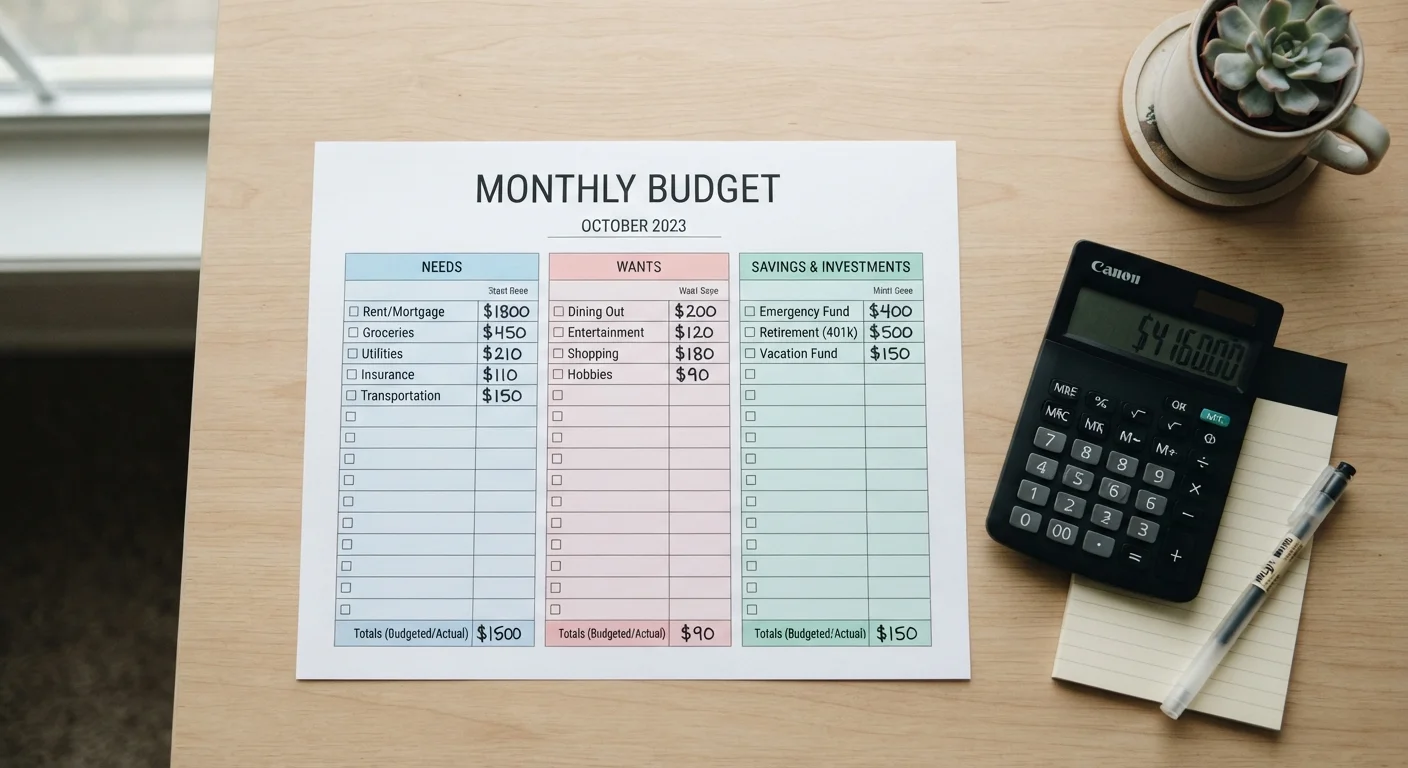
Key Takeaways
- The 50/30/20 rule splits after-tax income into needs (50%), wants (30%), and savings or debt (20%).
- Needs include essentials like rent, groceries, utilities, and minimum debt payments.
- Wants cover discretionary spending such as dining out, subscriptions, and entertainment.
- The 20% savings slice can go toward an emergency fund, retirement contributions, or paying down debt faster.
- The percentages are a starting point - adjusting them to fit your income and cost of living is entirely appropriate.
- Simpler than zero-based budgeting, this framework works well for people new to budgeting or with variable schedules.
The 50/30/20 Rule
The 50/30/20 rule is a budgeting framework that divides your after-tax income into three categories: 50% for needs, 30% for wants, and 20% for savings and debt repayment. It's designed to give people a simple, memorable structure for managing money without tracking every individual purchase. The goal is balance - covering essentials, enjoying life, and building financial security at the same time.
The framework was popularized by Senator Elizabeth Warren and her daughter Amelia Warren Tyagi in their 2005 book 'All Your Worth,' where it was positioned as a sustainable alternative to rigid line-item budgets.
How the Three Categories Actually Work
At its core, the 50/30/20 rule turns an overwhelming question - "where should my money go?" - into three manageable buckets. Before applying them, start with your after-tax monthly income: the net amount deposited in your account after all taxes and mandatory withholdings.
50% - Needs
Needs are non-negotiable expenses required to maintain your basic standard of living and meet financial obligations. Common examples include:
- Rent or mortgage payments
- Utilities (electricity, water, internet)
- Groceries and household essentials
- Health insurance premiums
- Transportation to and from work
- Minimum payments on loans or credit cards
A useful test: if skipping this payment would cause immediate harm or a financial penalty, it belongs here.
30% - Wants
Wants are the discretionary spending choices that make daily life more enjoyable but aren't essential to your survival. This includes dining out, streaming subscriptions, gym memberships, travel, clothing beyond the basics, and entertainment. This category gets a bad reputation as "frivolous," but research on behavioral finance consistently shows that budgets with no room for enjoyment tend to fail. See our explanation of why a fun money category matters for more on this point.
20% - Savings and Debt Repayment
This slice is your future-self's money. It covers emergency fund contributions, retirement account deposits (such as a 401(k) or IRA), investments, and above-minimum debt payments. For guidance on which of these to prioritize, our overview on where to direct savings first walks through a clear order of operations.
Automate Your 20% First
Set up an automatic transfer to your savings or retirement account on the same day you receive your paycheck. When savings happen automatically before discretionary spending begins, you're far less likely to skip them. Many employer-sponsored retirement plans allow you to direct a percentage of each paycheck directly, making this especially easy to implement.
A Real-World Example
Consider someone with a monthly after-tax income of $4,000. Under the 50/30/20 rule, the split looks like this:
| Category | Percentage | Monthly Amount |
|---|---|---|
| Needs | 50% | $2,000 |
| Wants | 30% | $1,200 |
| Savings / Debt | 20% | $800 |
That $800 in savings could be broken down further: $400 toward a starter emergency fund, $300 into a workplace retirement plan, and $100 applied as an extra payment on a student loan. The 50/30/20 framework sets the boundary; you decide the allocation within each bucket.
68%
Americans living paycheck to paycheck
According to a 2023 LendingClub report, roughly 68% of U.S. consumers reported living paycheck to paycheck, highlighting the widespread need for structured budgeting approaches.
$1,000
Threshold many lack for emergencies
A Bankrate survey found that a significant share of Americans could not cover a $1,000 emergency expense from savings alone, underscoring why the 20% savings category is foundational.
30%
Average share of income spent on housing
The U.S. Bureau of Labor Statistics Consumer Expenditure Survey consistently shows housing consuming roughly 30% of average household spending - putting pressure on the 50% needs target in many markets.
When to Adjust the Percentages
The 50/30/20 rule is a starting framework, not a rigid law. Several circumstances call for thoughtful modifications:
- High cost-of-living areas: Rent alone may consume 35-40% of take-home pay in many U.S. cities, leaving the 50% needs target unreachable without compromise. In this case, temporarily trimming the wants category is more sustainable than eliminating savings entirely.
- Aggressive debt payoff goals: Someone carrying high-interest credit card debt may prefer a 50/20/30 structure, shifting more dollars toward debt repayment while scaling back discretionary spending.
- Low income households: When income barely covers essentials, the 20% savings target may be temporarily out of reach. Saving even 5-10% consistently builds the habit and the balance simultaneously - start where you can.
- High earners with specific goals: Those with substantial incomes and ambitious financial independence timelines may choose to save 40-50%, compressing the wants category significantly.
For a broader view of how this framework compares to other approaches - such as pay-yourself-first or zero-based budgeting - see our tour of popular budgeting frameworks.
The 50% Needs Target Is a National Average Benchmark
The 50/30/20 rule was developed with median American incomes and cost structures in mind. In cities where housing costs are significantly above the national average - such as San Francisco, New York, or Seattle - keeping needs under 50% of after-tax income is genuinely difficult for many households. Treating the percentage as a directional target rather than a pass/fail threshold keeps the framework useful rather than demoralizing.
Getting Started Without Overthinking It
The most common mistake is waiting until the "right time" to budget. The 50/30/20 rule is specifically designed to reduce that friction. Here's a practical way to begin:
- Calculate your monthly after-tax income. If your income varies, use a conservative three-month average.
- Add up your current monthly needs. Pull your last two or three bank statements and categorize recurring essential expenses.
- Compare your needs total to 50% of your income. If it's over, identify which expenses could be reduced - or accept a temporary adjustment to the other categories.
- Set an automatic savings transfer. Move 20% to a separate account on payday so it's allocated before you spend it. Our guide on building a budget around savings goals explains how to make this automatic.
- Spend the remaining 30% on wants without guilt. This category is intentional - it's not a failure to spend it.
You don't need perfect categories to start. A reasonable approximation, applied consistently, will move you further than a theoretically perfect plan that never gets off the ground.
This article is for general informational and educational purposes only and does not constitute personalized financial, investment, tax, or legal advice. Consult a qualified financial professional before making decisions about your specific financial situation.