

Key Takeaways
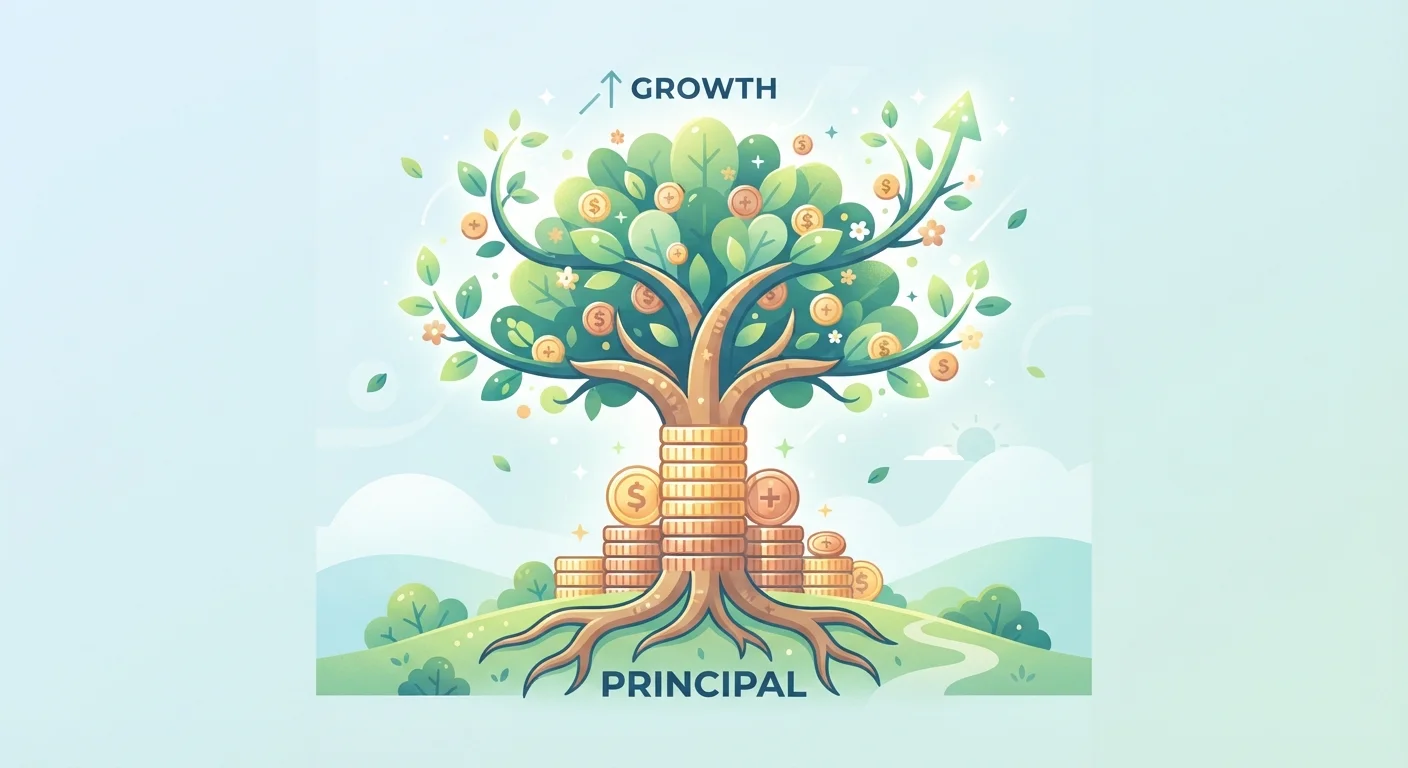
- Compound interest earns returns on both your original principal and previously accumulated interest.
- Starting earlier is more powerful than contributing more money later - time is the key variable.
- More frequent compounding periods (monthly vs. annually) produce meaningfully higher returns.
- Compound interest works against you when applied to debt, not just for you in savings.
- Even small, consistent contributions grow significantly when given enough time.
Compound Interest
Compound interest is interest earned not just on your original deposit or investment, but also on all the interest you've already accumulated. Over time, this creates a self-reinforcing growth cycle - your returns generate their own returns. It's the financial mechanism that can turn modest, consistent saving into substantial wealth over decades.
Mathematically, compound interest is expressed as A = P(1 + r/n)^(nt), where P is the principal, r is the annual interest rate, n is the number of compounding periods per year, and t is time in years.
How Compound Interest Actually Works
At its core, compound interest means your money earns money - and then that newly earned money earns money too. Each compounding period, interest is calculated on the full accumulated balance, not just what you originally deposited.
Consider a simple example: you deposit $1,000 at a 5% annual interest rate. After year one, you earn $50, bringing your balance to $1,050. In year two, you earn 5% on $1,050 - not $1,000 - so you earn $52.50. Each year, the base grows, and so does the interest earned on it.
This might seem minor early on, but the effect accelerates dramatically over time. After 30 years at 5% annual compounding, that same $1,000 grows to approximately $4,322 - without a single additional contribution. Understanding this mechanic is foundational to smart financial planning. For a broader vocabulary around how money grows, see our guide to essential investing terms.
$4,322
Value of $1,000 after 30 years at 5%
Illustrates how compound interest more than quadruples a single deposit without any additional contributions, based on standard compound interest calculations.
72
The Rule of 72 - years to double money
Divide 72 by your annual interest rate to estimate how many years it takes to double your money; at 6%, that's approximately 12 years.
20%+
Typical credit card APR in the US
According to Federal Reserve data, average credit card interest rates in the US have remained above 20% APR in recent reporting periods, making compound debt costly.
Why Time Is the Most Powerful Variable
The single biggest driver of compound growth is time - not the interest rate, and not even how much you contribute each month. The longer money compounds, the more pronounced the exponential curve becomes.
A common illustration: imagine two people, each saving $5,000 per year. Person A starts at age 25 and stops at 35, contributing for just 10 years. Person B starts at 35 and contributes every year until 65 - a full 30 years of contributions. Assuming the same return rate, Person A often ends up with more money at retirement, despite contributing one-third as much. That's the power of compounding time.
Start Small - But Start Now
You don't need a large sum to benefit from compound interest. Even $25 or $50 per month, invested consistently in an interest-bearing account, begins compounding immediately. The biggest cost of waiting is not the amount you miss contributing - it's the compounding time those dollars won't have.
This is why financial educators consistently emphasize starting early, even with small amounts. Waiting to save until you can afford to save more is one of the most common wealth-building mistakes people make. Our article on investing errors that slow down wealth building covers this and other patterns that quietly cost beginners over time.
Compounding Frequency and Its Effect on Growth
Interest doesn't always compound once a year. Many savings accounts compound monthly or even daily. The more frequently your interest compounds, the more you earn - because each period's interest begins generating returns sooner.
For example, $10,000 at 6% annual interest compounded yearly grows to roughly $17,908 after 10 years. The same amount at the same rate compounded monthly grows to approximately $18,194. The difference may look modest, but it becomes more significant at higher balances, higher rates, and longer timeframes.
APY vs. Interest Rate: Know the Difference
The stated interest rate tells you the base percentage applied to your balance. The Annual Percentage Yield (APY) reflects the actual return after accounting for compounding frequency. When comparing savings accounts, APY is the more accurate and useful figure to compare.
When evaluating a savings account or investment vehicle, look at the annual percentage yield (APY) rather than the stated interest rate. APY already accounts for compounding frequency, making it a more honest comparison tool.
Compound Interest in Debt: The Other Side of the Equation
The same mechanism that builds wealth in savings can work against you when it comes to debt. Credit cards typically charge compound interest on outstanding balances, often at rates of 20% or higher. If you carry a balance from month to month, interest is added to what you owe - and the next month you're charged interest on that larger total.
This is why high-interest debt can feel like it never shrinks, even when you're paying consistently. Understanding compound interest helps explain both why you should invest early and why eliminating high-rate debt quickly is such a financial priority. For more on managing credit responsibly, see our Credit and Debt hub.
Compound interest isn't inherently good or bad - it simply amplifies the direction your money is already moving. Put it to work in your favor by contributing regularly to interest-bearing accounts and tax-advantaged vehicles, and by keeping high-interest balances as low as possible. Our explainer on the difference between saving and investing can help you decide where to direct your money next.
This article is for general informational and educational purposes only and does not constitute personalized financial or investment advice. Consult a qualified financial professional before making decisions about your specific situation.