

Key Takeaways
- Physical greetings vary dramatically by country, religion, gender, and social context.
- Defaulting to your home-country greeting style can come across as presumptuous or even offensive abroad.
- Watching locals and mirroring their cues is one of the most reliable strategies for navigating unfamiliar greeting customs.
- Hierarchy, age, and gender often determine who initiates a greeting and what form it takes.
- A brief, sincere acknowledgment of your own uncertainty is usually received with grace.
Why Greetings Carry More Weight Than You Think
Before a single word of conversation is exchanged, your greeting has already communicated something - confidence, respect, curiosity, or, occasionally, uncomfortable ignorance. Across cultures, the physical act of saying hello is rarely just a formality. It encodes values about personal space, hierarchy, gender roles, religious observance, and social intimacy that have developed over generations.
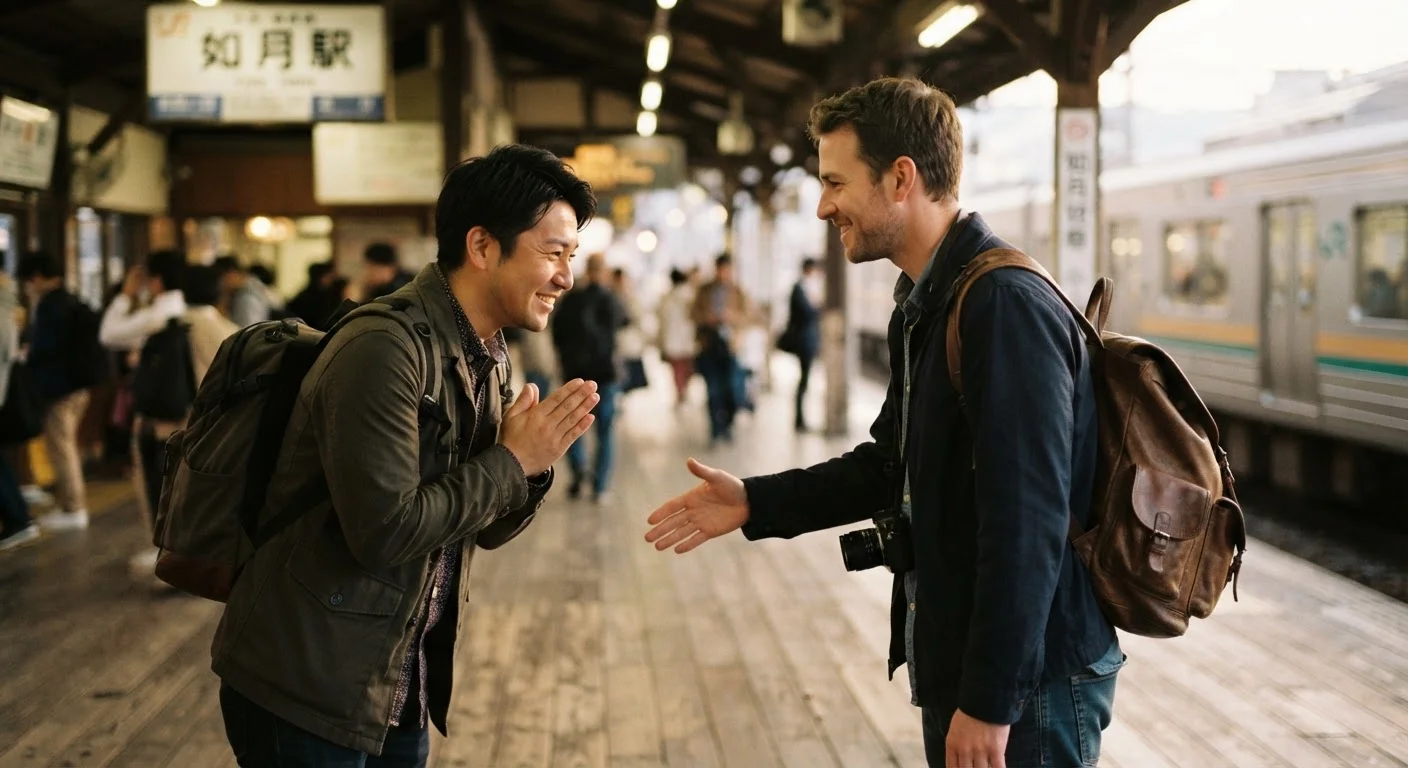
American travelers, accustomed to a firm handshake as the default professional and social opener, often discover abroad that what reads as confident warmth at home can register as presumptuous, aggressive, or even inappropriate elsewhere. The same goes for the European double cheek kiss, which bewilders visitors who don't know which cheek to start on, how many to give, or whether contact is expected at all. And the bow - so natural in parts of East Asia - is frequently mimicked awkwardly by Westerners in a way that can inadvertently signal mockery rather than respect.
Understanding greeting culture isn't about memorizing a rigid rulebook. It's about grasping the underlying logic - and that starts with recognizing your own assumptions. As our guide to social hierarchies and respect cultures explores, the way you address someone often reflects deeply held values about age, authority, and belonging that extend far beyond the moment of introduction.
Common Greeting Mistakes - and How to Avoid Them
The following mistakes appear repeatedly among well-meaning travelers. Recognizing them is the first step toward more respectful, confident interactions abroad.
Extending a handshake to someone for whom physical contact with strangers is religiously or culturally discouraged.
Why it happens: The handshake is so deeply normalized in American and Western European professional culture that travelers often extend one reflexively, without considering that many observant Muslim, Orthodox Jewish, and some Hindu individuals avoid same-sex or cross-sex physical contact with non-family members.
Attempting a bow in Japan or South Korea without understanding its mechanics, making it feel performative rather than respectful.
Why it happens: Travelers know bowing is the custom, but they rarely understand that depth, duration, and the question of who bows first are all meaningful signals tied to relative social status and context. A quick, exaggerated dip can read as mockery.
Initiating a cheek kiss greeting in a culture or context where it's reserved for close personal relationships.
Why it happens: Travelers who've spent time in France, Spain, or Latin America may develop the habit of leaning in for a cheek kiss as a general friendly greeting - then apply it indiscriminately in countries or settings where it would be considered overly intimate or inappropriate.
Greeting everyone in a room with the same style, regardless of age, gender, or status.
Why it happens: Egalitarian social norms in parts of the US and Northern Europe encourage treating everyone more or less the same in social settings. But in many cultures across East Asia, the Middle East, and parts of Latin America, greeting elders or senior figures first - and more formally - is an important sign of respect.
Assuming that a greeting custom you read about applies uniformly across an entire country.
Why it happens: Travel articles and guidebooks often present national customs as monolithic, when in reality greeting norms can vary significantly between generations, regions, urban and rural communities, and religious groups within the same country.
Greeting customs don't exist in isolation. They connect directly to broader expectations around public behavior - something worth exploring in our guide to public behavior norms around the world.
Reading the Room Before You Reach Out
74
countries with distinct regional greeting variations
Cultural anthropologists have documented greeting variation not just between nations but within them, with urban-rural and generational divides common across dozens of countries.
7 seconds
average time to form a first impression
Research in social psychology consistently finds that initial impressions form within seconds of a first meeting, making the greeting moment disproportionately influential.
One of the most underrated travel skills is the ability to pause before initiating contact. In any unfamiliar cultural setting, spending thirty seconds observing how locals greet each other - at a hotel reception desk, in a business meeting, or at a family gathering - will tell you more than any guidebook summary. Does the local person initiate physical contact, or do they wait? Do they make eye contact, or briefly avert their gaze as a sign of deference? Is there a verbal exchange before any touch occurs?
It's also worth noting that greeting customs within a single country can shift significantly based on context. Urban and rural settings often differ. A younger generation in a major city may embrace styles they've absorbed from international media, while traditional or religious communities in the same country maintain older customs with great care. Visitors should resist the temptation to assume that one interaction represents the whole.
When in genuine doubt, a slight, unhurried nod accompanied by a warm smile and a verbal greeting in the local language is almost universally inoffensive. It signals attentiveness without overstepping. And if you do get it wrong - offer a quiet, genuine acknowledgment and follow the other person's lead. Most people respond to honest effort with far more generosity than travelers tend to expect.
Cultural awareness in greetings pairs naturally with how you present yourself overall. Our overview of dress norms around the world offers equally practical guidance on how appearance shapes first impressions in different cultural contexts.
Don't Over-Correct Into Parody
Travelers who become anxious about getting greetings 'right' sometimes over-perform - bowing so deeply they lose their footing, or delivering a cheek-kiss with such theatrical uncertainty it draws more attention than a simple handshake would have. Cultural sensitivity is about genuine attentiveness, not theatrical effort. A calm, observant presence communicates respect far more clearly than an exaggerated attempt at imitation.