

Key Takeaways
- The Pacific Coast has a well-defined dry season, making weather planning more predictable for most visitors.
- The Caribbean Coast's Afro-Caribbean heritage shapes its food, music, and community character distinctly.
- Both coasts host exceptional wildlife, but the species mix and viewing conditions differ meaningfully.
- Surf conditions are generally more powerful and consistent on the Pacific side.
- The Caribbean is often less crowded, with a slower, more independent-travel atmosphere.
- Travel logistics differ significantly - the Caribbean is less developed and requires more planning.
Option A
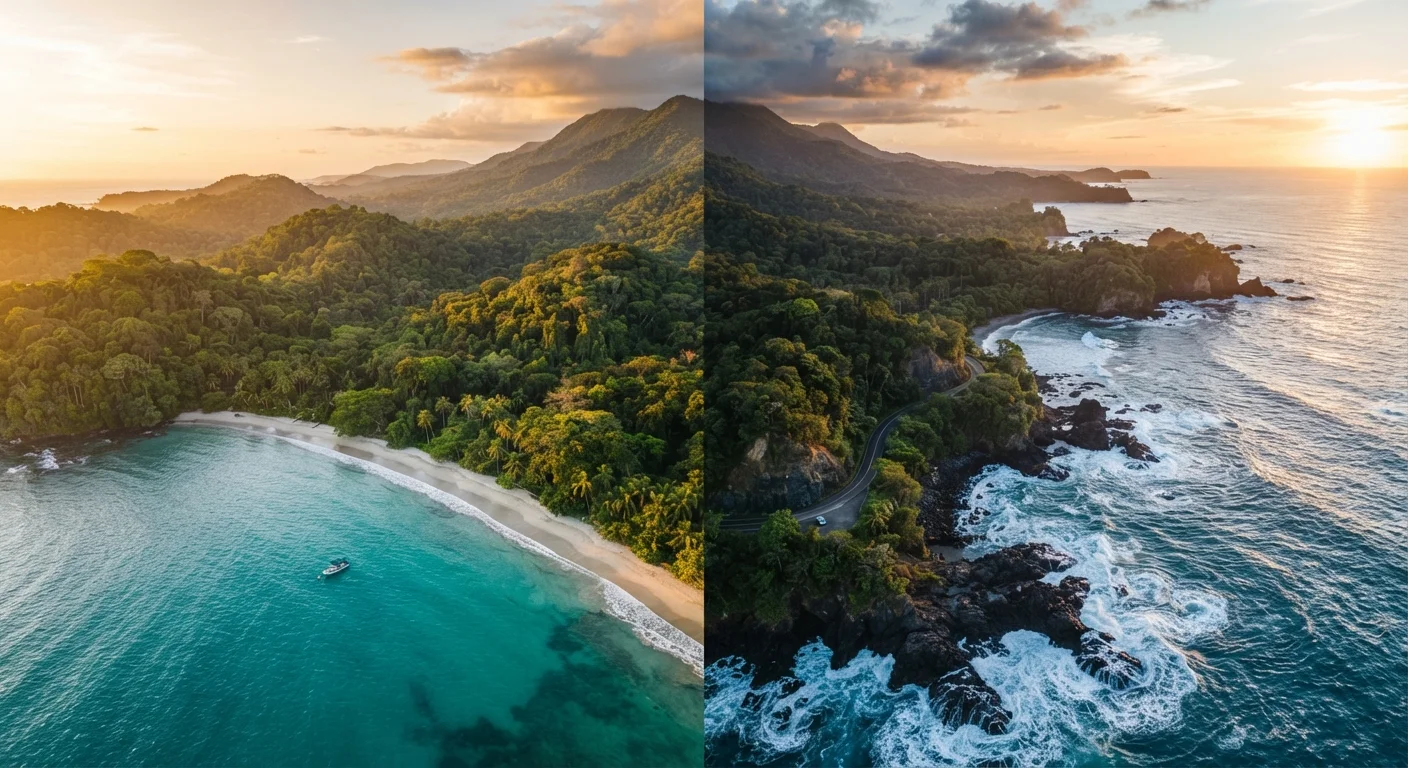
Pacific Coast
The dramatic, adventure-driven shoreline.
Best for: Travelers seeking big surf, wildlife-rich national parks, and reliable dry-season sunshine.
Option B
Caribbean Coast
The laid-back, culturally rich alternative.
Best for: Travelers drawn to Afro-Caribbean culture, calmer waters, and lush, rain-soaked biodiversity.
If you want reliable sunny weather and structured itineraries
Pacific Coast
The Pacific's dry season from December through April delivers consistently sunny skies, making it easier to plan outdoor activities and multi-day tours.
If you're drawn to cultural depth and off-the-beaten-path experiences
Caribbean Coast
The Caribbean's Afro-Caribbean communities, reggae rhythms, and distinctive cuisine offer a cultural texture largely absent on the Pacific side.
If surfing is a primary goal
Pacific Coast
Spots like Tamarindo, Nosara, and Dominical are renowned for powerful, consistent swells suited to a range of skill levels.
If snorkeling and calm swimming are priorities
Caribbean Coast
The Caribbean's calmer seas and reef systems near Cahuita and Manzanillo create clearer, more approachable conditions for snorkeling.
If seeing sea turtles nesting is your dream
Caribbean Coast
Tortuguero National Park on the Caribbean side is one of the hemisphere's most important green turtle nesting sites, with organized, conservation-focused viewing.
Two Coasts, Two Completely Different Countries - Almost
Stretching just 319 miles from northwest to southeast, Costa Rica somehow manages to pack in two entirely distinct coastal worlds. The Pacific and Caribbean shores are separated not just by a mountain spine but by profoundly different climates, ecosystems, cultural histories, and travel vibes. Many visitors pick one coast without realizing how different the other would have felt - and some end up wishing they'd budgeted time for both.
The Pacific Coast runs along roughly 800 miles of shoreline, taking in everything from the dry, cattle-ranching Guanacaste region in the north to the wild, jungle-draped Osa Peninsula in the south. The Caribbean Coast, by contrast, is narrower in scope and character - a humid, rainforest-backed stretch anchored by Afro-Caribbean culture, with towns like Puerto Viejo de Talamanca carrying a distinctly different soundtrack than anything on the Pacific side.
| Criterion | Pacific Coast | Caribbean Coast |
|---|---|---|
| Peak dry season | December - April | Sept - Oct, Feb - March |
| Surf quality | Powerful, consistent swells | Calmer, less suitable for surfing |
| Snorkeling & swimming | Variable; rougher conditions | Calmer water, reef access |
| Cultural character | Broadly Costa Rican/tourist-oriented | Afro-Caribbean heritage, distinct |
| Tourist infrastructure | Highly developed | Less developed, slower pace |
| Signature wildlife | Macaws, tapirs, monkeys (Corcovado) | Sea turtles, manatees (Tortuguero) |
| Accessibility | Easier road and air access | Often requires boat or small plane |
Climate and Weather: When to Go Where
Weather may be the single most practical reason to choose one coast over the other. The Pacific follows a relatively predictable pattern: a dry season running roughly from December through April, and a rainy season from May through November. That dry window aligns neatly with North American winter travel, which is one reason the Pacific draws higher visitor numbers.
The Caribbean plays by entirely different rules. It receives rainfall year-round - often dramatically so - because the trade winds push moisture off the sea with little seasonal break. However, the Caribbean actually enjoys two drier spells: a short one in February through March, and a longer relative dry window from September through October, which is paradoxically the rainy season on the Pacific side. Travelers who plan carefully can use this inverse pattern to find quieter, drier conditions on the Caribbean when Pacific crowds peak.
Timing the Caribbean's Drier Windows
The Caribbean's September-October relative dry spell coincides with the Pacific's rainy season - making it a smart window for budget travelers to find lower prices on the Pacific while Caribbean skies briefly cooperate. February and March offer a shorter but similarly useful drier stretch. Always check local forecasts before traveling, as Caribbean weather can be unpredictable regardless of season.
Wildlife and Ecosystems: Shared Riches, Different Stars
Both coasts are undeniably spectacular for wildlife, but the headlining species and settings differ. The Pacific's Corcovado National Park is frequently cited by biologists as one of the most biodiverse places on Earth, sheltering scarlet macaws, tapirs, white-lipped peccaries, and all four of Costa Rica's monkey species. Manuel Antonio, more accessible and developed, pairs white-sand beaches with sloths and capuchins at remarkably close range.
The Caribbean's showpiece is Tortuguero National Park - reachable only by boat or small plane - where green sea turtles haul ashore to nest in numbers that make it one of the most significant turtle rookeries in the Western Hemisphere. The canals threading through the park also reward boat-based wildlife spotting: manatees, caimans, river otters, and dozens of water bird species animate every slow glide through the waterways.
~34%
Of Costa Rica's land protected as national parks or reserves
Costa Rica's national park system covers roughly a third of the country's territory, supporting biodiversity on both coasts, according to Costa Rica's SINAC (National System of Conservation Areas).
~35,000
Green sea turtles nesting annually at Tortuguero
Tortuguero National Park hosts one of the largest green turtle nesting aggregations in the Atlantic, with tens of thousands of turtles arriving each season according to conservation monitoring data.
Culture, Food, and the Feel on the Ground
Arriving in Puerto Viejo de Talamanca after time on the Pacific is something of a gentle culture shock. The Caribbean coast's communities descend largely from Afro-Caribbean immigrants who arrived in the late 19th century to build the Atlantic railroad, and their cultural imprint is vivid and genuine - in the patois spoken on the street, the Rastafarian influence visible in the art and music, and especially in the food. Rice and beans cooked in coconut milk, jerk-seasoned meats, and fresh plantains prepared with West Indian techniques taste nothing like the casado (a traditional plate lunch) you'd find in a Pacific beach town.
The Pacific Coast's tourist infrastructure is considerably more developed, with more resort hotels, organized tour operators, and smoother road access. That development is a practical advantage for first-time visitors or families but can also mean a more homogenized travel experience. The Caribbean's relative lack of infrastructure is its double-edged charm - things move slower, logistics require more flexibility, and the reward is a feeling that you've found something less packaged.