

| Total regions | 20 (plus 2 autonomous provinces) (Italian Constitution, 1948) |
| Northernmost region | Valle d'Aosta |
| Southernmost mainland region | Calabria |
| Largest region by area | Sicily (Italian National Institute of Statistics (ISTAT)) |
| Most visited city | Rome (Lazio) (UNWTO and ISTAT tourism data) |
| UNESCO World Heritage Sites in Italy | 58 (most of any country) (UNESCO, 2023) |
Why Italy's Regions Matter for Travelers
Italy isn't a single destination - it's twenty distinct regions stitched together by history, dialect, and terrain. Understanding which region you're visiting, and what makes it different from the next, is one of the most practical things a traveler can do before booking a flight. The north is Alpine and industrial; the center is the storied heartland of Renaissance art; the south is sun-baked, ancient, and fiercely proud. Coastal, mountainous, volcanic, and lagoon-laced landscapes all coexist within a country slightly larger than Arizona.
Each region carries its own culinary identity, architectural character, and pace of life. A week in Lombardy feels nothing like a week in Calabria, and that contrast is precisely the point. This reference guide breaks down Italy's major regions so you can match the right place to your travel goals - whether that's world-class museums, slow coastal afternoons, or high-altitude hiking.
| Total regions | 20 (plus 2 autonomous provinces) (Italian Constitution, 1948) |
| Northernmost region | Valle d'Aosta |
| Southernmost mainland region | Calabria |
| Largest region by area | Sicily (Italian National Institute of Statistics (ISTAT)) |
| Most visited city | Rome (Lazio) (UNWTO and ISTAT tourism data) |
| UNESCO World Heritage Sites in Italy | 58 (most of any country) (UNESCO, 2023) |
The North: Alpine Grandeur and Urban Sophistication
Lombardy anchors the north with Milan at its center - Italy's financial capital and a global hub for design and fashion. Beyond the city, the region holds the celebrated Lake District, where Como, Maggiore, and Garda draw visitors with their mountain-framed shorelines. Risotto and braised meats dominate the table here.
Veneto is perhaps the most visited region in Italy, thanks to Venice - a city of canals, Gothic palaces, and Byzantine mosaics that sits on a lagoon in the Adriatic. Beyond Venice, Verona offers Roman amphitheaters and medieval streets, while the Dolomites rise dramatically in the north. Prosecco country fills the rolling hills in between.
Piedmont sits in Italy's northwestern corner, bordered by the Alps and France. Turin is its cosmopolitan capital, and the surrounding countryside - particularly the Langhe and Monferrato hills - is revered for Barolo and Barbaresco wines, white truffles, and rich, butter-forward cooking.
Autonomous region
A region granted special administrative powers under Italy's constitution, often due to distinct ethnic or linguistic heritage. Examples include Sicily, Sardinia, and Valle d'Aosta.
Trulli
Traditional dry-stone huts with conical roofs found primarily in Puglia's Itria Valley. They are a UNESCO World Heritage Site and a distinctive architectural symbol of the region.
DOC / DOCG
Italian wine classification labels - Denominazione di Origine Controllata and its stricter tier Garantita - that indicate wines made to regulated standards within defined geographic zones.
Mezzogiorno
An informal term referring collectively to the regions of southern Italy, roughly south of Rome. It reflects a shared history distinct from the industrialized north.
The Center: Art, History, and the Soul of Italy
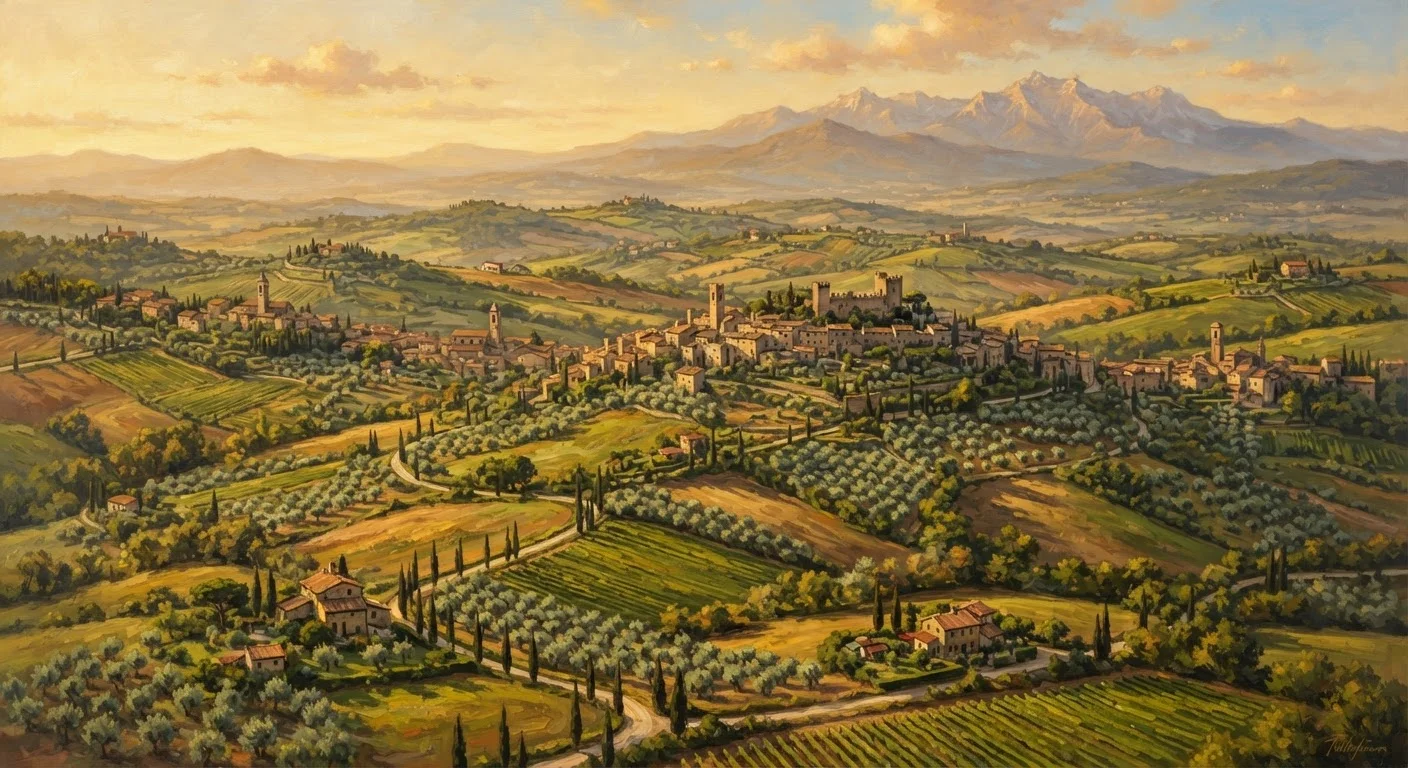
Tuscany is arguably the region most associated with Italy in the popular imagination - cypress-lined roads, medieval hill towns like Siena and San Gimignano, the Renaissance art of Florence, and Chianti vineyards. The food is deceptively simple: quality olive oil, grilled meats, ribollita soup, and salt-free bread that divides visitors sharply.
Lazio exists, for most travelers, as Rome. The Eternal City contains the Colosseum, Vatican City, the Pantheon, and layers of civilization spanning nearly three millennia. Beyond Rome, Lazio's volcanic lakes and medieval hilltop towns reward travelers willing to explore.
Umbria, landlocked and quieter than its famous neighbors, is sometimes called Italy's green heart. Perugia, Assisi, and Orvieto offer medieval architecture without the crowds of Tuscany, and the region produces excellent truffles and lentils from the Castelluccio plateau.
Central Italy's Shoulder-Season Advantage
Tuscany and Umbria tend to see peak crowds between June and August, particularly in Florence and Siena. Travelers who visit in April, May, October, or November often find milder temperatures, fewer tour groups, and a quieter atmosphere in hill towns. Entry requirements and opening hours at major sites can vary seasonally, so verifying details with official sources before travel is always recommended.
The South and Islands: Ancient Roots, Vivid Color
Campania centers on Naples - loud, layered, and magnificent - and radiates outward to Pompeii's Roman ruins, the Amalfi Coast's vertiginous cliffs, and the islands of Capri and Ischia. Neapolitan pizza originated here, and the region's tomatoes, mozzarella di bufala, and seafood are considered benchmarks of southern Italian cooking.
Sicily, the Mediterranean's largest island, blends Greek temples, Norman cathedrals, Baroque piazzas, and Arab-influenced cuisine into something entirely its own. Palermo's street food scene, the Valley of the Temples near Agrigento, and the active volcano Mount Etna all draw distinct types of travelers.
Apulia (Puglia), the stiletto heel of Italy's boot, has grown steadily in international reputation. Trulli houses in Alberobello, whitewashed Ostuni, the Baroque city of Lecce, and long Adriatic beaches characterize a region that remains more accessible and less crowded than many Italian alternatives.
58
UNESCO World Heritage Sites in Italy
According to UNESCO's 2023 listings, Italy holds more World Heritage Sites than any other country in the world.
~57M
International tourist arrivals per year
Pre-pandemic figures from UNWTO placed Italy among the top five most-visited countries globally, with visitors distributed unevenly toward northern and central regions.
20
Distinct administrative regions
Italy's regional system, established by its 1948 constitution, means each area has its own local government, cultural institutions, and distinct identity.