

Key Takeaways
- Refining strips wheat of its bran and germ, removing most fiber, B vitamins, and minerals.
- Whole grains retain all three kernel layers: bran, germ, and endosperm.
- Most refined grain products in the US are enriched, but enrichment doesn't fully restore what processing removes.
- Dietary fiber from whole grains is linked to improved digestive health and more stable blood sugar responses.
- Swapping some refined grains for whole grains is a straightforward, evidence-supported dietary shift.
Option A
Whole Grains
The nutritionally complete, minimally processed option.
Best for: People seeking more fiber, vitamins, and sustained energy from their carbohydrate sources.
Option B
Refined Grains
The streamlined, shelf-stable grain with a lighter texture.
Best for: Situations requiring longer shelf life, lighter texture, or highly specific culinary applications.
If you want to support digestive health and steady energy levels
Whole Grains
The fiber and intact nutrients in whole grains support gut function and slow the digestion of carbohydrates, helping to moderate blood sugar spikes.
If texture, rise, or shelf life matter most in cooking and baking
Refined Grains
Refined flours produce lighter, more predictable results in baking and have a longer shelf life, making them practical for specific culinary needs.
If you're building a more nutrient-dense everyday diet
Whole Grains
Whole grains deliver a broader array of naturally occurring vitamins, minerals, and phytonutrients in a single food source.
What Happens Inside the Mill
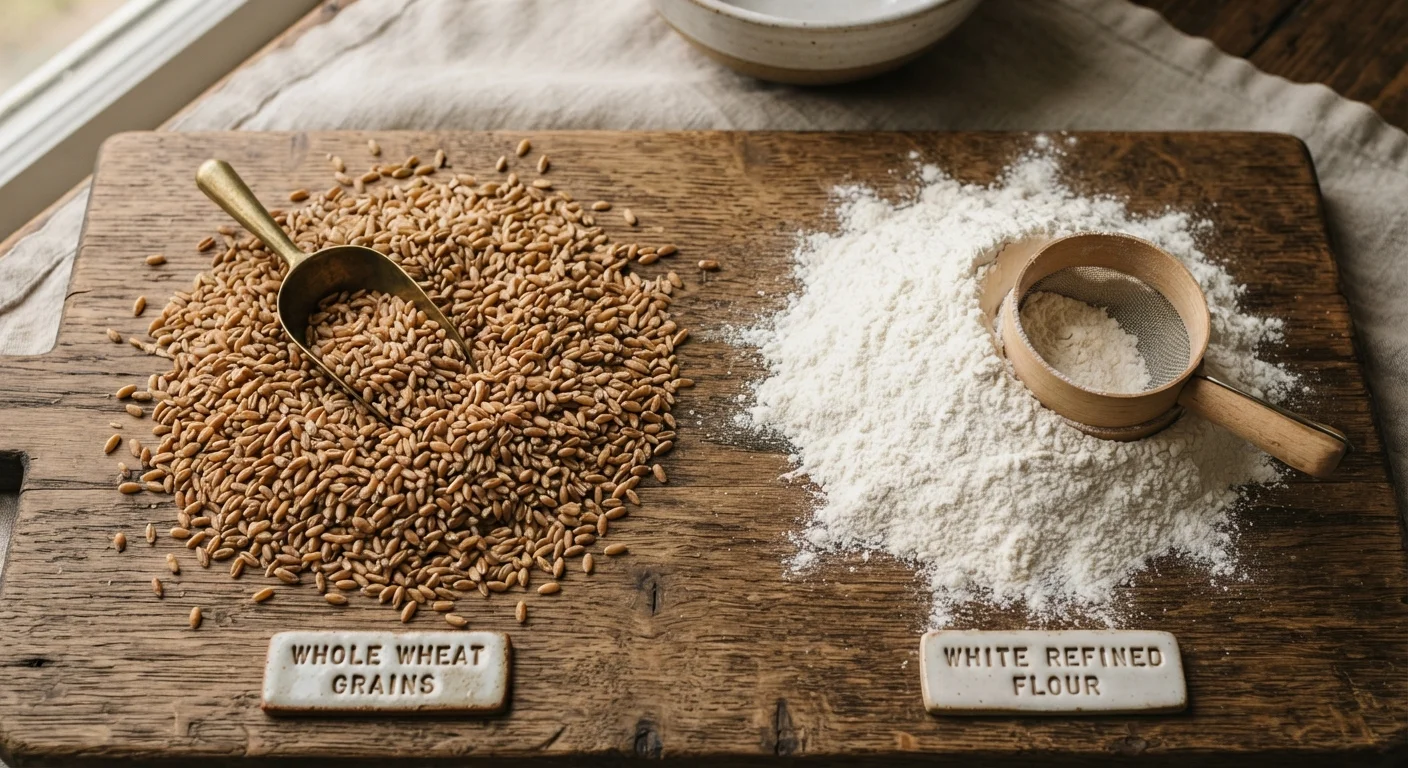
A wheat kernel is made up of three distinct layers. The bran is the tough outer shell, rich in fiber, B vitamins, and minerals like iron and magnesium. The germ is the embryo of the seed - packed with healthy fats, B vitamins, and vitamin E. The endosperm is the starchy interior that makes up the bulk of the kernel.
When wheat is refined, rollers strip away the bran and germ, leaving almost entirely the endosperm. This produces the smooth, white flour used in most commercial bread, pasta, and baked goods. The process extends shelf life and creates a milder flavor and lighter texture - but at a significant nutritional cost.
Studies consistently show that refining removes roughly 75% of the fiber, along with substantial portions of folate, magnesium, zinc, and vitamin E. To partially compensate, US regulations require that refined grain products be enriched - meaning certain B vitamins (thiamin, riboflavin, niacin, folic acid) and iron are added back. However, enrichment doesn't restore fiber or all the original nutrients, including vitamin E or many trace minerals.
| Criterion | Whole Grains | Refined Grains |
|---|---|---|
| Kernel layers retained | Bran, germ, endosperm | Endosperm only |
| Dietary fiber | High (intact) | Low (mostly removed) |
| B vitamins | Naturally present | Partially restored via enrichment |
| Vitamin E | Present in germ | Largely lost; not re-added |
| Glycemic response | Generally slower | Generally faster |
| Shelf life | Shorter (oils in germ can go rancid) | Longer, more stable |
| Texture in baking | Denser, earthier | Lighter, finer |
Fiber: The Most Consequential Difference
Dietary fiber is perhaps the most clinically significant nutrient lost during refining. Fiber slows gastric emptying, feeds beneficial gut bacteria, and helps moderate post-meal blood glucose responses. The Dietary Guidelines for Americans recommend adults consume 25-38 grams of dietary fiber per day, yet most Americans fall well short of this target.
<5%
Adults meeting daily fiber recommendations
Research published in the American Journal of Lifestyle Medicine estimated that fewer than 5% of Americans meet the recommended daily fiber intake.
~75%
Fiber lost during grain refining
Studies on wheat milling show that the refining process removes approximately 75% of dietary fiber present in the whole kernel.
3x
More magnesium in whole vs. refined wheat
Whole wheat flour contains roughly three times the magnesium of white flour, according to USDA nutrient data.
Whole grains contribute meaningfully to daily fiber intake in a way refined grains simply cannot. For example, a slice of 100% whole wheat bread typically provides 2-3 grams of fiber, while the same serving of white bread often supplies less than 1 gram.
It's worth understanding how to read labels when shopping. The ingredient list on packaged foods can be revealing - look for "whole wheat" or "whole grain" listed as the first ingredient. As we explain in our guide to reading nutrition facts labels, terms like "multigrain" or "wheat bread" do not necessarily mean the product is made primarily from whole grains.
Blood Sugar, Satiety, and Long-Term Health Patterns
Because refined grains are digested more quickly, they tend to produce a faster rise in blood glucose after eating. Whole grains, with their intact fiber and structure, slow digestion and typically result in a more gradual glucose response. This distinction is captured by the glycemic index, though it's important to note that glycemic response varies based on how a food is prepared, what it's eaten with, and individual physiology.
Long-term observational research - including large cohort studies - has associated higher whole grain intake with reduced risk of cardiovascular disease, type 2 diabetes, and certain digestive conditions. It's important to interpret these associations carefully; as our editorial team notes in where nutrition advice goes wrong, observational studies show correlation rather than direct causation.
That said, the convergence of mechanistic, clinical, and population-level evidence gives researchers reasonable confidence that whole grains offer meaningful advantages over refined grains for most people in most contexts.
A Note on 'Enriched' vs. 'Whole Grain'
Enriched refined grain products have added B vitamins and iron, but this is not the same as being nutritionally equivalent to whole grains. Fiber and several micronutrients - including vitamin E - are not restored through enrichment. When labels say 'enriched,' it signals that refinement occurred. If whole grain nutrition is the goal, look specifically for 'whole grain' or 'whole wheat' as the first listed ingredient. The context around an ingredient matters as much as its presence on the label.
This article provides general nutrition education and is not a substitute for personalized medical or dietary advice. Consult a qualified healthcare professional or registered dietitian regarding your specific health needs.