
Engineered Hardwood vs. Solid Hardwood Flooring: A Structural and Practical Comparison

Key Takeaways
- Engineered hardwood resists moisture-driven expansion better than solid hardwood, making it suitable for basements and kitchens.
- Solid hardwood can typically be sanded and refinished more times over its lifespan, extending its usable life significantly.
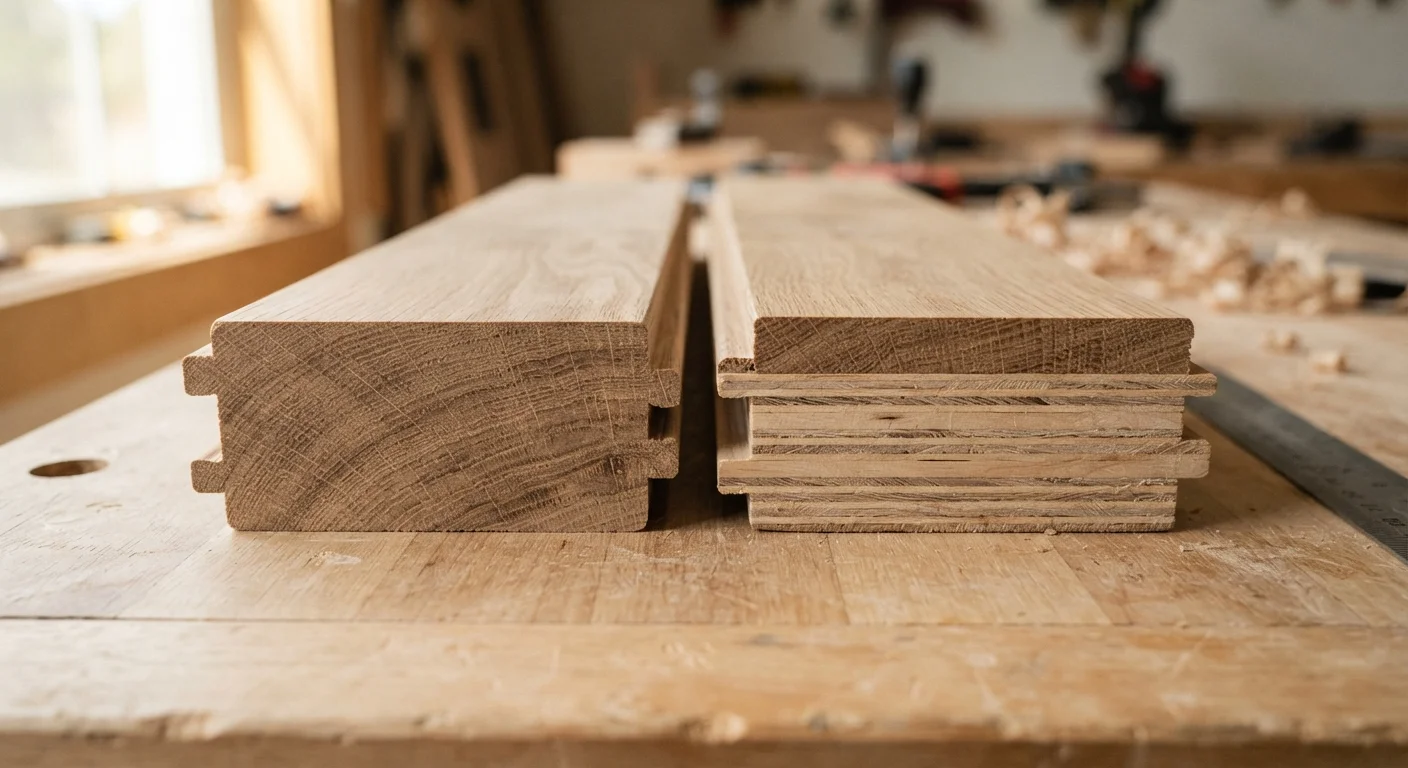
- Both products use real wood; the difference is construction - engineered planks have a veneer layer over a plywood or HDF core.
- Installation method varies: solid hardwood requires nail-down over wood subfloors, while engineered offers glue, nail, or float options.
- Climate, subfloor type, and room location are the three most important factors when choosing between the two.
Option A
Engineered Hardwood
The dimensionally stable, moisture-resilient modern option.
Best for: Homeowners installing flooring below grade, over radiant heat systems, or in areas with variable humidity levels.
Option B
Solid Hardwood
The traditional, refinishable choice built from a single piece of real wood.
Best for: Above-grade main living areas where long-term refinishing potential and classic authenticity are the top priorities.
If you're flooring a basement or below-grade space
Engineered Hardwood
Its cross-ply core construction limits seasonal expansion and contraction caused by ground-level moisture, making it a far more stable choice below grade.
If long-term refinishing and classic character matter most
Solid Hardwood
A thicker wear layer allows multiple sanding cycles over decades, letting you restore or change the stain color as styles evolve.
If you're installing over a radiant heat system
Engineered Hardwood
Engineered planks are less susceptible to the expansion and gapping caused by the heating and cooling cycles of in-floor radiant systems.
If you want an above-grade main living area with maximum longevity
Solid Hardwood
In stable, climate-controlled environments, solid hardwood performs reliably and offers the deepest refinishing potential of any wood floor option.
If you're working with a concrete slab subfloor
Engineered Hardwood
Solid hardwood cannot be nailed into concrete; engineered hardwood can be glued or floated directly over a concrete subfloor when prepared correctly.
How Each Floor Is Built
Understanding the structural difference between these two products removes most of the confusion surrounding which one to choose. Solid hardwood is exactly what it sounds like: a plank milled from a single piece of timber, typically ¾ inch thick. Its grain runs uniformly throughout, giving it that depth of character and the ability to be sanded down multiple times over its life.
Engineered hardwood, by contrast, is a layered composite. The top layer - called the wear layer or lamella - is genuine hardwood veneer, usually between 1 and 6 millimeters thick depending on the product grade. Beneath it sits a core of cross-directional plywood layers or high-density fiberboard (HDF). This construction counteracts the natural tendency of wood to expand and contract across its grain, which is the core reason engineered hardwood handles moisture fluctuations better.
Neither product is inherently "fake" or inferior. Both offer real wood surfaces. The difference is engineering - one prioritizes structural stability, the other prioritizes refinishing depth and authenticity.
| Criterion | Engineered Hardwood | Solid Hardwood |
|---|---|---|
| Construction | Real wood veneer over plywood/HDF core | Single solid timber plank throughout |
| Typical thickness | 3/8" to 3/4" | 3/4" standard |
| Moisture resistance | Better - cross-ply core limits movement | Lower - expands and contracts more |
| Installation methods | Nail, glue, or float | Nail or staple only |
| Subfloor compatibility | Wood, concrete slab, radiant heat | Wood subfloor only (above grade) |
| Refinishing cycles | 1-3 (depends on wear layer thickness) | 5-10 over lifetime |
| Suitable for basements | Yes (with moisture precautions) | No |
| Longevity potential | 25-30+ years with good wear layer | 50-100+ years with proper care |
Moisture, Subfloor, and Installation Compatibility
Room location and subfloor type are often the deciding factors for most homeowners. Solid hardwood is restricted to above-grade installation - it cannot be used in basements or directly over concrete slabs because ground moisture will cause it to swell, cup, or buckle over time. It must be fastened by nailing or stapling into a wood subfloor, typically requiring a minimum ¾-inch plywood base.
Engineered hardwood opens up significantly more installation scenarios. It can be nailed, stapled, glued, or floated (using a click-lock system), depending on the specific product. This flexibility means it can go over concrete slabs, directly over radiant heat systems, and in moisture-variable spaces like kitchens or basements - provided the subfloor is flat, clean, and within the manufacturer's moisture threshold guidelines.
3-6 mm
Recommended minimum wear layer thickness for refinishable engineered hardwood
Flooring industry guidelines generally suggest a wear layer of at least 3-4mm to allow even a single light sanding without risking the core.
¾ inch
Standard solid hardwood plank thickness
This uniform thickness is what makes solid hardwood compatible with multiple refinishing cycles and the defining measurement for traditional installation.
48-72 hrs
Typical acclimation period before installation
Most hardwood flooring manufacturers - both solid and engineered - specify an acclimation period to reduce post-installation gapping or buckling.
Regardless of which product you choose, acclimating the flooring to the room's temperature and humidity for 48 to 72 hours before installation is standard practice. Both types of wood expand and contract seasonally, and a proper installation accounts for this with expansion gaps at walls and transitions.
Refinishing Potential and Long-Term Maintenance
This is where solid hardwood holds a meaningful structural advantage. Because a solid plank is uniform wood all the way through, it can typically be sanded and refinished between 5 and 10 times over its lifespan - depending on how much material is removed each cycle. A well-maintained solid floor installed in the right environment can last over a century.
Engineered hardwood's refinishing potential depends entirely on the wear layer thickness. A thin 1mm veneer may allow only one light sanding, if any. A thicker 4-6mm wear layer can support two or three refinishing cycles. When shopping for engineered flooring, wear layer thickness is one of the most important specifications to examine.
For everyday maintenance, both floor types require similar care: regular sweeping or dry mopping, prompt cleanup of spills, and avoidance of wet mopping. Area rugs and furniture pads help prevent premature wear in high-traffic zones. If you're considering a large flooring investment, our overview of home improvement financing options covers general approaches to budgeting for renovation projects.
A Note on Wear Layer Labeling
Wear layer thickness in engineered hardwood is not always prominently displayed on packaging. Look for it in the product's technical specification sheet, not just the marketing materials. Some products list the total plank thickness without specifying how much of that is the actual hardwood veneer. Requesting this specification before purchasing is a reasonable and worthwhile step.
Making the Right Call for Your Home
The choice between engineered and solid hardwood is less about one being superior and more about matching the product's strengths to your specific conditions. Use this framework:
- Above-grade rooms with wood subfloors and stable humidity - both options work; solid hardwood gives you more refinishing depth.
- Basements, slab-on-grade, or kitchens - engineered hardwood is the structurally appropriate choice.
- Homes with radiant heat - engineered hardwood is generally more compatible; always verify with the specific product's installation guidelines.
- Historic or period homes - solid hardwood may better match existing flooring; consult a flooring professional for matching and transitions.
Just as it matters structurally whether a wall is load-bearing before you alter it - see our guide on load-bearing vs. partition walls for that kind of pre-project homework - knowing your subfloor, grade level, and moisture environment before selecting flooring prevents costly mistakes. Take measurements, test for moisture with an inexpensive moisture meter, and consult a flooring installer if you're uncertain about subfloor readiness.