

Key Takeaways
- Zero-based budgeting assigns every dollar of income a specific purpose before the month begins.
- The envelope method uses physical or virtual cash limits per spending category to prevent overspending.
- Both approaches promote intentional spending but differ in tools, flexibility, and daily effort required.
- Zero-based budgeting works well for detailed planners; envelopes suit those who respond to physical constraints.
- Either method can be adapted digitally, though the envelope approach is rooted in cash-based discipline.
Option A
Zero-Based Budgeting
The meticulous, comprehensive planning framework.
Best for: People who want a detailed, month-by-month plan that accounts for every dollar of income before spending begins.
Option B
The Envelope Method
The tactile, category-by-category cash system.
Best for: People who struggle with overspending in specific categories and benefit from a physical, hands-on limit on discretionary purchases.
If you want a complete monthly financial plan that covers every expense
Zero-Based Budgeting
Zero-based budgeting requires you to assign income to every category - including savings and debt - leaving nothing unaccounted for and giving you a clear financial picture each month.
If you frequently overspend on groceries, dining, or entertainment
The Envelope Method
Physical or digital envelopes create a hard stop when the money runs out, making it immediately clear when a spending limit has been reached in a given category.
If you are new to budgeting and want a structured starting point
Zero-Based Budgeting
The step-by-step process of listing income, then assigning it category by category, builds foundational awareness of where money actually goes each month.
If you prefer minimal tracking and a simple, tactile system
The Envelope Method
Once the envelopes are funded, day-to-day management is straightforward - spend from the envelope and stop when it's empty, no spreadsheet required.
What Each Budgeting Approach Actually Does
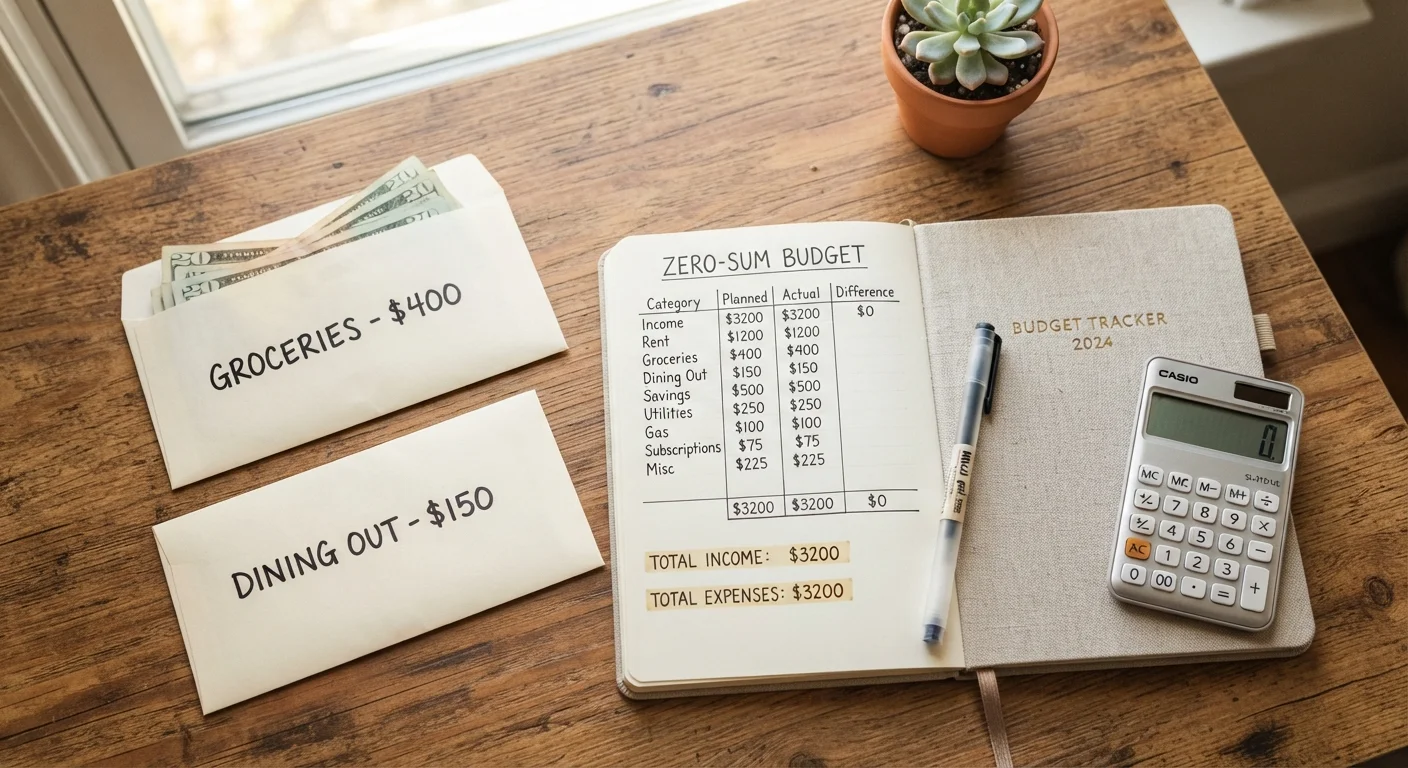
Zero-based budgeting (ZBB) is a method in which your total income minus your total budgeted expenses equals zero. That doesn't mean you spend everything - it means every dollar is intentionally directed somewhere, whether that's rent, groceries, an emergency fund, or debt repayment. The goal is to plan proactively at the start of each month so no money is left floating without a purpose.
The envelope method works differently. You divide your spending categories - groceries, gas, dining out, clothing - and physically (or digitally) separate a set amount of cash into labeled envelopes for each. When an envelope is empty, spending in that category stops for the month. Originally a cash-only system, many people now replicate it using budgeting apps or separate accounts.
Both approaches share a core philosophy: spending should be deliberate, not accidental. If you're just getting started with financial planning, the beginner's guide to building your first budget walks through the foundational steps that underpin both methods.
| Criterion | Zero-Based Budgeting | The Envelope Method |
|---|---|---|
| Core mechanism | Assign every dollar of income a category | Allocate cash to labeled spending envelopes |
| Scope | Covers all income and expenses | Typically covers variable/discretionary spending |
| Setup effort | Moderate - requires monthly planning session | Low - fund envelopes once, spend from them |
| Daily engagement | Periodic tracking and category updates | Built-in via physical cash or app limits |
| Best tool | Spreadsheet or budgeting app | Cash envelopes or digital envelope app |
| Flexibility | High - categories can shift month to month | Low within categories; encourages firm limits |
| Works for irregular income | Yes - recalculate each month | Possible, but requires envelope adjustment |
| Psychological mechanism | Awareness and planning ahead | Physical or visual constraint at point of spending |
How They Differ in Practice
The most meaningful difference is scope. Zero-based budgeting is a whole-income plan - it accounts for fixed expenses like rent, variable expenses like utilities, and financial goals like saving or investing, all in one place. You see the complete picture every time you sit down to budget.
The envelope method, by contrast, typically applies only to discretionary or variable spending categories. Most people still pay fixed bills like rent and insurance separately. Envelopes govern the flexible portions of a budget where overspending is most common.
There's also a difference in frequency of engagement. Zero-based budgeting requires deliberate setup each month and periodic check-ins to track whether spending matches the plan. The envelope method's daily friction - physically taking money from an envelope - serves as its own built-in accountability moment.
~33%
Americans with a detailed monthly budget
Gallup polling has consistently found that fewer than one in three U.S. adults maintains a detailed household budget, suggesting most people manage money without a formal system.
60%+
Adults living paycheck to paycheck at times
Various consumer financial surveys have found that a majority of Americans report occasionally or regularly running out of money before their next paycheck, underscoring the value of structured spending plans.
For a broader look at how these methods fit alongside other frameworks such as pay-yourself-first or the 50/30/20 rule, the overview of popular budgeting frameworks provides useful context.
Strengths, Limitations, and Who Each Suits
Zero-based budgeting excels at creating total financial clarity. Because every dollar has a job, it's harder for money to quietly disappear into vague categories. It also adapts well to irregular income - freelancers and gig workers can recalculate each month based on what they actually earned. The limitation is the time investment: it requires consistent tracking and honest category estimates.
The envelope method works especially well for people whose problem isn't awareness of their finances but willpower at the point of purchase. The physical constraint of a finite envelope is psychologically powerful. Its limitation is practicality in a digital-payment world - most transactions today are card or mobile-based, requiring either discipline to mentally track against an envelope or a dedicated app to replicate the system.
Neither approach guarantees results, and neither is right for every household. If common misconceptions have kept you from trying either, examining the most common budgeting myths may help reset expectations.
Unfamiliar with Key Terms?
Concepts like discretionary income, sinking funds, and variable expenses appear in both budgeting methods. If any of those terms are unclear, the glossary of essential budgeting vocabulary offers plain-language definitions worth bookmarking before you set up your first budget.
If you're managing debt alongside budgeting, understanding repayment strategies is equally important. The debt avalanche vs. debt snowball comparison explores how different payoff approaches complement a solid budgeting foundation.
This article is for general informational and educational purposes only. It does not constitute personalized financial advice. Consult a licensed financial professional for guidance specific to your situation.