

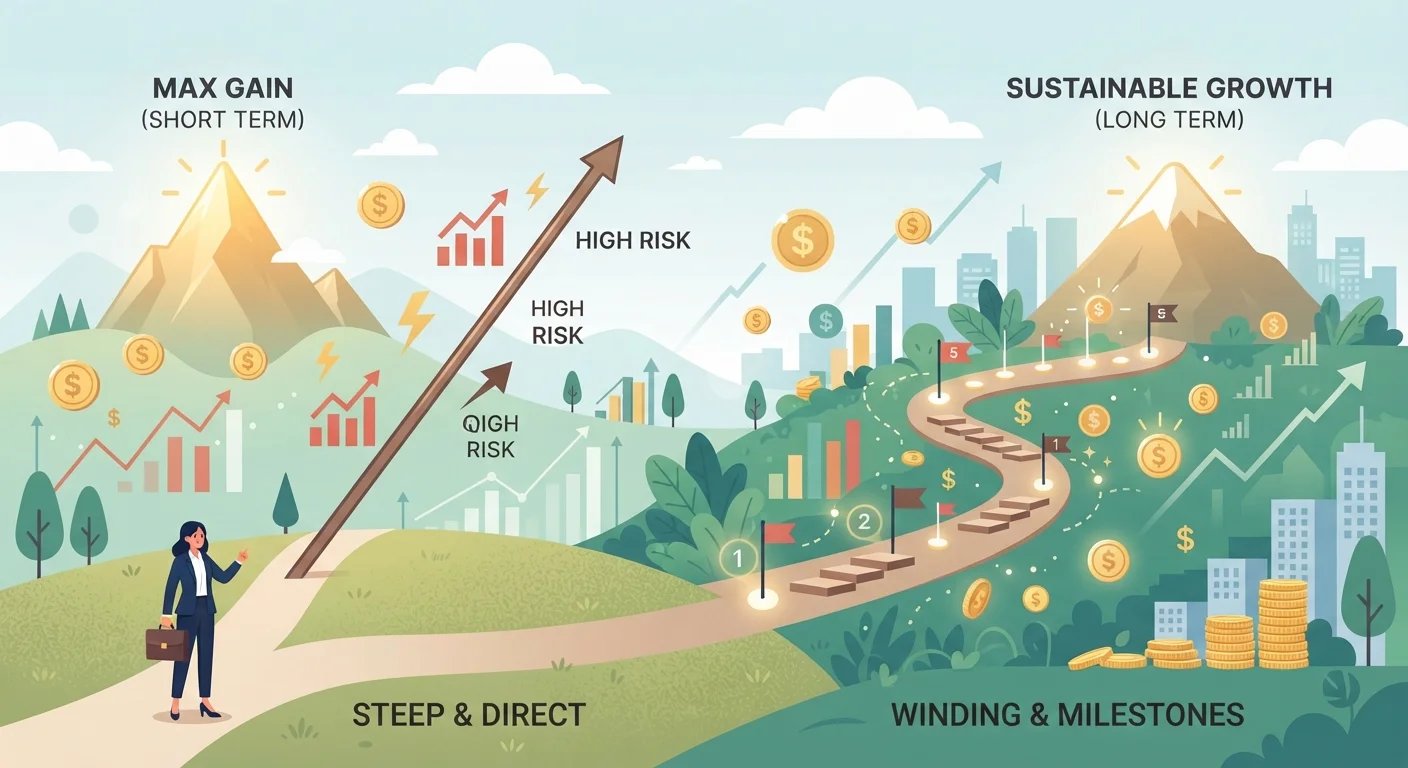
Key Takeaways
- The Debt Avalanche targets your highest-interest debt first, saving the most money over time.
- The Debt Snowball pays off the smallest balance first, delivering faster psychological wins.
- Neither method requires extra income - both rely on redirecting existing minimum payments.
- Research suggests the Snowball may produce better real-world completion rates despite costing more.
- Your choice should reflect both your financial picture and your personality and motivation style.
- Consult a qualified financial adviser to determine the approach that fits your specific situation.
Option A
Debt Avalanche
The mathematically optimal approach to minimizing total interest paid.
Best for: Best for disciplined savers who want to minimize total interest costs and don't need frequent motivational wins.
Option B
Debt Snowball
The psychologically rewarding approach built around quick, visible progress.
Best for: Best for people who need motivational momentum and benefit from celebrating early milestones to stay on track.
If you want to pay the least total interest possible
Debt Avalanche
By attacking high-interest balances first, the Avalanche mathematically reduces the amount of interest that accumulates across all your debts over time.
If you've struggled to stick with a debt payoff plan before
Debt Snowball
Eliminating smaller balances quickly delivers concrete wins that reinforce the habit of paying extra - helping you stay committed through a longer journey.
If your debts have similar interest rates but very different balances
Debt Snowball
When the interest-rate spread is narrow, the cost difference between methods shrinks, making the motivational benefits of the Snowball a compelling tiebreaker.
If you carry one or two very high-rate balances well above the others
Debt Avalanche
A dramatically higher rate on one account means interest compounds quickly; targeting it first produces meaningful savings that are hard to ignore.
How Each Method Actually Works
Both strategies share the same mechanical foundation: you continue making minimum payments on every debt each month, then direct any additional dollars toward one target account. The difference is entirely in how you choose that target.
Debt Avalanche: Rank your debts from highest annual percentage rate (APR) to lowest. Put every extra dollar toward the highest-rate balance until it's gone, then roll that freed-up payment to the next highest-rate debt, and so on. The "avalanche" builds as each eliminated debt adds momentum to the next attack.
Debt Snowball: Rank your debts from smallest balance to largest, regardless of interest rate. Direct extra funds toward the smallest balance first. Once it's cleared, that payment amount rolls into the next-smallest debt. Each payoff feels like a visible win and - according to behavioral research - reinforces your commitment to continue.
Neither method requires you to earn more money. Both work by intelligently redirecting money you're already spending on minimums. For a broader view of how debt fits into your overall financial picture, see our budgeting basics hub.
| Criterion | Debt Avalanche | Debt Snowball |
|---|---|---|
| Payoff order | Highest APR first | Smallest balance first |
| Total interest paid | Lower (often meaningfully) | Higher when rate spread is wide |
| Time to first payoff | Longer if high-rate debt is large | Faster - smallest balance clears first |
| Motivational wins | Fewer early milestones | Frequent early milestones |
| Best suited for | Disciplined, math-driven planners | Motivation-driven, habit-building planners |
| Complexity | Simple once ranked by APR | Simple once ranked by balance |
The Math vs. the Psychology
In a purely mathematical sense, the Avalanche wins every time when interest rates differ meaningfully across your debts. High-APR balances compound rapidly - every month you carry them, the interest charge itself becomes part of the balance accruing more interest. Eliminating the most expensive debt first stops that compounding sooner.
~$1,000+
Potential interest saved with Avalanche
Illustrative estimates suggest choosing Avalanche over Snowball can save over $1,000 in interest on a typical multi-debt scenario with a wide APR spread, though actual savings vary significantly by balance and rate.
77%
Americans carrying some form of debt
According to Experian's State of Credit report, the vast majority of U.S. adults carry at least one form of debt, from credit cards to auto loans and student loans.
20%+
Average credit card APR in recent years
The Federal Reserve has tracked average credit card interest rates above 20% APR in recent periods, underscoring how quickly high-rate balances compound.
The Snowball costs more in total interest when your rate spread is significant - sometimes hundreds or even thousands of dollars more, depending on balances and time horizon. However, academic and behavioral research has found that many people simply do not finish debt payoff plans they start. Motivation matters enormously in practice.
A body of research in behavioral economics suggests that the feeling of completing a goal - even a smaller one - activates reward pathways that sustain future effort. This is why some financial educators argue the "suboptimal" Snowball may produce better real-world results for many people than the mathematically superior Avalanche.
The honest answer is that the best strategy is the one you'll actually follow to completion. If you suspect your bigger obstacle is motivation rather than math, that's important self-knowledge worth honoring. You might also want to explore when debt consolidation is worth considering as a complementary option.
Choosing the Right Fit - and What to Do Next
Before choosing a method, take stock of your full debt inventory: list every balance, minimum payment, and APR. This exercise alone is clarifying. Then ask yourself two honest questions: How much does the total interest cost matter to me relative to how much I need early wins to stay engaged?
If your debts carry very similar interest rates, the financial difference between methods is small - default to the one that feels more motivating. If one debt carries a dramatically higher rate (say, a credit card at 28% APR when other debts sit at 8-12%), the Avalanche's advantage becomes harder to dismiss.
You can also consider a hybrid: pay off one or two small nuisance debts first for an initial confidence boost, then switch to Avalanche ordering. This isn't textbook either method, but it reflects how real financial behavior works.
Whatever you choose, pair your payoff strategy with a spending plan that protects your progress. Comparing zero-based and envelope budgeting can help you find a framework that keeps extra dollars available each month. And once debt is under control, understanding where to direct your money next becomes the natural follow-on question.
What About Balance Transfers and Personal Loans?
Both the Avalanche and Snowball assume you're working with existing debt at current rates. If you qualify, tools like balance transfer cards or personal loans may reduce your interest rate before you apply either strategy. See personal loans vs. balance transfer cards for a side-by-side look at how those options work. Lowering your rate first can make either payoff method more effective, but these tools carry their own terms and risks worth understanding carefully.
This article is for general informational and educational purposes only and does not constitute personalised financial or legal advice. Please consult a qualified financial adviser for guidance tailored to your individual circumstances.