

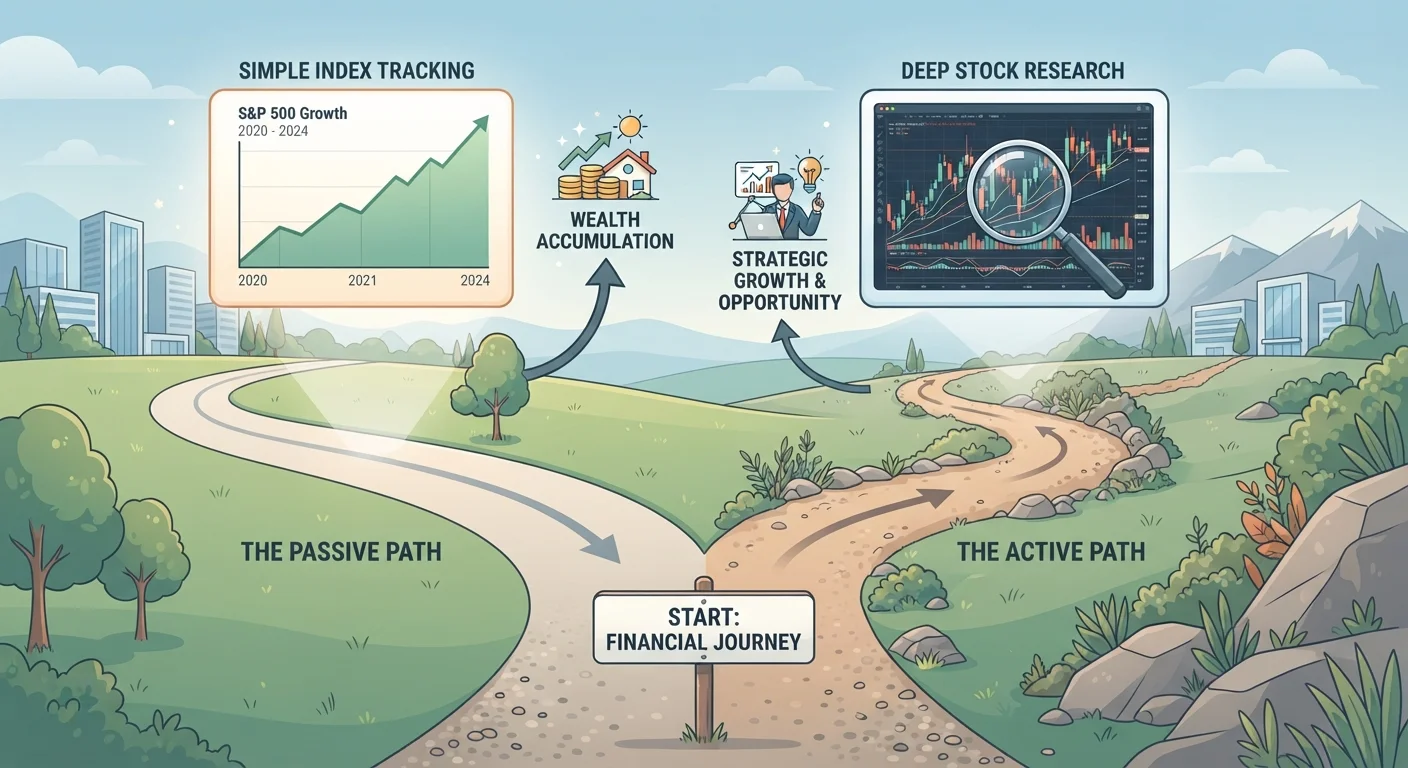
Key Takeaways
- Index funds track a market benchmark passively, while actively managed funds rely on professional managers to select investments.
- Index funds typically carry significantly lower fees, which can compound into major cost differences over decades.
- Research consistently shows most actively managed funds underperform their benchmark index over the long term.
- Actively managed funds may offer potential advantages in certain niche markets or during volatile periods.
- Neither fund type guarantees returns - all investing carries risk and past performance is not a predictor of future results.
Option A
Index Funds
The low-cost, hands-off approach to market participation.
Best for: Investors who want broad market exposure, minimal fees, and a straightforward long-term strategy.
Option B
Actively Managed Funds
The research-driven approach aimed at outperforming the market.
Best for: Investors who want a professional fund manager making tactical decisions on their behalf.
If you're a beginner seeking a simple, low-cost starting point
Index Funds
Index funds require no active decision-making and carry lower fees, making them an accessible entry point for those new to investing.
If you want professional oversight and are willing to pay higher fees for it
Actively Managed Funds
Actively managed funds give you access to experienced portfolio managers, though higher costs and no guarantee of outperformance are important considerations.
If minimising long-term investment costs is your top priority
Index Funds
The expense ratio gap between index and active funds can erode thousands of dollars in returns over a 20-30 year horizon.
If you're investing in a specialised or less efficient market segment
Actively Managed Funds
In less liquid or niche markets, skilled active managers may have a stronger case for adding value compared to broad-market index tracking.
What Sets These Two Approaches Apart
At their core, index funds and actively managed funds represent two philosophies about how markets work - and whether human judgment can reliably improve on them.
An index fund is designed to mirror the performance of a specific market benchmark - such as the S&P 500 or the total U.S. bond market. It holds the same securities as that index in roughly the same proportions, and changes only when the index itself changes. No manager is trying to pick winners or time the market. This is called passive investing.
An actively managed fund, by contrast, employs a portfolio manager (or a team) who researches, selects, and trades securities with the goal of beating a benchmark index. These managers use financial analysis, economic forecasts, and sector research to make ongoing decisions about what to buy, hold, or sell.
If you're new to the vocabulary here, our guide to key investing terms explains concepts like expense ratios and benchmarks in plain language.
| Criterion | Index Funds | Actively Managed Funds |
|---|---|---|
| Management style | Passive - mirrors an index | Active - manager selects holdings |
| Typical expense ratio | Under 0.20% annually | 0.50%-1.00%+ annually |
| Goal | Match benchmark returns | Beat benchmark returns |
| Trading frequency | Low - changes only with index | High - ongoing buy/sell decisions |
| Long-term performance vs. benchmark | Closely tracks benchmark | Majority underperform after fees |
| Complexity for the investor | Low - straightforward to understand | Higher - requires evaluating manager skill |
| Tax efficiency | Generally more tax-efficient | Lower - more taxable turnover events |
The Cost Difference: Why Fees Matter More Than You Might Think
One of the starkest differences between these two fund types is cost, measured by the expense ratio - the annual percentage of your investment that goes toward fund operating costs.
Index funds typically carry expense ratios well below 0.20%, with many broad-market options below 0.10%. Actively managed funds often charge 0.50% to over 1.00% annually. That gap may sound small, but compounded over decades, it can mean tens of thousands of dollars in reduced returns on a modest portfolio.
~0.05%
Typical index fund expense ratio
Many broad-market index funds now carry expense ratios at or below 0.05%, according to industry data from Morningstar.
Over 80%
Active U.S. equity funds underperforming over 15 years
The S&P SPIVA U.S. Scorecard has consistently found that more than 80% of actively managed large-cap U.S. equity funds trail the S&P 500 over a 15-year period after fees.
1%+
Annual fee drag from many active funds
A 1% annual fee difference, compounded over 30 years on a $50,000 portfolio, can reduce total value by more than $100,000 depending on return assumptions.
This matters because fees are one of the few investment variables entirely within your control. Market returns are uncertain; the cost you pay to access them is not. That's why cost transparency is a central principle for anyone learning to distinguish saving from investing.
Performance: What the Evidence Actually Shows
Supporters of active management argue that skilled managers can identify mispriced securities and navigate downturns more effectively than a passive strategy. The data, however, presents a consistent challenge to this claim.
The S&P Indices Versus Active (SPIVA) scorecard - a widely cited industry report - has repeatedly found that the majority of actively managed U.S. equity funds underperform their benchmark index over five-, ten-, and fifteen-year periods, after fees are accounted for. A small number of active funds do outperform, but identifying those funds in advance is difficult, and past outperformance does not reliably predict future results.
Active vs. Passive in Less Efficient Markets
The case for passive investing is strongest in large, well-researched markets like U.S. large-cap equities, where prices tend to reflect available information quickly. In smaller or international markets - where information gaps are larger - some research suggests active management may have a stronger opportunity to add value. This doesn't eliminate the fee and consistency concerns, but it does mean the comparison isn't identical across every market segment.
It's worth noting that active management may demonstrate more relative value in certain contexts: smaller-cap stocks, international emerging markets, or bond categories where information is less uniformly available. In these areas, the efficiency argument for passive investing is somewhat less clear-cut.
For a broader picture of what types of investments exist within and outside of funds, see our plain-language breakdown of common investment types.
Which Approach Fits Your Situation?
There is no universal answer. Your choice depends on your goals, timeline, risk tolerance, and how much complexity you want to manage.
For most beginning investors, index funds offer a clear structural advantage: lower costs, simplicity, and performance that keeps pace with the broader market. The Beginner's Map to the World of Investing can help you see how fund choices fit into the larger picture of building a portfolio.
Actively managed funds aren't inherently wrong choices - but they require scrutiny. Before investing in one, it's reasonable to ask: What is the fund's long-term track record relative to its benchmark? What is the expense ratio? Has the same management team been in place during that track record period?
Some investors combine both: using low-cost index funds as a portfolio core while allocating a smaller portion to active strategies in areas they believe managers may add value. This approach keeps overall costs manageable while leaving room for active exposure.
Whatever approach you consider, make sure your investment decisions fit within a broader financial plan. Understanding how your fixed and variable expenses work is a practical first step toward freeing up money to invest consistently.
This article is for general informational and educational purposes only and does not constitute personalised financial or investment advice. Past performance of any fund or strategy does not guarantee future results. Please consult a qualified, licensed financial adviser before making investment decisions based on your individual circumstances.