

Key Takeaways
- Parisians are not rude - a simple bonjour before any interaction goes a long way.
- The arrondissements spiral outward from the center; knowing this prevents wasted time navigating.
- Most of Paris's best eating and neighborhood life happens well away from major tourist corridors.
- The Eiffel Tower is farther from central Paris neighborhoods than first-timers often expect.
- French dining follows a distinct pace and structure that differs significantly from American expectations.
The Rude Parisian Myth - and What's Really Happening
No travel cliché is more persistent - or more misleading - than the supposedly cold, dismissive Parisian. First-time visitors often brace for hostility and interpret any reserved interaction as rudeness. What they're actually experiencing is a cultural register that values formality and ritual in daily transactions.
French social etiquette places real weight on greetings. Walking into a shop and immediately asking a question in English, without first offering a bonjour, genuinely reads as brusque to locals - not because Parisians dislike tourists, but because it skips a social step that French culture treats as fundamental. The fix is nearly effortless: a warm bonjour (or bonsoir in the evening) opens almost every door.
Myth
Parisians are unfriendly and actively unhelpful to tourists, especially Americans.
Fact
Parisians are generally willing to assist visitors who approach them with basic courtesy and some attempt at French etiquette.
The perception of Parisian coldness is largely a cultural mismatch rather than genuine hostility. French social norms prioritize formal acknowledgment before any transaction or request. A visitor who opens with Excusez-moi, bonjour - parlez-vous anglais? will typically find a very different response than one who launches directly into a question. Even a broken attempt at French is received warmly by most locals, who recognize and appreciate the effort.
Myth
You need to speak fluent French to get around Paris comfortably.
Fact
Basic French phrases, combined with patience and goodwill, are enough for most everyday interactions in Paris.
English is widely spoken in central Paris, particularly in hotels, major museums, and tourist-facing businesses. That said, making no attempt at French - even just merci, s'il vous plaît, and bonjour - does close off some warmth. Carrying a translation app as a backup, and approaching interactions without entitlement, smooths almost everything else.
Myth
The Eiffel Tower is a short walk from most central Paris attractions.
Fact
The Eiffel Tower is located in the 7th arrondissement and is a meaningful distance from neighborhoods like the Marais or Montmartre.
First-time visitors often build walking itineraries that treat Paris as though it were a compact historic city center. In reality, a walk from the Marais to the Eiffel Tower covers roughly four kilometers across distinct neighborhoods. The Métro covers this kind of distance in minutes. Over-relying on walking for cross-city movement is one of the most common reasons first-time visitors feel exhausted and frustrated by day two.
Myth
All Paris food is expensive, pretentious, and best suited to formal dining.
Fact
Paris has an exceptionally accessible everyday food culture - from bakeries and covered markets to affordable neighborhood bistros.
The idea of Paris as exclusively a white-tablecloth city ignores the boulangeries, street crêpe stands, Vietnamese restaurants in the 13th arrondissement, and bistronomie movement (a term for chefs who bring fine-dining technique to relaxed, affordable settings) that define everyday eating for most Parisians. Meals eaten near major landmarks tend to command premium prices; moving even two blocks off the tourist path typically changes both quality and cost.
Myth
The Louvre can reasonably be experienced in a single visit.
Fact
The Louvre is among the largest art museums in the world; a realistic visit covers a fraction of its collection.
The Louvre holds more than 35,000 works across multiple wings and floors. Visitors who arrive expecting to see the highlights - the Mona Lisa, the Venus de Milo, the Winged Victory - and then browse broadly often underestimate the sheer scale and leave exhausted. Museum professionals and seasoned travelers to Paris typically recommend choosing one or two wings or eras per visit, rather than attempting comprehensive coverage. Booking timed entry tickets in advance also helps avoid long queues at peak periods.
The Arrondissements, the Eiffel Tower, and the Geography of the City
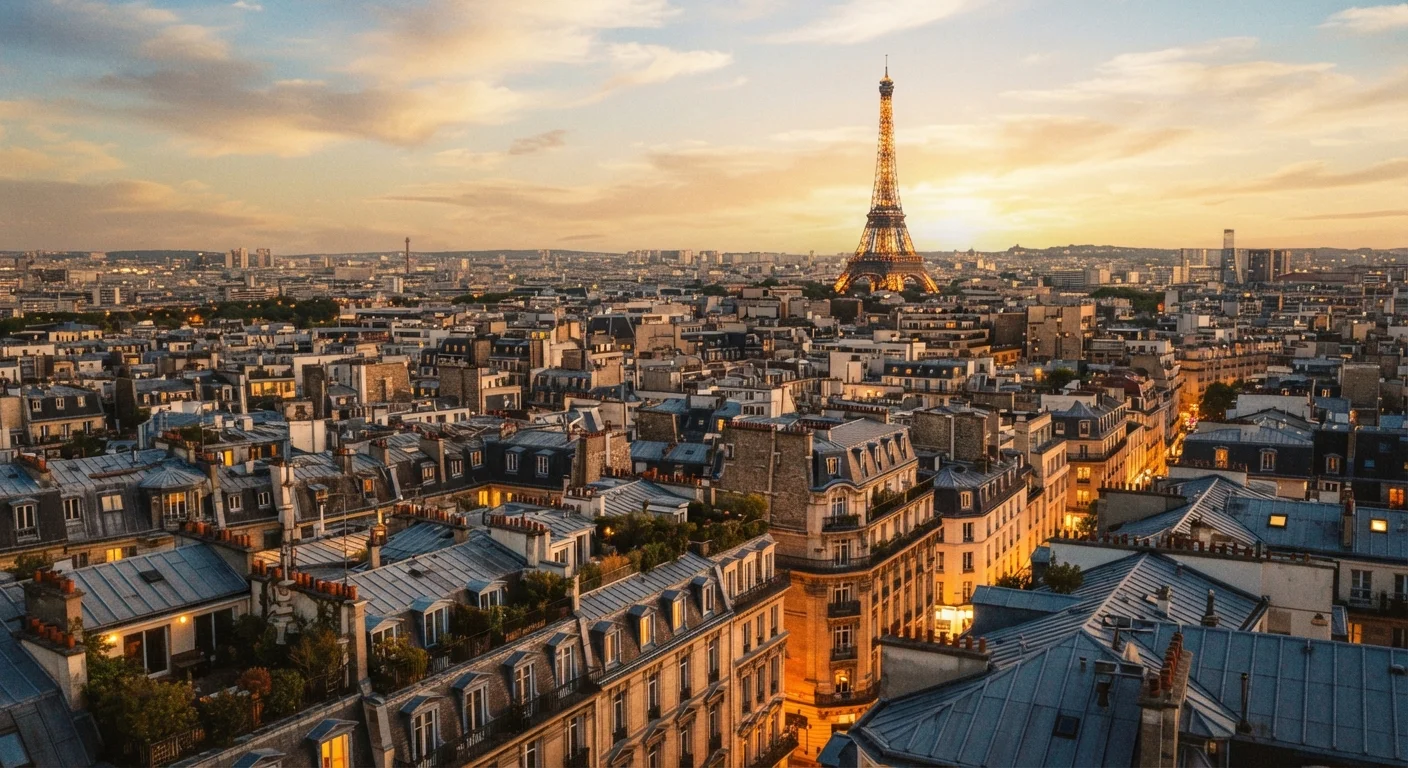
Paris's 20 arrondissements - its administrative districts - spiral clockwise outward from the 1st at the city's historic core. Many first-timers assume that famous landmarks cluster neatly together, but the city is larger and more spread out than it appears in iconic photographs. The Eiffel Tower sits in the 7th arrondissement, which is several neighborhoods removed from the Marais (3rd and 4th) or Montmartre (18th). Planning a day that hops between these areas on foot will exhaust most visitors.
The Paris Métro is one of the most extensive urban transit networks in the world, and learning to use it is genuinely one of the best decisions a first-time visitor can make. Taxis and rideshares exist, but in a city this well-served by rail and bus, surface traffic can slow ground travel considerably - especially near major attractions.
16 km
Diameter of Paris city proper
The city of Paris proper spans roughly 16 kilometers across, but its major landmarks are distributed across all 20 arrondissements, making transit planning essential.
302
Métro stations in central Paris
The Paris Métro operates 16 lines serving over 300 stations, making it one of the densest urban rail networks in the world for a city of its size.
Understanding the city's layout also means calibrating where to stay. The 1st and 4th arrondissements are convenient and historically rich, but they're also heavily touristed. The 11th, 9th, and parts of the 13th offer a more textured, local feel without sacrificing central access. If you're building a bigger trip, our introduction to planning a trip abroad covers the logistical groundwork - from accommodation choices to transit research - that applies directly here.
Food, Timing, and the Rhythm of Paris
Parisian food culture trips up visitors less through exotic unfamiliarity and more through timing. French restaurants typically serve lunch between noon and 2:30 p.m. and dinner from roughly 7:30 p.m. onward. Arriving at 3 p.m. hungry and expecting a full sit-down meal will often be met with a politely closed kitchen. Many visitors interpret this as unwelcoming service - it's simply a different schedule.
Don't Assume Kitchens Stay Open All Day
In Paris, most traditional restaurants close their kitchens between roughly 2:30 p.m. and 7:00 p.m. Showing up mid-afternoon expecting a full meal is a common source of visitor frustration. Plan lunch before 2 p.m. and dinner after 7:30 p.m. to align with local rhythm. Brasseries and cafés often bridge the gap with lighter fare during off-hours.
The idea that Parisian food is inaccessible, expensive, or always intimidating also deserves scrutiny. A neighborhood boulangerie (bakery) at lunch, a brasserie set menu, or a covered market like the Marché d'Aligre in the 12th arrondissement offer genuinely excellent food at modest prices. The tourist trap tendency is real - restaurants immediately adjacent to the Louvre or Notre-Dame cathedral area often charge significantly more for noticeably less - but it's avoidable with minimal planning.
First-time travelers to Paris sometimes compare the experience unfavorably to cities like New York. The comparison is worth flipping: Paris rewards slowing down. For a useful counterpoint on managing the intensity of another iconic first-timer city, see our guide to navigating New York City for the first time. The two cities ask very different things of their visitors - and Paris, specifically, asks for patience and presence.