

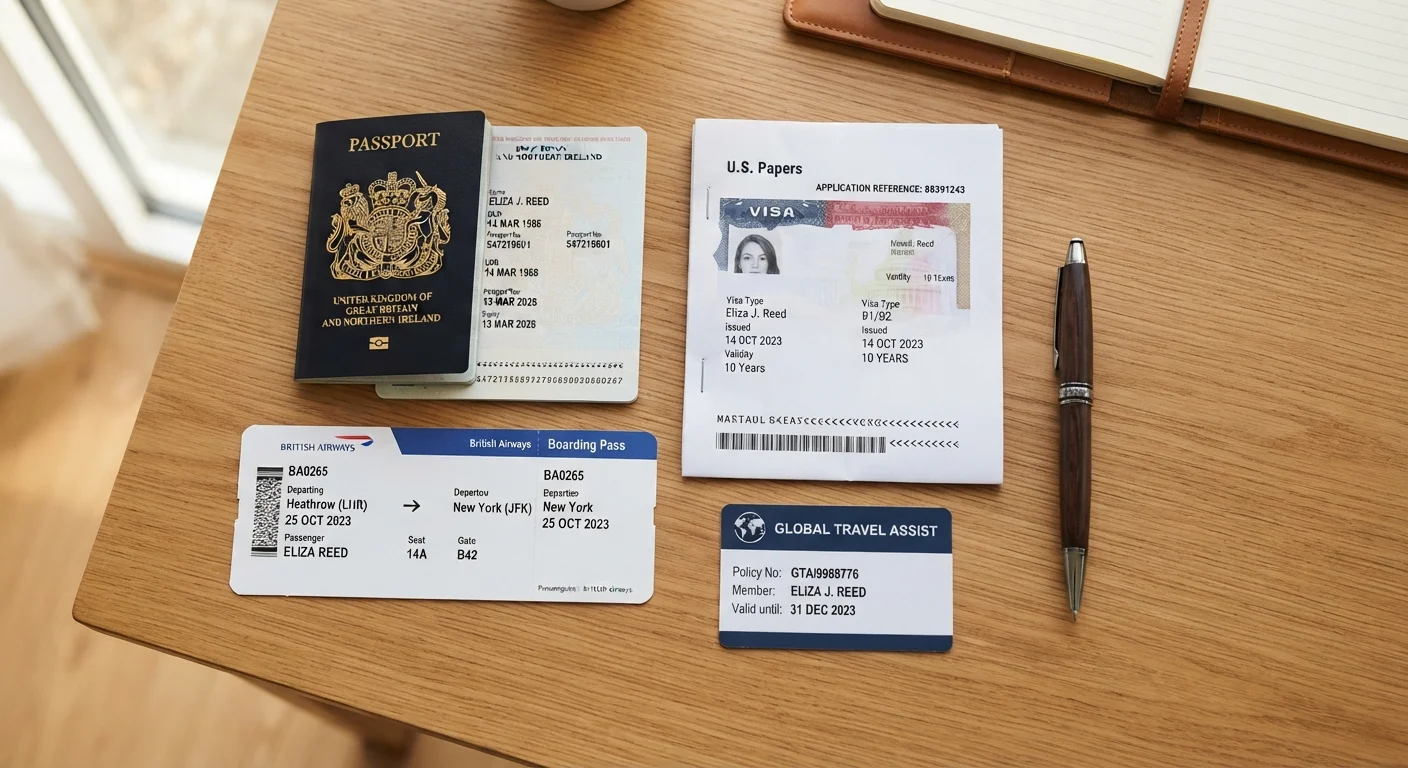
| Passport validity cushion | At least 6 months beyond return date (US Department of State) |
| Visa check source | Destination country embassy + US State Dept. |
| Emergency document copies | 1 printed + 1 emailed to yourself |
| Vaccination record format | CDC yellow booklet (ICVP) (Centers for Disease Control and Prevention) |
| IDP required in many countries | Yes, alongside US driver's license |
The Core Documents: What You Cannot Leave Without
Every international trip begins and ends at the same checkpoint: your identity and authorization to travel. These foundational documents aren't optional-missing any one of them can mean being turned away at the airport or denied entry at a foreign border.
| Passport validity cushion | At least 6 months beyond return date (US Department of State) |
| Visa check source | Destination country embassy + US State Dept. |
| Emergency document copies | 1 printed + 1 emailed to yourself |
| Vaccination record format | CDC yellow booklet (ICVP) (Centers for Disease Control and Prevention) |
| IDP required in many countries | Yes, alongside US driver's license |
Passport
Your passport is your primary identity document abroad. Most countries require at least six months of validity beyond your planned return date-a rule that catches many travelers off guard. If your passport expires within that window, renew it well before booking anything. Keep a photocopy of the photo page stored separately from the original, and email a scan to yourself as a digital backup.
Visa or Entry Authorization
Whether you need a visa depends on your nationality and destination. Some countries grant US citizens visa-free access for short stays; others require advance applications that can take weeks. Electronic travel authorizations (such as the ETIAS system planned for European travel) occupy a middle ground-quicker than a full visa but still a required step. Always verify current entry requirements through official government sources, as rules can change. The US Department of State's travel website and your destination country's embassy page are reliable starting points.
Return or Onward Travel Proof
Immigration officers in many countries will ask for evidence that you plan to leave. A printed or digital copy of your return flight-or a confirmed onward ticket to your next destination-satisfies this requirement. This is especially relevant for travelers on one-way outbound tickets.
For a broader view of what goes into preparing for an international trip, see our First-Time Traveler's Introduction to Planning a Trip Abroad.
Health, Insurance, and Emergency Documents
Unexpected illness or injury abroad can escalate quickly without the right paperwork on hand. This category of documents protects your health decisions and your finances when things go sideways.
Electronic Travel Authorization (ETA)
A pre-approval system that allows travelers to enter certain countries without a full visa. It is typically obtained online before departure and linked electronically to your passport.
International Driving Permit (IDP)
An official document that translates your domestic driver's license into multiple languages, required for renting or driving a vehicle in many countries outside the US.
ICVP (Yellow Card)
The International Certificate of Vaccination or Prophylaxis, a standardized document issued by health authorities to record travel vaccinations such as yellow fever.
Onward Ticket
Proof of a confirmed flight or transport booking leaving the destination country, used to demonstrate to immigration officials that a traveler does not intend to overstay their permitted entry period.
Trip Interruption Insurance
A type of travel insurance that reimburses non-refundable trip costs if you must cut a trip short due to covered reasons, such as a medical emergency or natural disaster.
Travel Health Insurance Card or Policy Summary
Print a one-page summary of your travel insurance policy that includes the policy number, emergency contact line, and coverage limits. Many travelers purchase coverage but cannot access their documents when it matters most-particularly in destinations with limited connectivity. If your domestic health insurance includes any international coverage, carry that card too, though most US plans offer little or no protection outside the country.
Prescription Medication Documentation
Travelers carrying prescription medications should bring a copy of the original prescription or a letter from their prescribing physician. This is particularly important for controlled substances, injectable medications, or quantities that exceed typical personal-use thresholds. Some countries require advance approval for certain medications. Verify destination-specific rules through the embassy or a travel health clinic before you depart.
Vaccination Records
Several countries require proof of specific vaccinations-yellow fever certificates are among the most commonly required. The CDC's yellow booklet (formally the International Certificate of Vaccination or Prophylaxis) is widely recognized. Even where not officially required, vaccination documentation helps at border health screenings and medical facilities if you need care abroad.
Emergency Contact Sheet
A simple printed sheet listing your emergency contacts, blood type, known allergies, and insurance details gives first responders or local medical staff crucial information if you're unable to speak for yourself. Keep one in your travel wallet and leave a copy with someone at home. Our pre-departure checklist covers this and other easy-to-miss preparations.
Note: This article provides general travel information only. For personal medical guidance, consult a qualified healthcare professional before traveling.
Financial and Logistical Documents Worth Printing
Digital documents are convenient until your phone battery dies, you lose connectivity, or a customs officer asks for paper. The travelers who move most smoothly through international checkpoints tend to carry both formats.
Store Copies in Multiple Places
Experienced international travelers typically keep one set of document copies in their carry-on bag, a second set in checked luggage, and a third stored digitally in a secure cloud folder or email draft. If your bag is lost or your wallet stolen, having accessible backups can make the difference between a manageable setback and a trip-ending crisis. Verify that digital copies are accessible offline or in low-connectivity environments.
Accommodation Confirmations
Border agents and customs forms often ask for your address in the destination country. A printed confirmation email from your hotel or rental host satisfies this instantly and removes any ambiguity at the entry desk.
Trip Insurance and Cancellation Policy Summaries
Beyond health coverage, trip cancellation and interruption insurance documentation tells you exactly what events qualify for reimbursement and how to file a claim. Keep the emergency claim number accessible-not buried in a PDF you'd have to hunt for during a crisis.
Currency and Banking Notes
While not a formal document, a brief printed note of your bank's international contact number and your account alert settings is worth tucking into your travel wallet. If a card is flagged or lost abroad, you'll want that number without relying on an internet search. Planning your travel budget thoroughly ahead of time also helps-see The Anatomy of a Travel Budget for a breakdown of where travel costs actually accumulate.
Copies of Your Driver's License and International Driving Permit
If you plan to rent a vehicle, many countries require an International Driving Permit (IDP) alongside your US license. The IDP is a translated version of your license issued through authorized US automobile associations. Carry both originals and photocopies, and store them separately in case one set is lost or stolen. Once your documents are organized, pairing them with a well-structured itinerary helps the whole trip come together-explore what a travel itinerary should actually include for guidance on that next step.