

Key Takeaways
- Flights and lodging are just the starting point - food, local transport, and activities often rival them in total cost.
- Hidden expenses like travel insurance, entry fees, and currency exchange fees are among the most commonly underestimated.
- A contingency buffer of 10-15% of your total estimated budget helps absorb unexpected costs.
- Knowing your cost categories in advance makes it easier to make trade-offs without overspending.
- Group travel introduces extra financial complexity that benefits from a shared cost framework.
Travel Budget
A travel budget is a structured estimate of every expense you expect to incur on a trip, organized by category - transportation, lodging, food, activities, and miscellaneous costs. It helps travelers understand how much a trip will actually cost before they commit, and gives them a framework for tracking spending while on the road. A good travel budget goes beyond the obvious big-ticket items to capture the smaller, recurring costs that quietly erode a traveler's funds.
In personal finance, a travel budget functions as a project-based spending plan - distinct from a monthly household budget - with a defined start date, end date, and cost categories unique to travel.
Why Most Travel Budgets Fall Short
Most travelers build their budgets the same way: find a flight price, find a hotel rate, multiply by the number of nights, and call it a plan. That approach almost always results in sticker shock at the end of the trip - or worse, mid-trip decisions to cut corners on things that matter.
The honest reality is that flights and accommodation are just the anchor costs. Everything that happens between checking in and checking out - meals, museum tickets, taxis, Wi-Fi, a spontaneous boat tour - forms a second, largely invisible budget that most people haven't mapped. Understanding the full anatomy of travel spending is the first step toward trips that feel financially comfortable rather than quietly stressful.
For travelers building their first structured plan, it's also worth reading what a travel itinerary should actually include - because the two documents, budget and itinerary, are more connected than they appear.
~30%
Of trip budget typically spent on food and drink
Travel budgeting frameworks from consumer finance researchers commonly estimate food and drink at roughly a quarter to a third of a traveler's total trip spend.
10-15%
Recommended contingency buffer on any trip budget
Personal finance educators and travel planners broadly recommend reserving 10-15% of estimated total trip cost to absorb unplanned expenses.
$50-$200+
Typical daily spending range by destination type
Daily all-in travel costs (food, local transport, activities) vary widely - from budget-friendly destinations in Southeast Asia to major European capitals.
The Core Cost Categories, Explained
Transportation to and from your destination is typically the largest single line item. For international trips, this means flights; for domestic travel, it might mean gas, train tickets, or bus fares. This category also includes airport transfers - a detail that surprises travelers who forget that getting from the airport to the city center can cost $40-$80 or more depending on the destination.
Lodging is the second anchor cost. Nightly rates vary enormously by destination, season, and accommodation type, so this figure requires real research rather than rough guessing. Don't forget to factor in city or tourist taxes, which some destinations add as a nightly surcharge.
Food and drink is where budgets most frequently go sideways. A conservative daily food budget for a moderate destination might look manageable on paper, but three restaurant meals a day - plus coffee, snacks, and the occasional craft beer - compound fast. Building a realistic daily food figure, based on researched local prices rather than assumptions, is one of the most valuable things a traveler can do.
Local transportation - metro cards, taxis, rideshare apps, day rental bikes, or ferries between islands - forms its own mini-budget within the trip. In cities with efficient public transit, this can be modest. In destinations where taxis are the primary option, it can be surprisingly significant.
Activities, experiences, and entry fees deserve their own line. Museum admissions, guided tours, national park passes, cooking classes, or a single opera ticket can individually run $30-$150. List the experiences you genuinely want and price them out; this category often holds the most pleasant surprises and the most painful ones.
The Hidden Costs That Derail Budgets
Beyond the core categories lies a cluster of expenses that don't appear in any booking confirmation but reliably show up on the credit card statement. These are the costs that separate experienced travelers from first-timers - not because first-timers are careless, but because no one told them to look.
Currency exchange and foreign transaction fees can quietly claim 2-3% of every purchase made abroad. Baggage fees for checked luggage, once free on most carriers, are now standard add-ons priced separately from the base fare. Visa application fees for international destinations vary from nominal to several hundred dollars. Travel gear - a new daypack, travel-size toiletries, a universal adapter - often gets purchased in the week before departure when attention is elsewhere.
Perhaps the most underestimated hidden cost is simply the time and money spent on travel days themselves: terminal meals, lounge access, a book or magazine, incidentals at the hotel check-in. These aren't large individually, but across a long trip they form a meaningful tail on the expense report.
Travel insurance occupies a category of its own. It's not a hidden cost in the sense of being invisible - it's simply one many travelers consciously skip. For international trips in particular, medical coverage and trip cancellation protection represent meaningful financial risk management. Whether it's appropriate for your situation is a personal decision best made with full information rather than impulse.
Build Your Budget in a Simple Spreadsheet
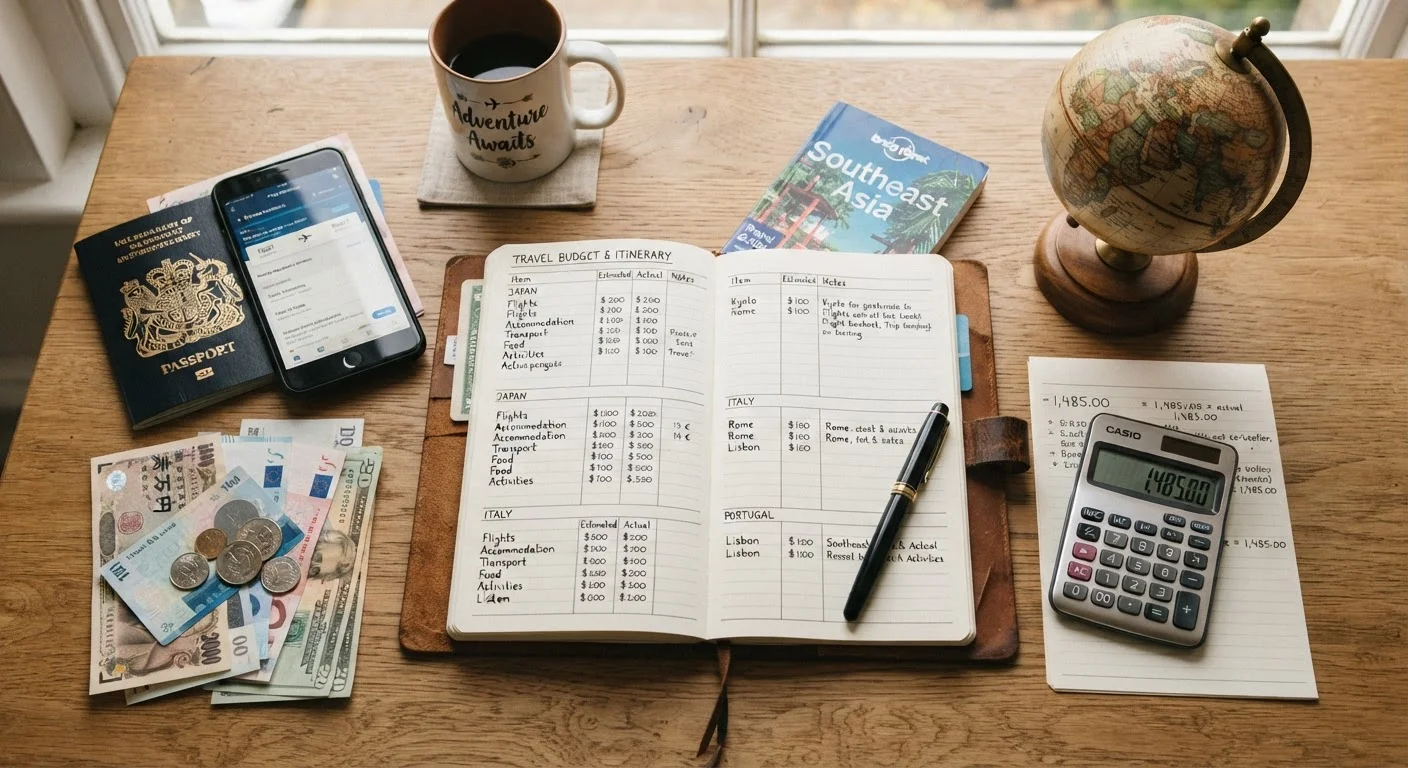
Create one row per cost category and fill in both a researched estimate and the actual amount spent. Even a basic two-column structure makes it immediately obvious where your assumptions were off - and helps you calibrate more accurately for the next trip. Review it once at the trip's midpoint while you can still adjust.
The things travelers forget to plan for extends beyond budget into logistics, but the financial gaps it surfaces are worth folding into your cost estimate before departure.
Building a Budget That Holds
The goal of a travel budget isn't to restrict spending - it's to make conscious trade-offs. When you know your full cost picture, you can choose to stay somewhere simpler in order to do more meaningful things. Or splurge on accommodation in a city where a well-located hotel genuinely changes the experience, then offset that cost elsewhere.
A practical structure is to build the budget in two passes. First pass: fill in every known or researchable cost. Second pass: apply a 10-15% contingency buffer across the total. That buffer isn't pessimism - it's acknowledgment that travel involves variables no spreadsheet fully captures.
For group trips, an honest conversation about budget expectations before booking anything is essential. Misaligned assumptions about what the group will spend are a reliable source of tension. Our guide to splitting costs fairly on a group trip offers concrete frameworks for navigating shared expenses without friction.
If you're also planning the paperwork side of an international trip, organizing your documents early frees up mental bandwidth for the budget work. See documents every international traveler should organize before departure for a useful pre-departure checklist.
“A budget is telling your money where to go instead of wondering where it went. The same principle applies to travel - the travelers who feel most free on a trip are often the ones who did the most planning before it.”
— Dave Ramsey, Personal finance author and radio host