

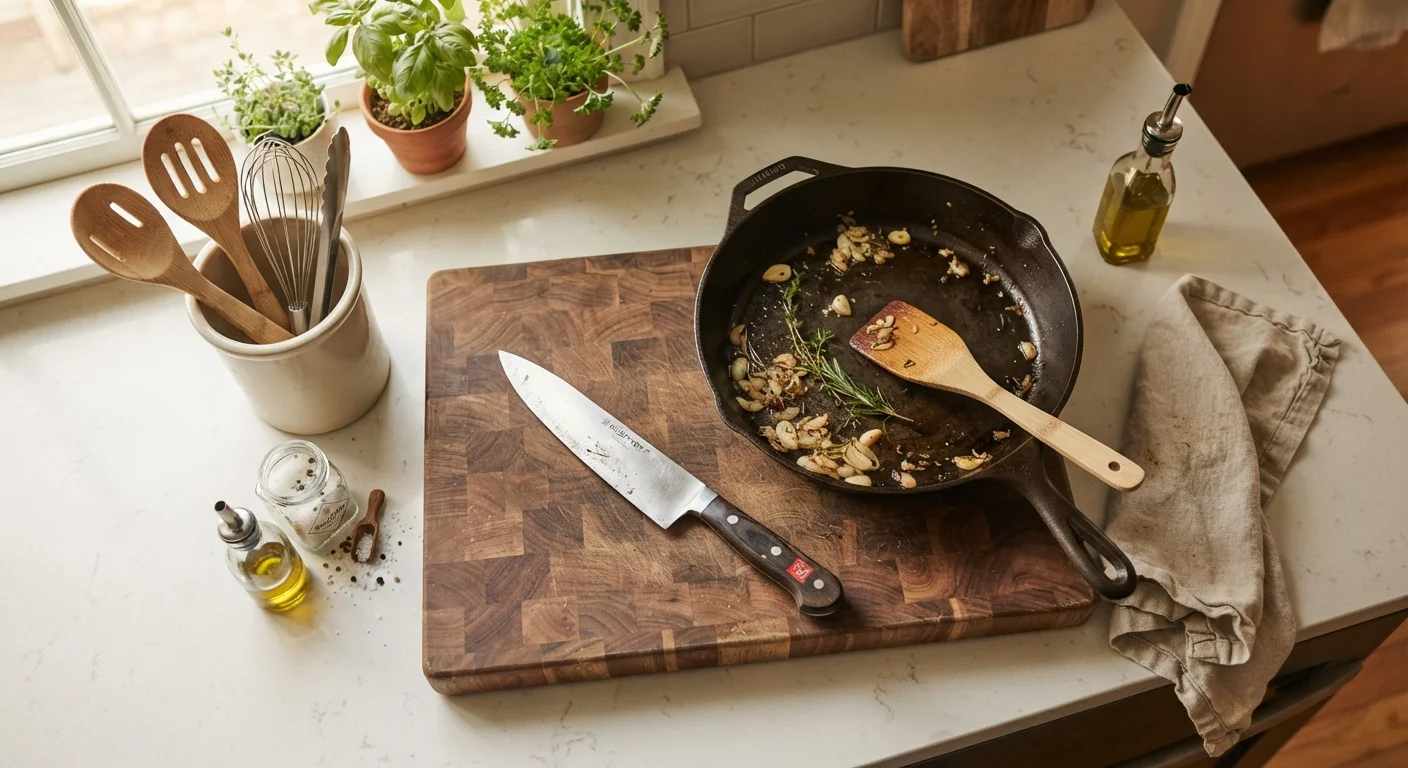
Key Takeaways
- Mastering a few core tools consistently produces better results than owning many rarely used gadgets.
- A quality chef's knife, a sturdy skillet, and a few versatile basics cover the vast majority of everyday cooking tasks.
- Understanding what each tool does well helps you cook more confidently and waste less time troubleshooting.
- Spending time with fewer tools builds intuition that no appliance can replicate.
Why fewer tools actually make you a better cook
Walk into any well-equipped kitchen store and it's easy to leave with a spiralizer, an avocado slicer, and a electric egg cooker - none of which you truly needed. The reality of everyday cooking is that a small handful of versatile tools does the heavy lifting for the vast majority of meals. When you spread your attention across too many gadgets, you never fully understand what any of them can do.
The home cooks who seem effortlessly capable aren't usually the ones with the most equipment. They're the ones who have spent real time with the basics - who know how their skillet behaves, how their knife moves, and how to adapt on the fly. That kind of intuition only builds through repetition with a limited set of tools. Reading a recipe the way experienced cooks do is a related skill that pairs naturally with this equipment-first mindset.
Quality Matters More Than Quantity
You don't need to invest in an expensive kitchen to cook well. What matters is choosing fewer tools and understanding them properly. A single well-maintained chef's knife, used confidently, will outperform a block of unused specialty knives every time. Focus on getting comfortable with what you have before expanding your collection.
The core tools - and what makes each one worth your time
A reliable chef's knife
If there's one tool worth understanding deeply, it's a well-balanced chef's knife - typically 8 inches long. It handles roughly 80% of kitchen prep: chopping vegetables, slicing proteins, mincing garlic, and breaking down herbs. The key isn't owning a premium blade; it's knowing how to hold it correctly, keep it sharp, and use a rocking motion rather than forcing cuts. A dull knife is both inefficient and genuinely more dangerous than a sharp one, because dull edges require more force and are prone to slipping. Foundational knife techniques make every session faster and more enjoyable.
A sharp chef's knife handles 80% of kitchen prep - technique matters more than price.
A heavy-bottomed skillet
Cast iron or stainless steel - both reward patience and proper heat management. A 10- or 12-inch skillet gives you room to sear, sauté, pan-fry, and even finish dishes in the oven. The most common beginner mistake is not letting the pan heat up before adding food, which leads to sticking and uneven browning. Once you understand how your skillet retains and distributes heat, you'll stop second-guessing every recipe that asks you to get a good sear. It's also one of the most durable purchases you'll ever make in a kitchen.
Proper heat management in a skillet is a skill that transforms everyday cooking.
A wooden spoon or silicone spatula
Simple as they sound, these are the tools you reach for constantly - stirring, scraping, folding, deglazing. A wooden spoon won't scratch cookware, won't melt, and gives you tactile feedback as you stir. A silicone spatula is flexible enough to get into bowl corners and sturdy enough to fold batters. Most home cooks underestimate how much control comes from simply choosing the right stirring tool for the task. Keep one of each near the stove and you'll naturally start using them more deliberately.
The right stirring tool gives you more control than most cooks realize.
A medium saucepan
A 2- to 3-quart saucepan with a lid is the workhorse for grains, sauces, soups, blanching vegetables, and reheating nearly anything. Learning to control liquid-to-ingredient ratios and how different heat levels affect simmering versus boiling opens up enormous range in your cooking. This is the tool that teaches heat control on a smaller, more forgiving scale than a large stockpot. Pair it with a well-stocked pantry and weeknight meals become dramatically easier to improvise.
A saucepan teaches heat control in ways no other piece of cookware quite matches.
A cutting board that actually stays put
A cutting board that slides around while you're chopping is a safety hazard and a frustration. A large, sturdy wooden or composite board - placed on a damp towel to keep it from shifting - creates a stable, generous prep surface. Size matters more than most beginners expect: a too-small board means food falls off, prep slows down, and you end up making more work for yourself. Think of the cutting board less as passive surface and more as the base of your whole prep station. Setting up your prep area before you start is one of the habits that quietly separates confident cooks from frustrated ones.
A stable, generously sized cutting board is the foundation of efficient prep work.
A box grater or microplane
Fresh zest, finely grated hard cheeses, and grated vegetables transform flavors in ways that pre-packaged alternatives simply don't replicate. A box grater gives you multiple textures - fine, medium, coarse - for everything from shredding mozzarella to grating potato for latkes. A microplane is even more precise, ideal for citrus zest, ginger, or Parmesan over pasta. Both tools are inexpensive, easy to store, and expand your flavor vocabulary considerably. Once you start adding fresh lemon zest to a weeknight pasta, it's hard to go back.
Fresh zest and grated cheese elevate dishes in ways few other techniques can match.
Practice One Tool at a Time
When you're building kitchen confidence, resist the urge to use every gadget at once. Pick one tool - say, the skillet - and cook five different things with it over a week. You'll develop instincts for heat, timing, and texture that no recipe instruction can fully convey. That kind of hands-on repetition is where real skill lives.
Building skill, not just adding stuff
Mastering these tools isn't about perfection - it's about building enough familiarity that cooking feels less like following instructions and more like making decisions. When you know your skillet runs hot, or that your knife needs more frequent honing, you stop blaming the recipe and start trusting your own judgment. That's what confidence in the kitchen actually feels like.
The habit of tasting as you cook pairs especially well with tool mastery - because both practices are about paying attention rather than just following steps. Together, they move you from uncertain beginner to someone who actually enjoys the process. Start with what you have, use it often, and let the skill build naturally from there.