

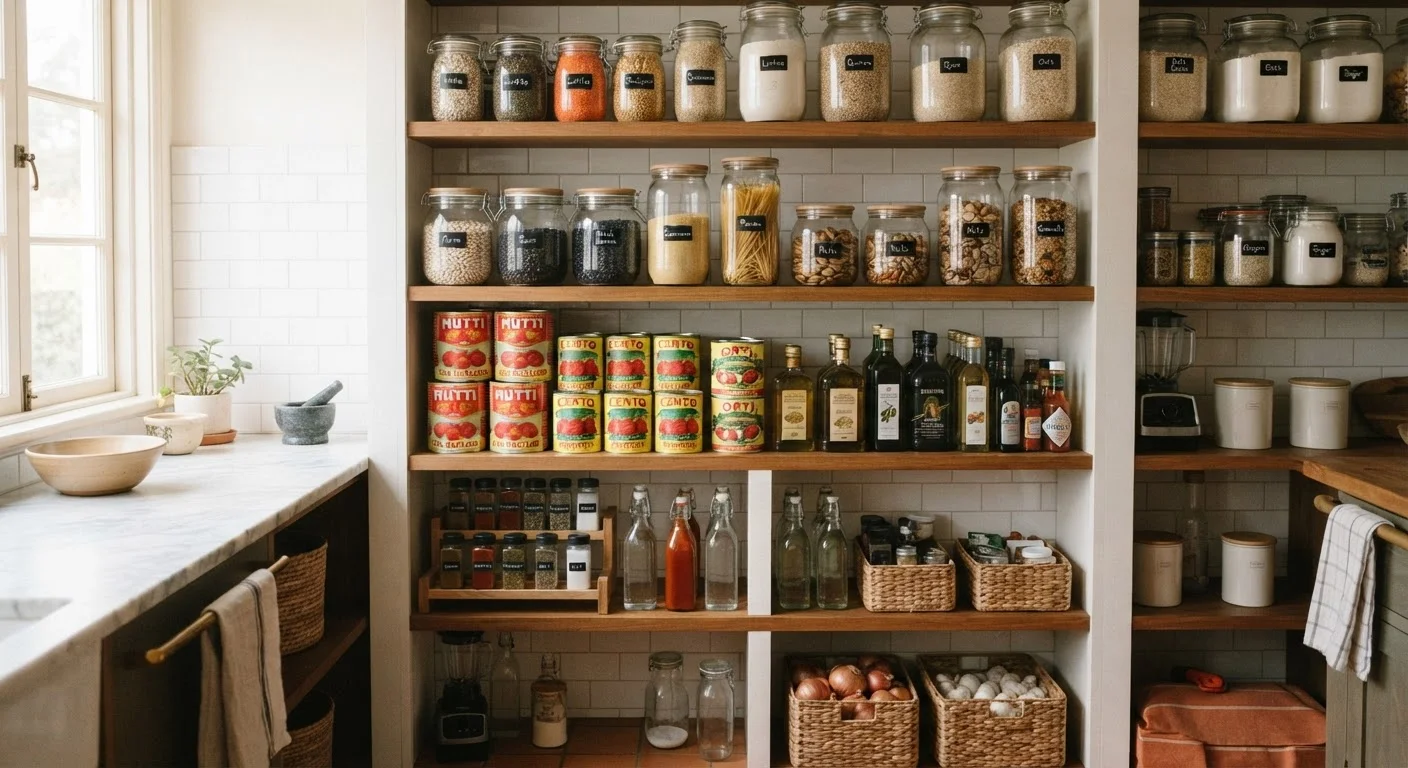
Key Takeaways
- A small collection of versatile pantry staples can cover the majority of everyday recipes.
- Canned, dried, and shelf-stable ingredients reduce reliance on last-minute grocery runs.
- Layering pantry staples - acids, fats, aromatics, and proteins - builds flavor without much effort.
- Stocking smarter, not bigger, gives beginners a reliable foundation for confident cooking.
Why Your Pantry Does Most of the Heavy Lifting
Ask any experienced home cook what separates stressful weeknight dinners from easy ones, and the answer usually comes back to what's already on the shelf. A thoughtfully stocked pantry doesn't mean a cluttered one - it means keeping a handful of high-leverage, multi-use ingredients that show up reliably across dozens of recipes.
If you're still building your kitchen confidence, pairing a smart pantry with good prep habits makes a real difference. The mise en place approach - having everything organized before you start - works even better when your shelves are already set up to support you.
The staples below aren't about stocking everything. They're about stocking the right things: ingredients that cross cuisines, combine easily, and reduce the gap between an empty-looking fridge and a satisfying dinner.
Canned whole tomatoes
Few ingredients punch above their weight the way canned whole tomatoes do. They form the backbone of pasta sauces, braises, soups, shakshuka, and chili - practically any dish that wants body and a gentle acidity. San Marzano-style tomatoes are widely praised for sweetness and low seeds, but any good-quality whole canned tomato works beautifully. Crush them by hand straight into the pan for a rustic sauce, or blend them smooth for something more refined. A couple of cans on the shelf means dinner is never more than 20 minutes away.
Canned whole tomatoes are the backbone of sauces, soups, braises, and so much more.
Dried lentils and canned beans
Protein doesn't have to come from the refrigerator. Canned chickpeas, black beans, and cannellini beans are ready to use straight from the can - rinse them and they go into salads, tacos, stews, or a quick pan sauté with garlic and olive oil. Dried lentils are even more flexible: they cook in about 20 minutes without soaking, making them the fastest legume in the pantry. Both are inexpensive, shelf-stable for long periods, and rich in fiber and plant-based protein - a sensible addition to any eating pattern, as nutrition guidelines broadly support increasing legume intake.
Dried lentils cook in 20 minutes with no soaking - they're the fastest protein in your pantry.
Extra-virgin olive oil and a neutral oil
Fat is flavor, and keeping two oils on hand covers every situation. Extra-virgin olive oil brings fruitiness and depth to dressings, finishing drizzles, and lower-heat sautés. A neutral oil - such as avocado or canola - handles high-heat cooking without smoking or competing with other flavors. Together, they cover roasting, stir-frying, baking, and salad dressing. Storing oils away from heat and direct sunlight helps preserve their quality longer.
Two oils - one robust, one neutral - handle every cooking scenario from dressings to high-heat searing.
Garlic and onions
Aromatics are the starting point for most savory cooking. Garlic and onions (along with shallots, if you like) build the flavor base for virtually every cuisine in the world. They're inexpensive, store well at room temperature for weeks, and can transform a bland dish into something deeply savory just by being sautéed in a little oil first. Learning to start nearly every dish this way - the "soffritto" principle used across Italian and Spanish kitchens - is one of the most transferable habits a beginner can build.
Sautéing garlic and onion first is one of the most transferable flavor habits in all of cooking.
A solid acid: vinegar and/or citrus juice
Acid brightens food. A dish that tastes flat or muddy almost always improves with a squeeze of lemon or a small splash of vinegar - it's the adjustment professional cooks make constantly. Keep red wine vinegar, apple cider vinegar, or white wine vinegar on the shelf, and try to have lemons or limes accessible too. They show up in dressings, marinades, finishing sauces, and even baked goods. Understanding how acid balances richness is a small shift in thinking that pays off across every kind of cooking.
Acid - vinegar or citrus - is the simplest fix for a dish that tastes flat or one-dimensional.
Grains: rice, pasta, and one whole grain
Grains provide the neutral, filling base that makes a collection of pantry flavors into an actual meal. White rice and dried pasta are the most universal - they pair with almost anything. Adding one whole grain, such as farro, quinoa, or barley, introduces more texture and nutritional variety. Whole grains take a little longer to cook, but they hold up well in grain bowls, soups, and salads, and a large batch keeps in the refrigerator for several days of easy meals.
White rice, pasta, and one whole grain give you a neutral base that pairs with almost any flavor.
A spice core: cumin, smoked paprika, and red pepper flakes
You don't need a wall of spices to cook interesting food - you need the right few. Cumin is earthy and warm, used across Mexican, Middle Eastern, and South Asian cooking. Smoked paprika adds depth and a subtle campfire quality that works in roasted vegetables, eggs, and rice dishes. Red pepper flakes bring adjustable heat to pasta, pizza, and stir-fries. These three, alongside kosher salt and black pepper, cover a remarkably wide range of flavor directions and make it easy to vary the feel of a dish without changing the core ingredients.
Cumin, smoked paprika, and red pepper flakes cover more flavor directions than an entire shelf of single-use spices.
Building Meals From What You Have
Once these staples are in place, the mental load of weeknight cooking drops noticeably. Canned tomatoes plus lentils plus garlic and a handful of spices is already a hearty soup. Rice plus beans plus acid and olive oil is a quick grain bowl. The combinations multiply quickly.
Pantry Size Isn't the Goal
A large pantry stocked with rarely used items often leads to waste and confusion at mealtime. The aim isn't volume - it's versatility. Ingredients that appear across multiple cuisines and techniques give you far more cooking range than specialty items used once or twice. Start with this core list and add only as you identify a genuine cooking need.
Rotate What You Buy
When restocking, place new cans and bags behind older ones so you use the oldest items first. Check expiration dates on spices every six months - ground spices lose their punch after about a year, so smell-testing before cooking is a simple habit worth building. A well-rotated pantry wastes less and actually tastes better.
For beginners who want to keep building, it helps to understand what trips people up in the kitchen too - why recipes fail usually traces back to a few fixable habits. And when you're ready to invest in the tools that work alongside these ingredients, mastering a few core kitchen tools is a natural next step. A well-stocked pantry and a well-chosen set of tools together give you the kind of cooking freedom that makes the whole process feel less like a chore and more like something you actually want to do.