

Key Takeaways
- Your home layout influences behavior more reliably than motivation or willpower alone.
- Making healthy choices the default - not the effort - is the core principle behind environmental design.
- Small physical changes, like where you place food or your phone, can shift long-standing habits.
- Clutter, lighting, and room organization all carry measurable effects on stress and decision-making.
- Sustainable routines are easier to build when your space actively supports them.
Environmental Design for Habits
Environmental design for habits is the practice of arranging your physical surroundings so that healthy or desired behaviors become the easiest, most natural option. Rather than relying on motivation or self-discipline alone, it works by reducing friction for good choices and increasing friction for less helpful ones. In short, your environment acts as a silent architect of your daily routine.
Behavioral scientists sometimes call this approach 'choice architecture' - structuring the decision landscape so that default options align with a person's goals without requiring active deliberation every time.
Why Willpower Alone Is an Unreliable Strategy
Most of us have been told, at some point, that changing habits is a matter of wanting it badly enough. But behavioral science paints a more nuanced picture. Willpower is a finite resource - it fluctuates with sleep, stress, hunger, and the sheer number of decisions you've already made in a day. Relying on it as your primary tool sets up a cycle of effort and exhaustion.
What researchers have found instead is that the environment surrounding a person often determines behavior more consistently than internal motivation does. Your kitchen, your bedroom, your living room - each one sends constant, quiet signals that steer your choices before you've consciously weighed them. Understanding how habit loops form helps explain why these environmental cues are so powerful: cues trigger routines almost automatically, bypassing active deliberation.
Start With One Room, One Change
Environmental redesign doesn't need to be an all-or-nothing project. Identify the single room where you make the most repeated daily decisions - usually the kitchen - and make one physical change that makes your desired behavior easier. Let that adjustment settle for a week before adding another.
The Science of Friction and Defaults
The concept is sometimes called choice architecture - the idea that whoever designs a space, menu, or system shapes the decisions made within it. Applied to your home, it means that where you store things, what's visible, and what requires effort all function as invisible nudges.
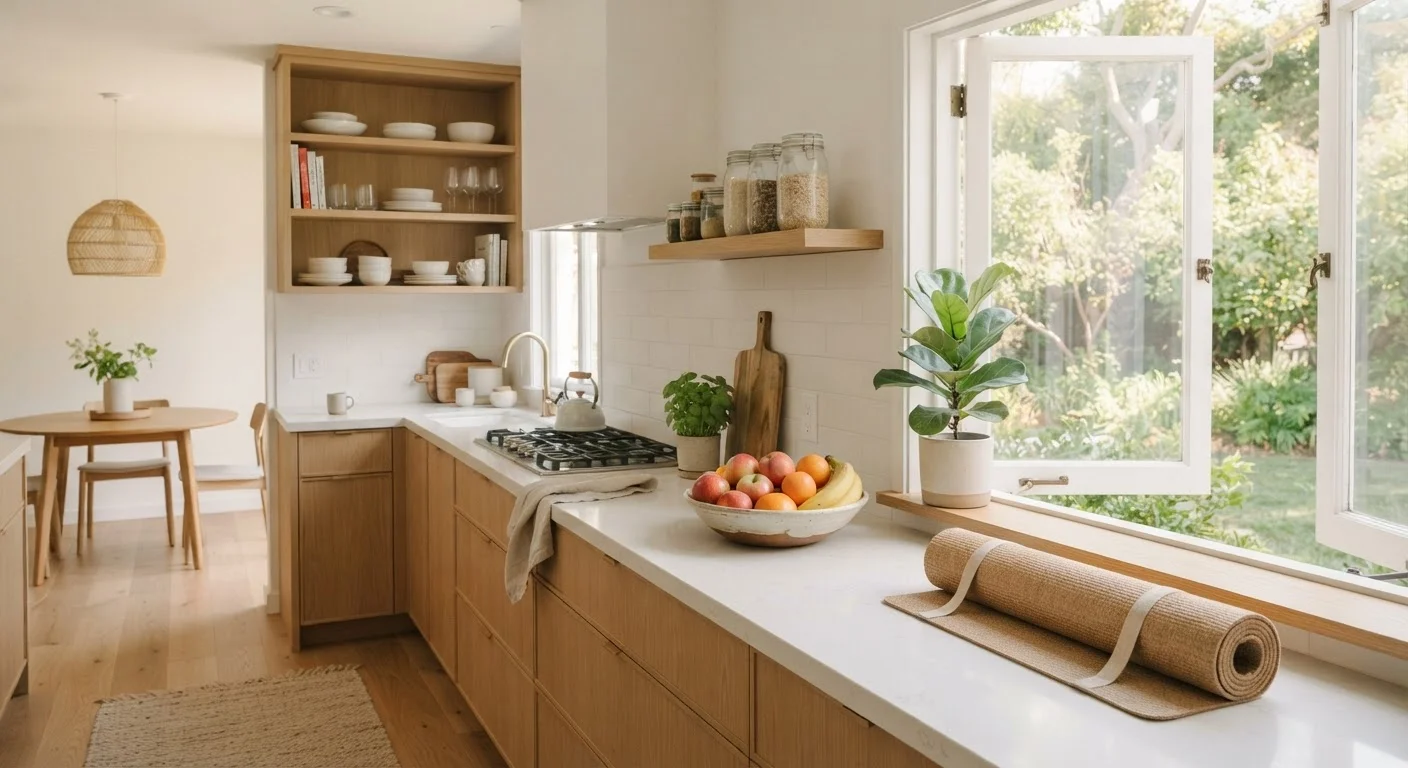
Consider a simple example: keeping a bowl of fruit on the counter while snacking chips are stored in an opaque container at the back of a high shelf. No rule-setting, no calorie counting - just a change in placement. Studies in food environment research have consistently found that visibility and convenience predict consumption more reliably than stated preferences. The principles of everyday nutrition become far easier to apply when your environment is doing some of the work for you.
70%
Of eating decisions influenced by visibility
Food environment research by Brian Wansink at Cornell University found that people eat what they see - making counter placement a stronger predictor of food choice than hunger or stated preference.
2x
Increased healthy food selection with eye-level placement
Studies on cafeteria and home food arrangement suggest that placing nutritious options at eye level roughly doubles the likelihood of choosing them compared to foods stored out of sight.
20-30%
Rise in perceived stress linked to cluttered homes
Research published in Personality and Social Psychology Bulletin found that women who described their homes as cluttered showed higher cortisol profiles throughout the day compared to those in tidy environments.
The same logic applies beyond food. Laying out workout clothes the night before, placing a book on your pillow rather than a phone charger, or positioning your desk near natural light are all small physical shifts with measurable behavioral consequences.
Room by Room: Where Environment Shapes You Most
Kitchen: This is where the evidence is strongest. What sits on your counter, how your fridge is organized, even the size of your plates - all of these have been studied for their effects on eating behavior. Front-loading healthy foods at eye level is one of the most evidence-supported environmental adjustments available to everyday households.
Bedroom: Light and temperature are the two biggest levers here. Bright overhead light in the evening suppresses melatonin production, making it harder to wind down naturally. A cooler room temperature is associated with improved sleep onset. These aren't personality traits - they're physical conditions you can actually adjust. A consistent sleep environment also anchors the kind of foundational daily routines that support overall wellbeing.
Living room and shared spaces: Clutter in shared areas isn't just an aesthetic issue. Research has linked chronically disorganized spaces to elevated stress hormones and reduced ability to focus. Understanding why clutter accumulates in the first place can help you address it more sustainably than a single big organizing session ever will.
Designing Your Space to Work With You, Not Against You
You don't need to renovate or buy anything to start applying these principles. The most effective changes are often free rearrangements: moving your phone charger out of the bedroom, keeping a water bottle where you'll see it, or designating a specific corner for exercise.
These small upgrades compound over time. Targeted home improvements - better lighting controls, thoughtful storage placement - can meaningfully change how your space feels and functions day to day. And for households where multiple people's habits intersect, navigating shared spaces becomes its own form of intentional design.
Think of your environment as a teammate rather than a neutral backdrop. When you align your surroundings with the person you're trying to be, individual moments of discipline become far less necessary - and far less exhausting. Pair that with a focus on keystone habits, and you have a framework for change that actually holds up over time.