
Shared Living, Shared Spaces: Organizing a Home When Multiple People Have Different Habits

Key Takeaways
- Shared households work better when systems are built around behavior patterns, not idealized habits.
- Defining zones for individual ownership within communal spaces reduces daily friction significantly.
- A brief household conversation about standards is more effective than unilateral reorganizing.
- Low-effort reset routines - not perfection - are the realistic goal in multi-person homes.
- Physical design of a space shapes daily habits more than willpower alone.
What you will need
Why Shared Homes Need Different Organization Logic
Most organization advice is written for a single person - or at least for a household where everyone shares the same standards. Shared living rarely works that way. One person's 'tidy enough' is another's 'barely started.' One person categorizes by type; another by frequency of use. Neither approach is wrong, but when they collide in the same kitchen cabinet, daily friction follows.
Research into household dynamics consistently shows that disagreements about cleanliness and organization are among the most common sources of tension in shared homes - whether between roommates, partners, or family members. The solution isn't to find the objectively correct organization system. It's to design a home environment that functions well for the actual people living in it.
As explored in how your home environment shapes daily habits, the physical setup of a space influences behavior far more than motivation or intention alone. That means thoughtful design - not stricter personal resolve - is the most reliable path to a calmer shared home.
What you will need
If your household is navigating the additional layer of rental constraints, how your housing situation shapes your organization options covers practical approaches for organizing without permanent modifications.
A Step-by-Step Approach to Shared-Space Organization
The steps below are designed to be completed collaboratively, ideally with all household members involved at least in the early stages. The time estimate reflects the initial setup; ongoing maintenance is minimal once systems are in place.
Labeling supplies (label maker or tape and marker)
Clearly mark designated zones and shelves so every household member can follow the system without guessing.
Small bins or baskets
Create contained zones within drawers, shelves, and cabinets to separate each person's belongings.
Hooks or over-door organizers
Add personal drop zones near entryways without requiring permanent wall modifications.
Whiteboard or shared digital note
Track household tasks, restock reminders, or agreements in a visible, neutral format.
Map the friction points honestly
Before moving a single item, spend five minutes walking through your home and noting where clutter accumulates or disagreements arise most often. Common hotspots include entryways, kitchen counters, bathroom vanities, and the area around the couch. Write these down - you're creating a working list, not a complaint log.
Have a brief, solution-focused household conversation
Organizing a shared home unilaterally - without buy-in - tends to backfire. Call a short, low-stakes meeting (15 minutes is enough) to share observations and agree on two or three shared standards: what counts as 'clean enough,' who owns which storage areas, and how quickly common spaces should be reset after use. Keep the conversation concrete and forward-looking.
Assign personal zones within shared spaces
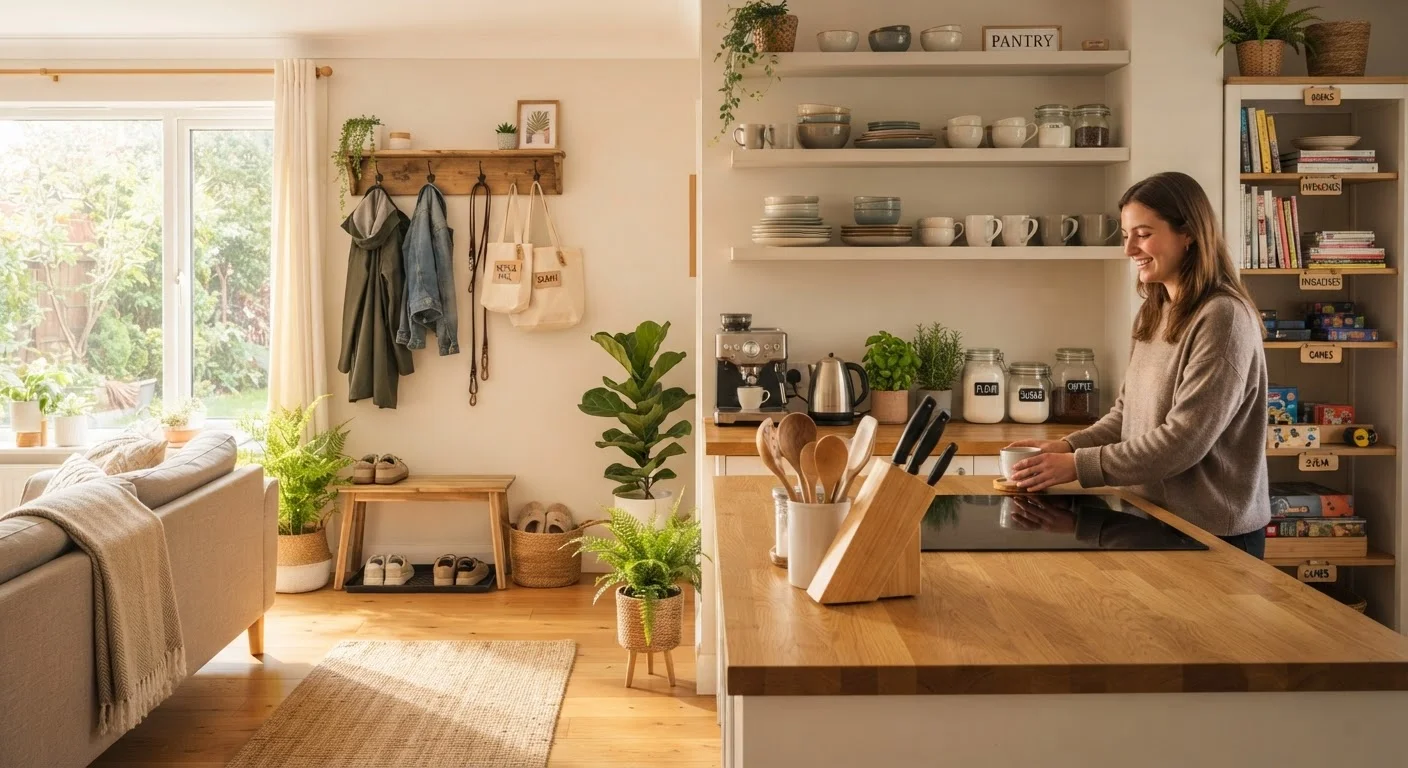
In kitchens, bathrooms, and living areas, designate a shelf, cabinet section, or drawer for each person's belongings. Even a single labeled shelf in the pantry or a basket on the bathroom counter can dramatically reduce the 'where does this go?' ambiguity that leads to clutter. The goal is clear ownership - not segregation.
Design shared surfaces for easy resets
High-traffic surfaces - kitchen islands, coffee tables, entryway consoles - should have a default 'empty or minimal' state that's genuinely easy to return to. Remove excess decor or items that make clearing the surface feel like a project. The simpler the baseline, the more realistic it is for multiple people with different energy levels to maintain it.
Build a lightweight shared maintenance routine
Daily tidying works better than periodic deep cleans in shared households. Agree on a short evening reset - wiping counters, returning items to their zones, clearing the sink - that takes under 10 minutes collectively. Rotate any tasks that one person would otherwise absorb disproportionately. Consistency matters far more than thoroughness here.
Revisit and adjust every few months
Households change - schedules shift, new items arrive, routines evolve. Plan a brief check-in every two to three months to assess what's working and what isn't. Small adjustments made regularly prevent the gradual drift that leads to full-scale reorganization projects down the line.
Start With One Space, Not the Whole Home
Attempting to reorganize an entire shared home in one session often leads to abandoned projects and increased tension. Pick the single space that causes the most daily friction - usually the kitchen or entryway - and implement your new system there first. Once that zone is running smoothly, use it as a template and proof of concept for the rest of the home.
For a broader look at how to think about storage options in any home, vertical versus horizontal storage strategies offers a useful framework for deciding where different categories of items belong.
When Systems Keep Failing: Common Reasons and Realistic Fixes
Even well-designed systems break down in shared homes. Some common reasons - and practical responses:
- The system only works for one person's habits. If the designated 'clean zone' requires steps that feel unnatural to others, it won't stick. Revisit the design with input from everyone.
- There are too many rules. Overly detailed systems create cognitive load. Pare back to the two or three agreements that matter most and let the rest flex. Common organization myths explores why more rules often produce messier outcomes.
- No one owns the process. Without a designated person to notice drift and call for adjustments, systems quietly erode. Rotate this role or share it explicitly.
- The baseline was unrealistic. A shared home with four people and one bathroom will never look like a staged interior. Set expectations based on your actual household, not an idealized version of it.
For households short on time as well as space, building habits that hold up under real schedule pressure offers complementary strategies for keeping routines sustainable when bandwidth is limited.
Don't Reorganize Without Buy-In
Rearranging shared spaces unilaterally - even with good intentions - can feel controlling or dismissive to other household members. Changes to communal areas should involve input from everyone who uses them. If a conversation feels difficult, focus on the practical problem (the space isn't working) rather than personal habits or preferences.