
Living Well on a Tight Schedule: Sustainable Habits for Genuinely Busy People

Key Takeaways
- Reliable habits require less willpower than motivation-driven bursts of effort.
- Short, frequent food prep sessions outperform ambitious Sunday cooking marathons for most busy people.
- Even 10-minute movement breaks meaningfully support physical and mental health.
- Consistent sleep and wake times protect energy levels more than sleeping in on weekends.
- A simple home reset routine prevents small messes from becoming overwhelming clutter.
- Sustainable routines should flex with your life stage and energy, not stay rigid.
Why Sustainable Habits Beat Motivation Every Time
Motivation is a mood. Habits are infrastructure. When your calendar is packed and your energy is low, the routines you've automated are the ones that actually survive - motivation rarely shows up on a Tuesday evening when you're depleted.
Research in behavioral science consistently suggests that habit formation works best when behaviors are tied to existing cues rather than willpower. In practical terms, that means attaching a new behavior to something you already do reliably: drinking water while the coffee brews, doing a five-minute tidy while waiting for the microwave, or reviewing tomorrow's schedule at the same point each night.
The goal isn't a perfect lifestyle - it's a resilient one. A routine that holds up during a hard week at work is more valuable than an optimized one that collapses the moment things get busy. See how structured versus flexible approaches compare to find a system that fits your personality and life stage.
40%
Of daily actions driven by habit, not decision
A widely cited estimate from habit research suggests roughly 40% of our daily behaviors are habitual rather than consciously chosen.
66 days
Average time to form a new habit
A study published in the European Journal of Social Psychology found that, on average, it took 66 days for a new behavior to become automatic.
1 in 3
US adults reporting insufficient sleep
The CDC has reported that approximately one in three US adults do not regularly get the recommended amount of sleep.
Feeding Yourself Well Without Overthinking It
Nutrition doesn't require elaborate meal plans or hours of prep. The fundamentals are simpler: have accessible ingredients on hand, reduce the number of decisions you need to make, and lower the friction between you and a decent meal.
A few principles that hold up well in busy households:
- Stock a reliable rotation. Choose five to eight meals your household genuinely enjoys and can make quickly. Rotating these removes decision fatigue without forcing boredom.
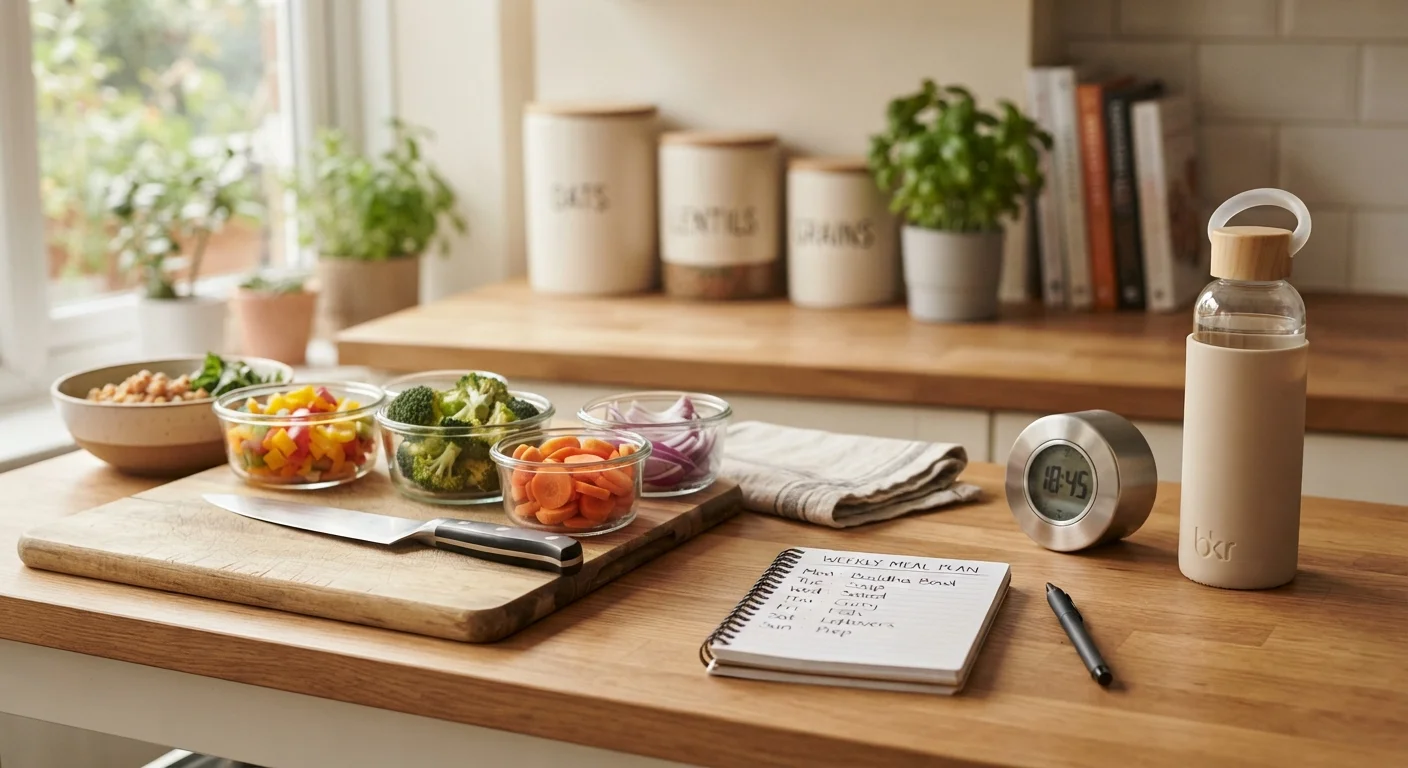
- Prep components, not whole meals. Cooking a pot of grains, washing and chopping a few vegetables, and having a protein option ready means you can assemble something nutritious in minutes rather than starting from scratch.
- Use short prep windows. Ten minutes while dinner is cooking, or while coffee brews in the morning, is often enough to reset the kitchen or prepare something for the next day.
For households sharing a kitchen with different habits and preferences, practical strategies from organizing shared living spaces can reduce daily friction significantly.
Batch your decisions, not just your cooking. Decide on your week's meals in one five-minute session rather than solving 'what's for dinner?' from scratch each day.
Decision fatigue is real - repeated small choices deplete mental energy. Front-loading food decisions reduces stress and impulsive choices later in the week.
When you set up a new habit, make it slightly too easy to fail. If a walk feels daunting, commit to just putting on your shoes - the behavior often follows naturally.
Behavioral research supports 'minimum viable habits' as a way to get started; the action of beginning tends to carry momentum forward.
Movement That Actually Fits Your Day
Exercise doesn't have to mean a gym membership or a blocked-off hour. For genuinely busy people, the more useful question is: where does movement already make sense in my day?
Short bouts of activity - a brisk walk at lunch, a stretch sequence before bed, or walking while on a phone call - accumulate real benefit over time. Public health guidance generally supports the value of breaking up sedentary time throughout the day, not just during a dedicated workout window.
If your job involves long stretches of sitting, the effects on posture, circulation, and energy can be meaningful. The movement strategies for desk workers guide covers practical ways to offset a sedentary workday. For a broader look at accessible routines, the Fitness & Movement hub is a useful starting point.
Stack Movement onto Existing Routines
The most durable exercise habits tend to attach to something you already do - a morning podcast becomes a walking podcast, a lunch break becomes a short walk around the block. You're not adding a new commitment to your day; you're changing the shape of one that already exists. Even 10 minutes of brisk walking has been associated with improved mood and energy in the short term.
Sleep and Rest: The Non-Negotiable Foundation
Everything else in a wellness routine depends on adequate sleep. Cognitive function, mood, appetite regulation, and immune response are all meaningfully affected by chronic sleep deprivation - and most of the habits covered in this guide will feel harder to maintain when sleep is poor.
A few evidence-supported practices that support consistent sleep:
- Keep wake times consistent, even on weekends. This anchors your circadian rhythm more effectively than varying your bedtime.
- Treat the hour before sleep as a wind-down buffer - lower lighting, reduce screen brightness, and avoid stimulating content or work tasks.
- Cool, dark, and quiet environments generally support better sleep onset and quality.
Rest also extends beyond sleep. Intentional downtime - time that isn't productive in any measurable way - supports mental recovery. If this feels counterintuitive, the case for rest as a mental health practice offers a grounded perspective on why deliberate rest is not a luxury. More strategies for managing stress and emotional health are available through the Mental Well-Being hub.
Chronic Sleep Deprivation Is Not a Badge of Honor
Consistently getting fewer than seven hours of sleep is associated with increased risk for a range of health concerns, including cardiovascular issues, impaired glucose metabolism, and mood disorders. No productivity routine compensates for structural sleep loss. If you regularly struggle with falling asleep, staying asleep, or feeling rested, consult a healthcare professional rather than relying solely on sleep hygiene tips.
Keeping Your Home Functional Without Constant Effort
A chaotic home environment adds low-level stress to an already full day. The goal isn't a showroom - it's a space that doesn't create extra friction when you're already stretched thin.
A few principles that work without demanding hours of upkeep:
- Daily resets, not deep cleans. A 10-minute evening tidy - dishes cleared, surfaces reset, items returned to their home - prevents accumulation without requiring big weekend cleaning sessions.
- Everything needs a place. Items that don't have a designated spot tend to drift and pile. Assigning a home to frequently used items (keys, bags, chargers) eliminates repeated small decisions and searches.
- Think in systems, not tasks. A laundry system that runs on a fixed day, a grocery restock routine tied to a specific trigger - these remove the mental overhead of remembering what needs doing.
For smaller homes or apartments where space itself is part of the challenge, organization principles for small spaces covers targeted strategies for making limited square footage work harder.
Putting It All Together: Building Your Minimal-Effort Routine
The most effective routines aren't built all at once. They're assembled gradually, tested against real conditions, and adjusted over time. Start with whichever area creates the most friction in your current week - food, sleep, movement, or home - and build one anchor habit there before layering in others.
Use a periodic check-in to assess what's holding up and what's slipping. The weekly self-care audit is a practical tool for reviewing your habits across multiple dimensions without requiring a full overhaul. And remember that what works at one life stage may need adjustment at another - how routines should evolve across the decades is worth a read when your circumstances shift.
Finally, protecting your capacity to maintain any routine sometimes requires setting clear personal boundaries - particularly around commitments that drain time and energy without reciprocating value. A sustainable routine isn't just about what you do; it's also about what you decide not to take on.
Routines Should Flex, Not Break
A sustainable routine is one that can absorb a bad week, a travel disruption, or an unexpected life event without requiring a full restart. Build in a 'minimum version' of each habit - the smallest form of it you'd still be satisfied with - so that even during hard stretches, you maintain the thread. Recovering a routine is much easier when you never fully abandoned it.
This article is for general informational purposes only and does not constitute medical, nutritional, or professional health advice. Consult a qualified healthcare provider for guidance specific to your individual circumstances.