
Structured Schedules vs. Flexible Routines: Which Approach Works Better for Daily Life?

Key Takeaways
- Structured schedules reduce decision fatigue and suit people with predictable external demands.
- Flexible routines adapt better to variable energy, family obligations, or irregular work hours.
- Most people benefit from a hybrid approach - anchoring a few fixed habits within a flexible framework.
- Neither approach works long-term if it doesn't match your personality and current life stage.
- Small, consistent anchors matter more than perfectly planned hours.
Our Verdict
Structured schedules and flexible routines aren't rivals - they sit at opposite ends of a spectrum, and most people land somewhere in the middle. The right approach depends on your life stage, personality type, and how much external variation you deal with day to day. Rather than committing rigidly to one camp, experimenting with a hybrid model often yields the most durable results.
| Best for | Recommended |
|---|---|
| Those with predictable work hours and clear goals | Structured Schedules |
| Parents, caregivers, or people with irregular schedules | Flexible Routines |
| Anyone prone to all-or-nothing thinking | Flexible Routines |
| People building new habits from scratch | Hybrid Approach |
What We Mean by Each Approach
Before comparing the two, it helps to be clear about what each one actually looks like in practice - because both terms get used loosely.
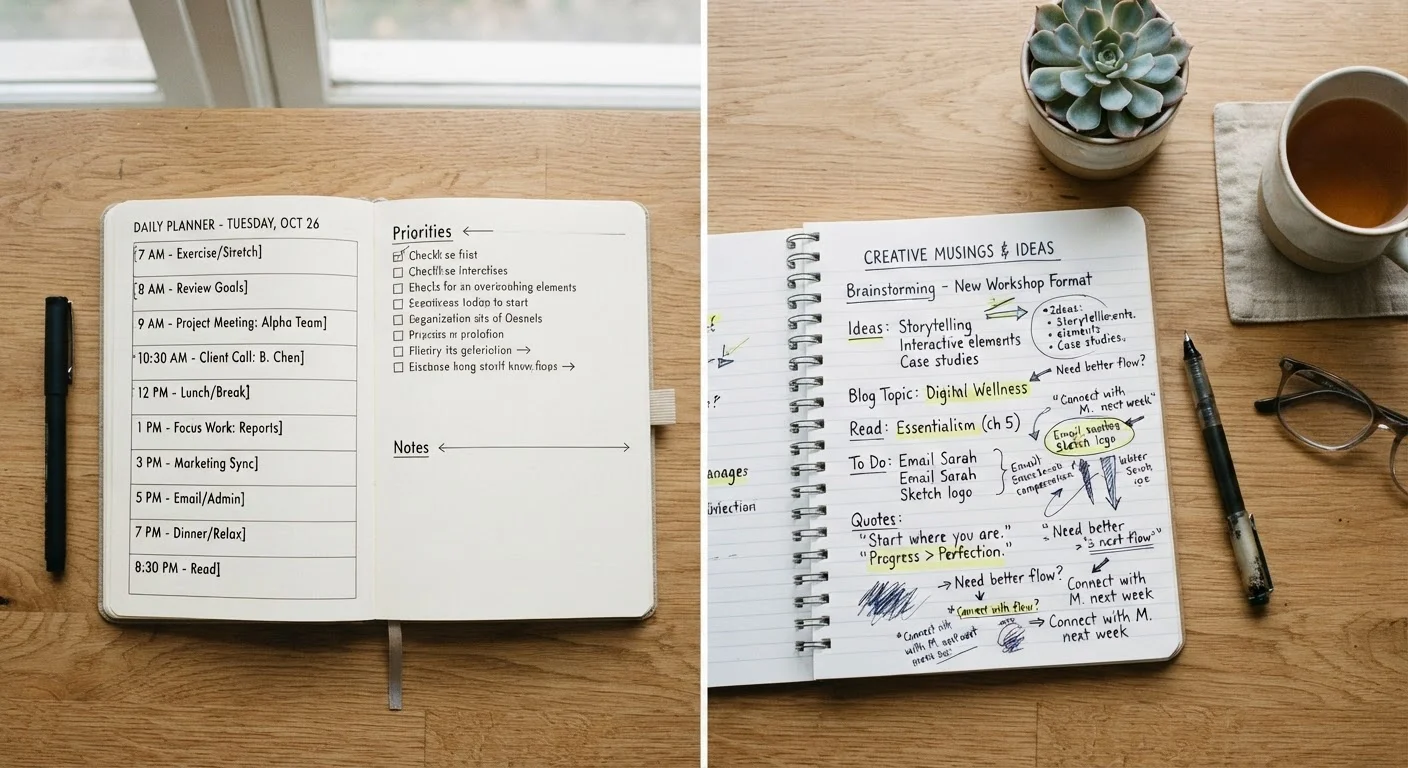
Structured schedules assign specific activities to specific time slots. Think: wake at 6:30 a.m., exercise from 7:00-7:45, eat breakfast by 8:00, and so on through the day. The logic is that by pre-deciding when things happen, you spend less mental energy making choices in the moment. Time-blocking - the practice of dividing your day into labeled chunks - is the most common form of this approach.
Flexible routines, by contrast, establish what gets done without dictating when. You might aim to move your body, prepare a home-cooked meal, and spend 20 minutes on a creative project each day - but you let the timing shift based on how the day actually unfolds. The emphasis is on consistency of habit, not consistency of clock.
Understanding what makes a routine genuinely sustainable can help clarify which style is worth investing in before you commit.
The Case for Structured Schedules
For certain personalities and life situations, a tighter structure delivers real advantages.
- Reduces decision fatigue. When your day is pre-mapped, you spend less mental bandwidth deciding what to do next - a meaningful benefit if your work already demands high cognitive output.
- Supports complex goals. People training for a fitness event, working toward a certification, or managing a household with multiple members often find that explicit time blocks are the only way to make important activities non-negotiable.
- Creates accountability. Seeing a gap on your schedule is more concrete than a vague intention. Many people find the visual structure motivating.
That said, rigid time-blocking has a well-documented downside: it can collapse spectacularly under real-world pressure. A delayed meeting, a sick child, or an energy slump can throw off the entire day - and for some people, missing one block triggers an all-or-nothing spiral. As our guide to building sustainable habits on a tight schedule points out, the structure needs buffer time baked in to survive contact with actual life.
Build Buffer Time Into Your Structure
If you time-block your day, schedule at least one 15-20 minute buffer slot per half-day. This absorbs small disruptions before they cascade. Treating transitions as part of the schedule - rather than empty space - makes structured plans far more resilient in practice.
The Case for Flexible Routines
Flexible routines have gotten more attention in recent years, partly because rigid schedules have a poor track record for people with unpredictable lives - and that describes a lot of us.
- Adapts to variable energy. If you're a parent of young children, work in shifts, or manage a chronic health condition, your available energy at any given hour is genuinely unpredictable. A flexible framework lets you honor the habit even when the timing moves.
- Lower psychological cost of disruption. Missing your 7 a.m. workout doesn't have to mean the whole day is ruined - you can simply move it to noon.
- Encourages intuition. Loose routines can build a stronger relationship with your own energy patterns over time, helping you learn when you actually focus best or feel hungriest.
The risk is that without any anchoring structure, flexible routines can quietly dissolve into no routine at all. If everything is negotiable, some habits - especially enjoyable or restorative ones - tend to get pushed to the end of the day and skipped. This is especially relevant for building a flexible meal rhythm that actually holds up through the week.
Flexibility Without Anchors Can Backfire
A routine that has no fixed reference points tends to drift. If you notice that your 'flexible' habits are getting skipped more often than not, it may be time to anchor at least one of them to a consistent time or trigger - like doing a short walk right after lunch rather than 'sometime in the afternoon.'
How to Find Your Hybrid Sweet Spot
Most research and practical experience points toward a middle path: a small number of fixed anchors embedded in an otherwise flexible day. Think of it as giving your routine a skeleton, not a straitjacket.
| Structured Schedules | Flexible Routines | |
|---|---|---|
| Best for | Predictable work days, goal-driven people | Variable schedules, caregivers, shift workers |
| Core strength | Reduces decision fatigue | Adapts to real-life disruption |
| Main risk | Collapses under unexpected changes | Habits quietly drift away |
| Cognitive load | Lower day-to-day, higher to set up | Higher day-to-day, lower to start |
| Personality fit | Planners, high-achievers, routine lovers | Intuitive thinkers, creatives, parents |
| Recovery from a bad day | Harder - gaps feel significant | Easier - timing can just shift |
A good starting point: identify two or three habits that genuinely matter to your wellbeing - consistent sleep timing, regular meals, some form of movement - and treat those as non-negotiable in terms of whether they happen, while remaining flexible about when. Everything else can flow around them.
Your choice of morning vs. evening routine often signals which end of the day is most naturally structured for you - and that's a useful clue about your overall style. Similarly, over-scheduling can be as harmful as under-scheduling; the same lesson that applies to travel planning holds for daily life too.
The goal isn't the perfect schedule. It's a livable, repeatable framework that nudges you toward the life you want without requiring heroic willpower every single day.