

| Core concepts in a functional home system | Zones, Labels, Limits |
| Zones defined by | Deliberate assignment of a single use to a space or container |
| Most common labeling mistake | Labeling some containers but not all within the same zone |
| Simplest limit-setting rule | One-in, one-out: new item enters only when one exits |
| Applies to space types | Entire rooms, room sections, shelves, drawers, or single containers |
| Primary purpose of limits | Preventing gradual overflow without requiring periodic major overhauls |
Why These Three Concepts Matter
Most home organization advice eventually circles back to the same three building blocks: zones, labels, and limits. Individually, each concept is straightforward. Together, they form a system that makes it easier to put things away, find them again, and keep your home from drifting back into disorder.
This reference guide defines each concept clearly, explains how they interact, and shows how to apply them regardless of your home's size or layout. Whether you're tackling home organization for the first time or refining a system already in place, these fundamentals apply.
Zone
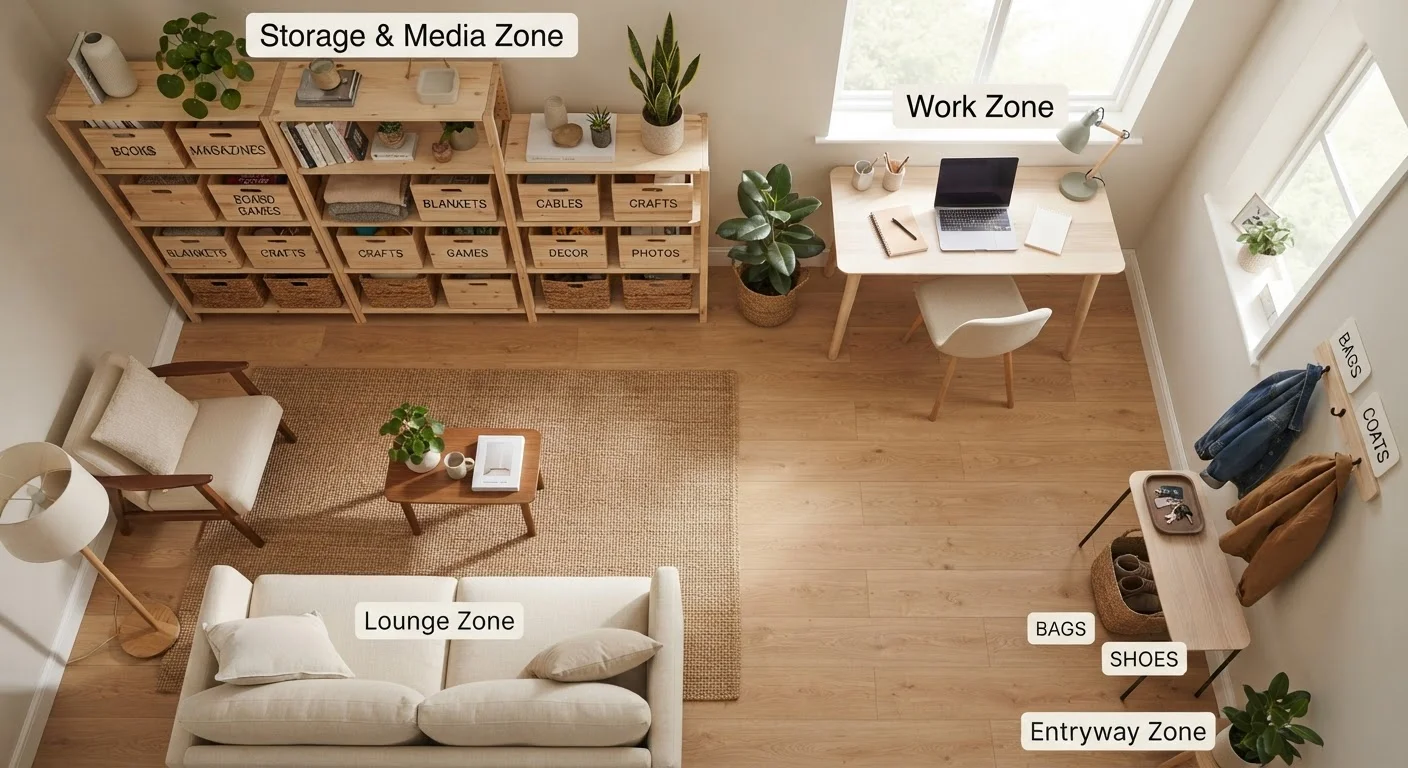
A designated area of your home assigned to a single category of use or activity. Zones can be entire rooms, portions of a room, or individual storage units. They work best when they reflect where you naturally use or reach for a particular type of item.
Label
Any marking - printed, handwritten, or visual - that identifies what belongs in a container or space. Labels make a system usable by all household members without relying on memory.
Limit (Capacity Rule)
A defined maximum for how many items of a category can occupy a given space. Limits prevent gradual overflow and make routine maintenance straightforward rather than overwhelming.
One-In, One-Out Rule
A simple limit-setting practice where a new item may only enter a category's storage space when an existing item leaves. It maintains a fixed volume over time.
Fixed-Container Storage
A limit-setting strategy in which you own only as much of a category as fits a single, designated container - whether a basket, drawer, or shelf. When the container is full, no more is added until space opens up.
Decision Fatigue
The mental exhaustion that results from making too many small decisions. In home organization, clear labels and defined zones reduce everyday decision-making, lowering cognitive load.
Zones: Assigning Purpose to Space
A zone is any area of your home that has been deliberately assigned a single category of use. Zones can be entire rooms, sections of a room, or even a single drawer. The defining quality is intentionality - the space exists for a specific function, and items belonging to that function live there.
Common home zones include a bill-paying zone near a desk, a morning routine zone in the bathroom, a homework zone at the kitchen table, or a hobby zone in a spare corner. Zones don't require physical barriers; a basket, a rug, or a shelf section can define one just as clearly as walls do.
Effective zoning matches storage to behavior. Ask where you naturally drop, use, or reach for a category of item - then zone that area accordingly. Fighting natural habits tends to fail over time. This principle is especially relevant in apartments and small homes, where zones may overlap and must be carefully negotiated.
| Core concepts in a functional home system | Zones, Labels, Limits |
| Zones defined by | Deliberate assignment of a single use to a space or container |
| Most common labeling mistake | Labeling some containers but not all within the same zone |
| Simplest limit-setting rule | One-in, one-out: new item enters only when one exits |
| Applies to space types | Entire rooms, room sections, shelves, drawers, or single containers |
| Primary purpose of limits | Preventing gradual overflow without requiring periodic major overhauls |
Labels: Making the System Legible
Labels serve one purpose: making your system readable to anyone who uses the space, including future-you after a stressful week. A well-labeled system removes decision fatigue - you don't have to remember where something goes because the container tells you.
Effective labels are specific enough to be useful without being so narrow that they exclude related items. "Batteries" is better than "Miscellaneous Electronics." "Kids' Art Supplies" is clearer than "Craft Stuff." In shared households, label specificity helps everyone maintain the same standard - a practical consideration explored further in our guide to organizing homes with multiple people.
Labels don't have to be printed or permanent. Chalkboard tape, handwritten tags, and sticky notes work until you're ready to commit. The format matters far less than consistency - every container in a zone should be labeled, not just some.
Labels Work Best as a System, Not Selectively
Labeling only the containers you're unsure about is a common shortcut that usually backfires. When some containers in a zone are labeled and others aren't, the unlabeled ones become catch-alls for anything that doesn't have a clear home. Commit to labeling every storage unit within a zone to maintain consistency and reduce guesswork for everyone using the space.
Limits: Keeping the System Sustainable
A limit - sometimes called a capacity rule - is a defined maximum for how much of a category can live in a given space. The container itself often sets the limit: when the bin is full, something must leave before something new comes in.
Limits are the least intuitive of the three concepts, but they're what prevent a system from silently expanding until it collapses. Without limits, zones blur, labeled containers overflow, and clutter returns. With limits, maintenance becomes a simple, recurring check rather than an annual overhaul.
Common limit-setting strategies include the one-in, one-out rule (a new item enters only when an old one exits) and fixed-container storage (you own only as much as one shelf, box, or drawer holds). These approaches align with several popular decluttering frameworks - comparing methods like KonMari and the Four-Box System can help you find a limit-setting style that suits your household.
For storage decisions that affect how limits work vertically versus horizontally across your rooms, see our overview of vertical versus horizontal storage.
3 concepts
Core building blocks of most home organization systems
Zones, labels, and limits together form the structural foundation that most professional organizers reference across different methods and room types.
1-in, 1-out
The simplest sustainable limit rule for any category
This rule requires no measurement or tracking - only a commitment to balance: one item exits each time one enters, keeping volume stable.