

Key Takeaways
- The claw grip is the single most important safety habit a home cook can develop.
- A sharp knife is safer than a dull one - a dull blade requires more force and slips unpredictably.
- Most home cooking relies on just three cuts: the slice, the dice, and the mince.
- Proper board stability prevents accidents before the knife even moves.
- Consistent cut sizes matter for even cooking, not just appearance.
What you will need
Why Knife Skills Matter More Than Recipes
Most beginner cooks focus on finding the right recipe. But even the best recipe can't compensate for prep that takes three times longer than it should or uneven pieces that turn a stir-fry into a guessing game. Knife skills are the foundational layer under everything else - they affect how long cooking takes, how evenly food cooks, and how safe the whole process is.
The good news: home cooking doesn't require the speed or precision of a professional kitchen. You need three cuts - a slice, a dice, and a mince - and two habits: a stable board and a claw grip. That's genuinely it. Everything else is refinement that comes naturally with practice.
If you're pairing these skills with a broader approach to kitchen prep, the concept of mise en place (prepping everything before you cook) will make these techniques feel even more useful. And if you're still building your overall cooking routine, this fits neatly into a first-week cooking plan for beginners.
What you will need
What You'll Need Before You Start
You don't need a knife block full of specialty blades. One good chef's knife, kept reasonably sharp, handles the vast majority of what home cooks do. A honing steel (which realigns the edge without sharpening) used regularly between sharpening sessions will keep that knife performing well longer.
Chef's Knife (8-inch)
The all-purpose workhorse for slicing, dicing, and mincing most vegetables, proteins, and herbs.
Cutting Board
Provides a stable, hygienic surface that protects both the knife edge and your countertops.
Honing Steel
Realigns the knife edge between uses to maintain sharpness without removing metal.
Damp Kitchen Towel
Placed under the cutting board to prevent it from sliding while you work.
Once your workspace is set up, run through the steps below slowly. Speed is irrelevant at this stage - control and consistency are what you're building. These same fundamentals apply whether you're running through a prep checklist or diving straight into a new recipe.
Step-by-Step: The Cuts You'll Actually Use
Stabilize Your Board
Before anything else, lay a damp kitchen towel or a non-slip mat flat on the counter and set your cutting board on top. Give it a firm press. It shouldn't budge. A sliding board is one of the most common causes of kitchen cuts - solving it takes five seconds.
Master the Claw Grip
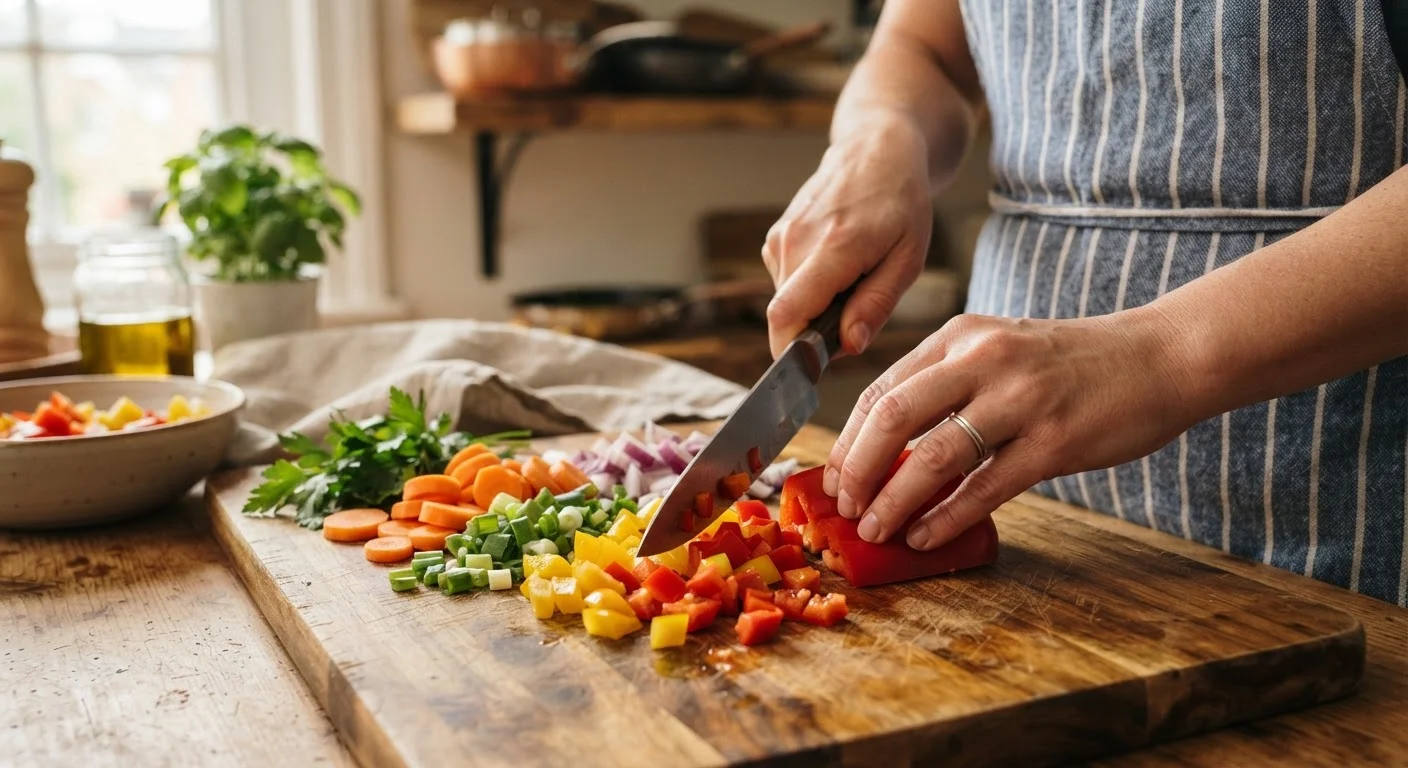
Curl your non-knife hand into a claw shape: fingertips tucked under, knuckles facing forward. Rest your knuckles lightly against the flat side of the blade as you cut. The blade rides against your knuckles rather than your fingertips, making it physically impossible to slice them. Practice this slowly with a carrot before picking up speed.
Practice the Basic Slice
A slice is a smooth, forward-and-down motion - not a chop. Keep the tip of the knife in contact with the board and rock the heel down through the ingredient. This rocking motion gives you control and speed. Use it for onions, tomatoes, mushrooms, and most proteins.
Learn the Dice
A dice is a slice done in three directions. Take an onion as your practice subject: halve it through the root, peel it, then make horizontal cuts parallel to the board (stop before the root), followed by vertical cuts from tip to root, and finally crosscuts across the onion. The root holds the layers together throughout - don't cut it off until the end.
Nail the Mince
Mincing produces tiny, fine pieces - essential for garlic, ginger, shallots, and fresh herbs. After a rough chop, lay your non-knife hand flat on the spine of the blade and use a rocking motion to work back and forth over the pile, gathering it back to center periodically with the blade. Thirty seconds of focused rocking turns a rough chop into a true mince.
Create a Flat Side on Round Vegetables
Round produce - potatoes, beets, citrus - rolls dangerously on the board. Always start by cutting a thin slice off one side to create a flat, stable surface, then set that flat side down before continuing. This one habit eliminates a huge category of slipping accidents.
Practice With Forgiving Ingredients
Onions, carrots, and celery are ideal for building knife skills - they're inexpensive, firm enough to cut cleanly, and used in almost every cuisine. Run through a full dice on an onion a few times a week and the motion will feel automatic within a couple of weeks.
Once these three cuts feel comfortable, you'll notice recipes making more sense at a glance. Understanding what "finely minced" versus "roughly chopped" means changes how you read a recipe - and how confidently you execute it.
Putting It All Together
Knife skills compound. Once slicing feels natural, dicing gets easier. Once you can mince garlic without thinking about it, the whole rhythm of prep speeds up. That efficiency pays off every single time you cook - especially on weeknights when a well-stocked pantry (see pantry staples that give you flexibility) and fast prep make the difference between cooking and ordering out.
The goal isn't perfection. It's building enough fluency that your hands can handle the prep while your mind stays on the bigger picture - like how a squeeze of lemon or a drizzle of oil can transform what's already in the pan.
A Dull Knife Is a More Dangerous Knife
It seems counterintuitive, but a dull blade requires significantly more force to cut, which means it's more likely to slip unpredictably. If your knife is squashing a tomato instead of slicing it cleanly, it's time to sharpen. Most kitchen stores and many grocery stores offer knife sharpening services if you're not ready to do it yourself.