

Key Takeaways
- Annuals complete their entire life cycle in one growing season and must be replanted each year.
- Perennials return year after year from the same root system, often spreading and filling in over time.
- Annuals typically offer more continuous bloom color; perennials may bloom for a shorter window each season.
- Perennials generally cost more upfront but reduce long-term replanting expense and labor.
- Most successful gardens combine both plant types to balance structure, color, and seasonal interest.
- Your USDA hardiness zone influences which perennials will reliably survive winter in your area.
Option A
Annual Plants
The high-impact, one-season performers.
Best for: Gardeners who want bold, season-long color, flexibility to change their layout each year, or reliable blooms while perennials are getting established.
Option B
Perennial Plants
The long-term backbone of a maturing garden.
Best for: Homeowners looking to reduce replanting effort over time and build a garden with reliable structure that returns and expands each year.
If you want maximum color impact this season with room to change things up next year
Annual Plants
Annuals bloom prolifically from planting to frost and give you the freedom to try a completely different palette or layout the following season.
If you want to invest once and reduce how much you replant each spring
Perennial Plants
Perennials return reliably each year, gradually filling in beds and lowering the cost and effort of annual replanting over time.
If you're establishing a brand-new garden bed
Annual Plants
Annuals fill space beautifully while slower-growing perennials get established, preventing bare patches during the critical first season or two.
If you want to support local pollinators and ecosystems long-term
Perennial Plants
Many native perennials develop deep root systems and provide consistent habitat and food sources for pollinators across multiple seasons.
If you want a garden that performs well across all seasons with minimal gaps
Annual Plants
Strategically selected annuals can fill blooming gaps left by perennials that have finished their seasonal window.
What Sets Annuals and Perennials Apart
The distinction between annuals and perennials comes down to life span. Annual plants germinate, grow, flower, set seed, and die all within a single growing season. They put enormous energy into blooming, which is why they're known for long-lasting, vivid color. Common examples include marigolds, zinnias, petunias, and impatiens. To enjoy them again, you replant the following spring.
Perennial plants, by contrast, die back to their root system at the end of the season but regrow from those same roots the following year. Examples include coneflowers (echinacea), black-eyed Susans, hostas, and daylilies. They typically bloom for a shorter window each season compared to annuals, but they multiply, spread, and deepen their root systems over time.
A third category worth knowing: biennials complete their life cycle over two years, growing foliage the first year and flowering the second. Foxglove and hollyhock are familiar examples. They're less common in typical home gardens but worth noting if you encounter them.
If you're just getting started laying out a new garden, the first-year garden planning guide walks through how to approach plant selection alongside soil preparation and spacing decisions.
| Criterion | Annual Plants | Perennial Plants |
|---|---|---|
| Life span | One growing season | Returns year after year |
| Bloom duration | Often all season long | Typically a few weeks per season |
| Upfront cost | Lower per plant | Higher per plant |
| Long-term cost | Higher (replant yearly) | Lower (self-renewing) |
| Establishment time | Performs immediately | May take 2-3 seasons to peak |
| Flexibility | Easy to change each year | More commitment to layout |
| Maintenance | Regular deadheading needed | Periodic dividing; less day-to-day |
| Hardiness zone dependency | Low (replanted fresh each year) | High (must survive local winters) |
Cost, Effort, and Long-Term Value
Annuals are typically less expensive per plant at the nursery, but that cost repeats every single year. Over a decade, replanting the same bed with annuals adds up - both in dollars and in labor. Perennials generally cost more upfront, but once established, they multiply and fill space on their own, reducing what you need to buy and plant each season.
That said, annuals require less patience. They perform immediately, whereas many perennials follow the gardening adage: sleep, creep, leap - meaning they spend the first year establishing roots, the second year showing modest growth, and the third year truly taking off.
2-3 years
Time for perennials to fully establish
Horticultural extension programs commonly note that most perennials reach their mature size and full bloom potential by their third growing season.
~50%
Typical garden area filled by self-spreading perennials
Many clumping perennials like daylilies and hostas can double in spread every few years under favorable conditions, reducing the need to purchase additional plants.
Maintenance differs too. Annuals need consistent deadheading (removing spent blooms) to keep them producing flowers. Perennials often need dividing every few years to prevent overcrowding, but day-to-day upkeep is generally lower once they're established.
For a broader look at how your growing setup affects plant performance, the comparison of raised beds vs. in-ground gardening covers drainage, soil control, and effort trade-offs across both bed types.
Combining Both for a Garden That Works Year-Round
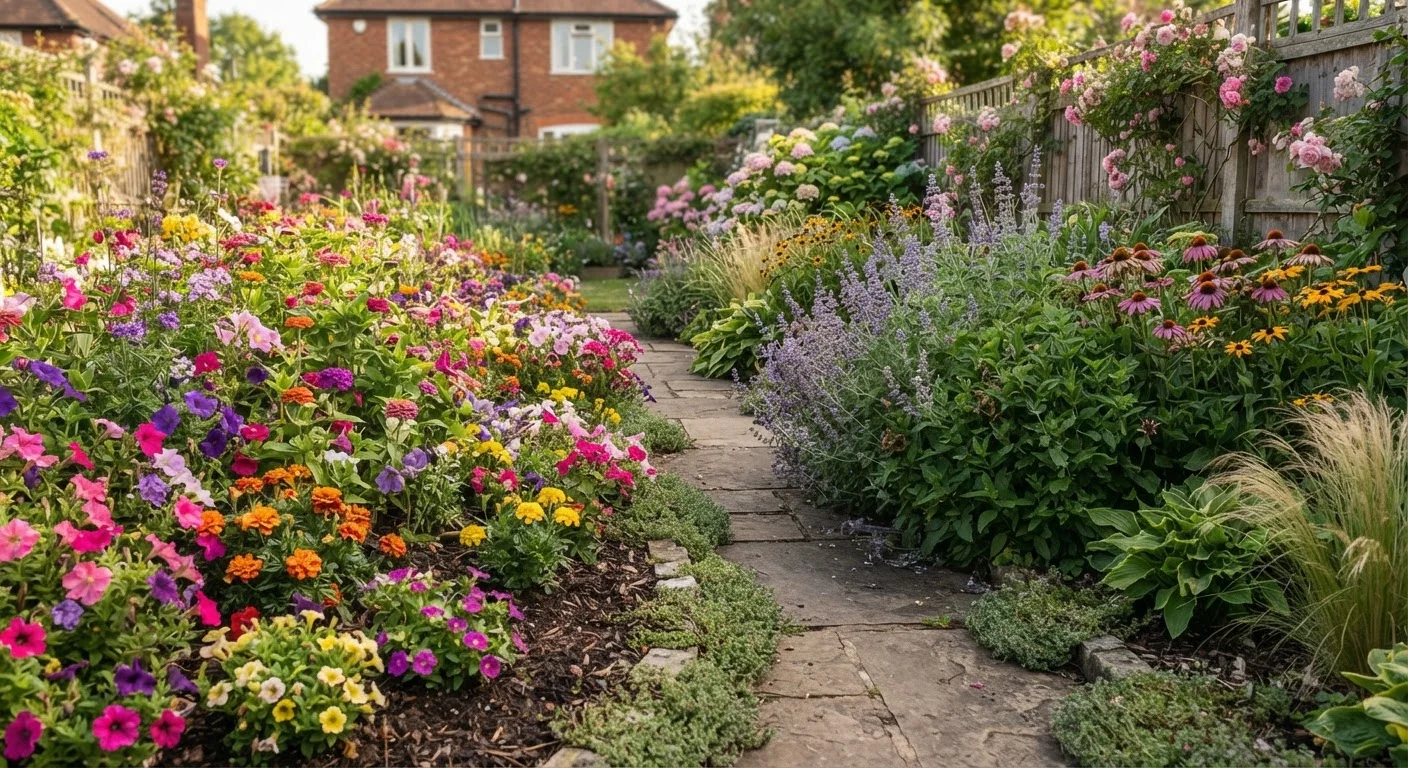
The most practical approach for most yards isn't choosing one type exclusively - it's using both strategically. Perennials form the reliable backbone of a bed: they define the structure, return each year, and gradually expand. Annuals fill the gaps, extend the color season, and let you inject personality or experiment without a long-term commitment.
A common strategy is to plant perennials at the back or center of a bed and surround them with annuals that bloom during the perennials' off-season. For example, spring-blooming perennials like peonies can be flanked by warm-season annuals that carry color through summer and fall once the peonies have finished.
Climate Determines What 'Perennial' Really Means
A plant's perennial status is always relative to where you garden. Some plants sold as perennials in warmer USDA zones (8-10) won't survive freezing winters in colder zones and must be treated as annuals or overwintered indoors. Always check the zone rating on plant tags before assuming a perennial will return in your region. When in doubt, consult your local cooperative extension service for region-specific guidance.
Your location matters significantly when choosing perennials. A plant labeled as a perennial in Georgia may behave as an annual in Minnesota if it can't survive the winter. The USDA hardiness zone guide explains how to read zone labels and select plants suited to your specific climate.
For those interested in supporting local wildlife, native perennials are particularly worth exploring - many are low-maintenance once established and provide consistent habitat value season after season. You can also enhance any bed by reading up on companion planting strategies to make the most of how different plants interact.
For timing your plantings and maintenance tasks through the year, the year-round garden planning reference offers a practical seasonal breakdown of what to sow, divide, and harvest.